
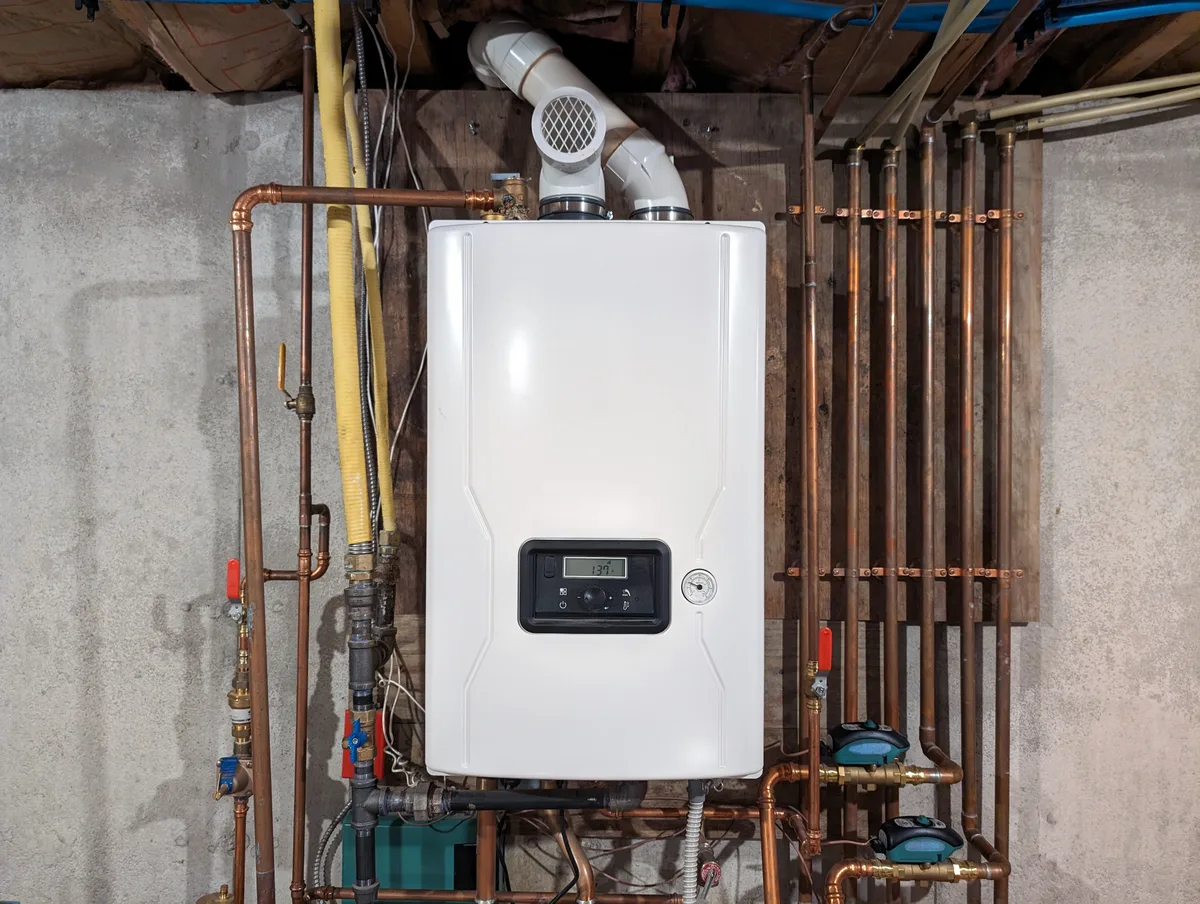
The best combi boilers for Ontario homes are chosen on two numbers: hot water flow at winter inlet temperature first, then minimum firing rate against the home's heat loss. A one-bathroom house needs about 3.3–3.5 GPM at a 43 °C rise; two showers at once need a 199,000 BTU class unit delivering 4.7–5.4 GPM. Among the four brands commonly installed here, Navien's NCB-H suits households that want the most hot water, Viessmann's Vitodens 100-W and NTI's TRX suit radiator systems where a low firing rate and a stainless heat exchanger matter, and IBC's SFC suits buyers who want the fewest moving parts. If more than two bathrooms run at the same time, do not buy a combi at all.
Start With Hot Water Flow at Winter Inlet Temperature
A combi boiler heats tap water on demand, so its hot water output depends on how cold the incoming water is. Municipal water drawn from Lake Ontario arrives close to 4 °C in late winter. Lifting that to 49 °C at the tap is a 45 °C rise, and that is the number to size against.
Manufacturers publish flow at different temperature rises, which makes brochures hard to compare. Viessmann and NTI rate at a 43 °C (77 °F) rise, close to an Ontario February. Navien and IBC rate at a 39 °C (70 °F) rise, so expect roughly 13% less than the brochure figure in deep winter: a unit listed at 5.4 GPM delivers about 4.7 GPM.
- One shower at a time, one bathroom: 3.3–3.5 GPM at winter rise is enough, since a standard showerhead uses up to 2 GPM. That is the 120,000–150,000 BTU class.
- Two showers at once, or a shower plus the dishwasher: 4.5 GPM or more at winter rise. That is the 199,000 BTU class.
- Three fixtures at once, a large soaker tub or a rain-head shower: a combi will disappoint. A boiler with an indirect tank is the right system, as set out in combi boiler vs boiler and separate water heater.
Then Check Turndown Ratio Against Your Heat Loss
A combi is sized for hot water, which makes it far too big for the heating side of most houses. Turndown ratio is what rescues it: the ratio between the maximum and minimum firing rate. A 120,000 BTU boiler with 10:1 turndown can idle at about 12,000 BTU/h.
The rule we use: the minimum firing rate should be at or below about a third of the home's design heat loss. A house rarely needs its full design heat; on a 5 °C day it needs well under half. A boiler that cannot fire low enough short-cycles through spring and fall, which wears the igniter, fan and gas valve and gives up the condensing efficiency you paid for.
That is why the heat-loss calculation comes before the brand. A 1950s brick bungalow with original windows and a 2000s townhouse can differ by a factor of two. What size boiler do I need walks through the numbers.
Navien, Viessmann, NTI and IBC Compared
These four are the combi brands we see most often in Ontario mechanical rooms. The figures come from each manufacturer's current published data, so check the spec sheet for the exact model on your quote.
- Navien NCB-H: dual stainless steel heat exchangers for heating plus a separate stainless flat-plate exchanger for hot water. Turndown is up to 11:1 on heating and 15:1 on hot water. Flow is up to 5.4 GPM at a 39 °C rise, and heating input comes in steps from 60,000 to 150,000 BTU/h, so the heating side can be matched to a small house while the hot water side stays large.
- Viessmann Vitodens 100-W (B1KE combi): stainless steel Inox-Radial heat exchanger, 10:1 turndown and 95% AFUE. Flow is 3.3 GPM on the B1KE-120 and 4.7 GPM on the larger combi at a 43 °C rise. Viessmann's Canadian head office is in Waterloo, Ontario.
- NTI TRX combi (TRX110C, TRX150C, TRX199C): stainless steel heat exchanger with large-diameter tubing, modulation up to 11:1 and up to 96% AFUE across the series. Flow is 3.5 GPM on the TRX150C and 4.8 GPM on the TRX199C at a 43 °C rise. NTI's head office and factory are in Saint John, New Brunswick.
- IBC SFC: two independent copper waterways cast into an aluminum block, a design IBC lists as having five moving parts (fan, pump, bypass valve, gas valve and damper). The SFC-199 delivers 5.0 GPM at a 39 °C rise at 95% AFUE. IBC was founded in Vancouver, runs its Canadian office from Burnaby, and has been part of Rheem since 2019.
Free quotes, written pricing.
On parts supply, Viessmann, NTI and IBC each have a Canadian office or factory, and Navien is carried in depth by wholesalers because its tankless water heaters are so common. Whichever brand you choose, ask the installer which local wholesaler stocks its igniter, fan and plate heat exchanger. A boiler that waits a week for a part in January is the wrong boiler, whatever its rating.
Heat Exchanger Material: What It Changes
Stainless steel, used by Navien, Viessmann and NTI, tolerates a wide range of system water and is the usual choice on older systems with mixed metals. IBC takes a different route: the heating water and the tap water each run through their own copper waterway inside one aluminum block. Fewer parts move, which is the appeal.
No material survives a dirty system. Sludge from old radiators blocks the narrow passages in any condensing heat exchanger, and scale from hard water coats the hot water side. The installation decides how long the exchanger lasts more than the metal does.
Installation Details That Decide Reliability
A combi is less forgiving than the cast-iron boiler it replaces. These are the details to see written on the quote.
- Primary-secondary piping on old radiator systems: a combi has a small internal pump and a tight heat exchanger. A large cast-iron radiator loop gets its own circulator, hydraulically separated from the boiler with closely spaced tees or a low-loss header, so the boiler always sees the flow it needs.
- System flush and dirt separation: decades of iron oxide sludge sit in old radiators. The system is flushed before the new boiler is connected, and a magnetic dirt separator goes on the return. See hydronic system flush.
- Scale protection in hard-water areas: Halton and Hamilton water is hard, and the hot water side of a combi scales the way a tankless heater does. Isolation valves with service ports go on at install, a descale flush runs $150–$300, and a softener or scale-inhibiting cartridge reduces how often it is needed.
- Gas line and venting: a 199,000 BTU combi draws far more gas at once than an old boiler. The line is sized for the new load and the vent run stays inside the manufacturer's length limits.
- Condensate: neutralised before it reaches the drain, with the line protected from freezing where it crosses a cold space.
What a Combi Boiler Costs in Ontario
We do not publish a single price band for combi installations, because three things move the cost: how much repiping the old system needs, the venting route, and whether the gas line must be upsized. Swapping one combi for another on modern piping is a different job from converting a 60-year-old cast-iron boiler and a separate tank. You get the number in a written quote after a site visit. A diagnostic visit on an existing boiler is $90–$150, credited to the repair if you proceed.
Verdict: Which Combi Boiler for Which House
- Two-bathroom household that wants the most hot water: a Navien NCB-H in the 199,900 BTU hot water size, with the heating input chosen from the heat-loss calculation.
- Cast-iron radiator house with one bathroom in use at a time and an owner staying long term: a Viessmann B1KE-120 or an NTI TRX150C, piped primary-secondary.
- Small, tight house or townhouse with a low heat loss: choose on minimum firing rate first. The small heating inputs in the Navien NCB-H range are built for this; confirm the minimum input on the spec sheet against a third of your heat loss.
- Owner who values simplicity over features: the IBC SFC.
- Three bathrooms in use at once, or a large soaker tub: not a combi. Buy a heat-only boiler and an indirect tank.
If your current boiler is still running, start with a diagnosis: a no-heat call is often a circulator, an expansion tank or a zone valve, not the boiler. See boiler repair, or combi boiler installation if replacement is decided, and contact us for a written quote built on a heat-loss calculation.
Frequently asked questions
What size combi boiler do I need for a two-bathroom house?
Size it on hot water first. Two showers running together need about 4.5 GPM or more at an Ontario winter temperature rise, which points to a 199,000 BTU class combi. Then check the heating side: the boiler's minimum firing rate should sit at or below about a third of the home's design heat loss, or it will short-cycle in mild weather.
Can a combi boiler run old cast-iron radiators?
Yes, if it is piped for them. The radiator loop needs its own circulator and hydraulic separation from the boiler, the system has to be flushed, and a magnetic dirt separator should protect the new heat exchanger. Large radiators suit a condensing boiler well, because they heat the house with cooler water, which keeps the boiler in its efficient condensing range.
Does hard water damage a combi boiler?
It scales the hot water side. Minerals drop out of hard water as it is heated and coat the passages that heat your tap water, which cuts flow and efficiency. In Halton and Hamilton we fit isolation valves with service ports so the exchanger can be descaled, and recommend a softener or scale-inhibiting cartridge where the water is hardest.
Why does my combi stop heating the house when someone showers?
That is hot water priority, and it is normal. A combi sends its full output to the tap whenever hot water is drawn and pauses space heating until the draw ends. In a well-insulated house you will not notice a ten-minute shower. Long back-to-back showers in a draughty house can let rooms cool, which is one reason larger households suit a boiler with an indirect tank.