
80% vs 96% AFUE furnace: is high efficiency worth it? In Ontario it is not a shopping decision at all, because a contractor cannot legally install a new 80% furnace in a house here. Canada's Energy Efficiency Regulations have required at least 90% AFUE for residential gas furnaces since 2010, and the federal minimum stepped up to 95% in 2019, with only narrow exceptions. That also means every 80% furnace still running in a Halton or Hamilton basement is at least 16 years old. The live question is whether to replace a working mid-efficiency furnace before it dies — and once it needs a real repair, or the chimney or the air conditioner is due, the answer is usually yes, because the gas savings, the safer venting and the option of pairing the new furnace with a heat pump outweigh a couple more winters on borrowed time.
What AFUE Measures and What It Leaves Out
AFUE is the share of the gas you pay for that ends up as heat in the ductwork over a season. An 80% furnace sends about one dollar in five up the flue as hot exhaust; a 96% furnace wastes about four cents on the dollar. The gain comes from a second heat exchanger that pulls the remaining heat out of the exhaust until water vapour condenses out of it, which is why high-efficiency furnaces are called condensing furnaces and why they need a drain.
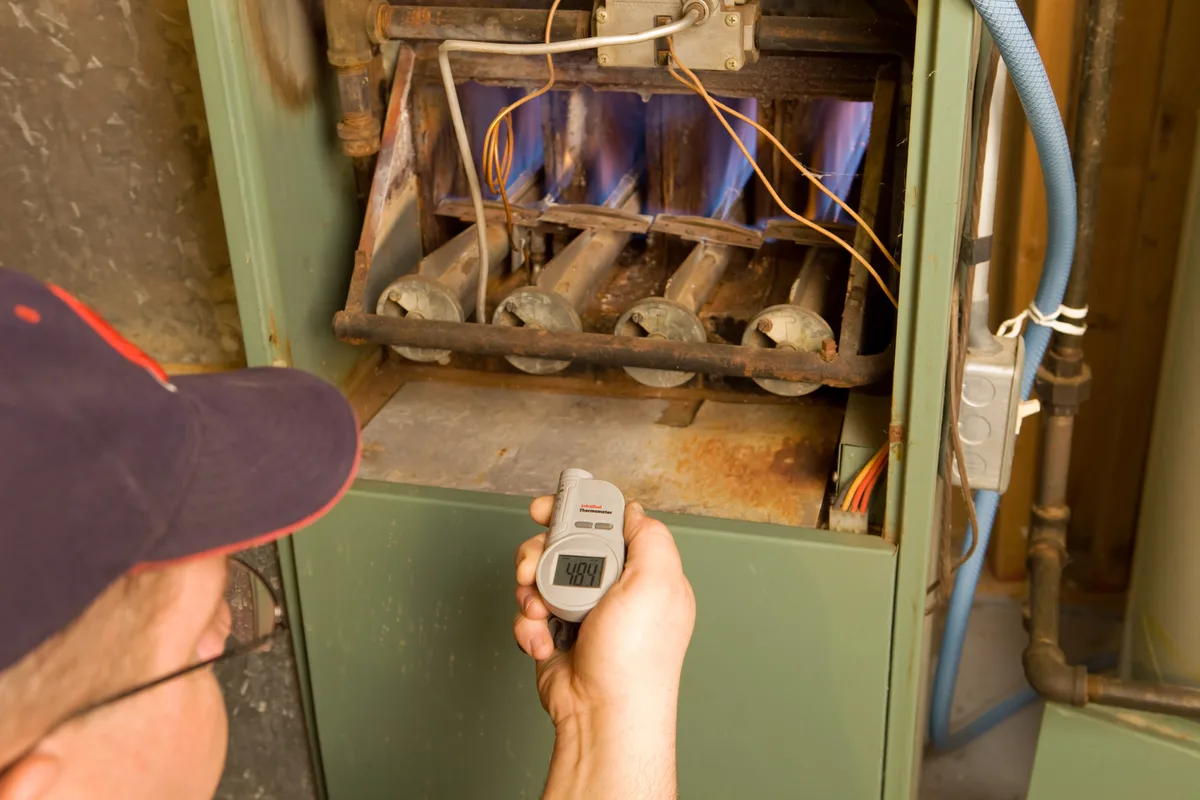
AFUE does not count the electricity the blower uses, the heat that leaks off the cabinet, or the losses from short cycling, and it assumes the furnace still performs like it did on the test bench. A 20-year-old furnace with a tired inducer, a dirty burner assembly and a heat exchanger coated in scale rarely still delivers its nameplate 80%, which is why real-world savings after a replacement tend to beat the paper calculation.
The Gas-Bill Math for a Halton or Hamilton Home
On paper, moving from 80% to 96% cuts gas use for heating by about 17%, because the new furnace needs only 80/96ths of the fuel to deliver the same heat. In practice the drop is usually a bit larger, because a furnace old enough to be mid-efficiency rarely still hits its nameplate rating — a tired inducer and a scaled heat exchanger both cost efficiency the label never mentions. For a household spending around $1,800 a year on gas heat through Enbridge, that works out to roughly $360–$450 a year, or $5,400–$6,750 over a 15-year life.
That saving alone does not repay a whole furnace, and we are not going to pretend it does. What it does is cover most of the price difference between limping along on repairs and buying the furnace you will need anyway. The repair-or-replace cost guide walks through the break-even, and it lands in the same place: once an 80% furnace needs a blower motor, inducer or control board past year 15, the money belongs in a new unit.
Venting Is the Real Difference Between 80% and 96%
The exhaust from an 80% furnace is hot enough to rise on its own, so it leaves through metal B-vent into a chimney. A 96% furnace produces cool, wet exhaust that has to be pushed out through PVC pipe, usually two pipes through the side wall — one exhaust, one combustion-air intake. That change has three consequences that shape every replacement quote.
- The chimney is orphaned. If your water heater shares the chimney with the old furnace, it will be venting alone into a flue that is now far too big for it, which causes condensation and backdrafting — and a backdrafting water heater spills combustion gases, carbon monoxide included, into the basement. A stainless liner sized to the water heater, or a switch to a power-vent water heater, is the fix — see do you need a chimney liner when replacing a furnace.
- The furnace needs a drain. Condensate has to run to a floor drain, a laundry standpipe or a condensate pump. In 1950s–60s bungalows on the Hamilton Mountain and in Aldershot the floor drain is often on the far side of the basement, so a pump ($250–$450 installed) is common.
- The side-wall terminations need clearances. Exhaust cannot terminate near a window, a door, a gas meter or a neighbour's air intake, which on narrow pre-war lots in Kerr Village or Westdale sometimes means a longer PVC run than the standard allowance. Our guide to furnace venting types covers the options.
Free quotes, written pricing.
Which Local Houses Still Have 80% Furnaces
Mid-efficiency furnaces were the standard new-build install through the 1990s, so the houses most likely to still have one are the subdivisions of that era: Orchard and Millcroft in Burlington, River Oaks and Glen Abbey in Oakville, the 1990s phases of Stoney Creek and Binbrook. Those furnaces are now 25–35 years old, well past the 15–20 years a gas furnace gives in this climate, and most are still on the original inducer and control board.
The other group is older brick housing — pre-war Kerr Village, Old Oakville, Westdale, Roseland — where a mid-efficiency furnace replaced a gravity or oil furnace in the 1990s and has been venting into a masonry chimney ever since. Those chimneys are often already deteriorating from years of cooler mid-efficiency exhaust, which is one more reason the water heater will need its own liner when the furnace moves to PVC.
When It Is Not Worth Rushing the Upgrade
If the furnace passes a heat-exchanger inspection and a combustion check, has not needed a major part, and the chimney it shares is sound, nothing says it has to go this year. Replacing a healthy furnace purely for the AFUE gain is a slow payback, and there are cheaper ways to cut a gas bill first: air-sealing, attic insulation, a smart thermostat, a proper tune-up. Be honest about the timeline, though. At 16-plus years you are scheduling the replacement, not avoiding it, and it is far better done in September than at 2 a.m. in January.
There is one exception worth thinking about. If you are planning a heat pump anyway, the furnace can stay as the backup in a hybrid system and run only on the coldest nights, at which point its AFUE barely matters. Read our page on heat pump vs furnace in Ontario before you spend on a furnace you might barely use.
Verdict: Who Should Replace Now and Who Should Wait
- Replace now if the furnace has needed a repair in the last two winters, if the chimney shows staining or crumbling mortar, or if you are already replacing the air conditioner and can bundle the work.
- Replace now if you want the hybrid route that current Ontario programs reach: a new 96% two-stage furnace paired with a cold-climate heat pump, with the furnace handling only the deep-cold nights. Eligibility attaches to the heat pump model rather than the furnace, so get it confirmed before you sign.
- Wait a planned season or two if the furnace passes inspection and has needed nothing major, if the water heater is also near the end and you would rather replace both in one job, or if this year's budget is better spent on insulation and air-sealing. Do not wait for it to fail.
- Whatever you choose, get the venting plan and the water-heater liner question answered in writing before you sign — that is where 80%-to-96% quotes in older Halton and Hamilton homes go wrong.
When we install a 96% furnace in Burlington, Oakville or Hamilton, we commission it with a combustion analysis and check what the old chimney is left doing. If you want a straight answer on whether your mid-efficiency unit has another winter in it, our furnace repair team in Burlington can inspect it, or you can request a replacement quote and we will price both the furnace and the venting honestly.
Frequently asked questions
Can I still buy an 80% AFUE furnace in Ontario?
Not for a normal house. Federal regulations set a 90% minimum for residential gas furnaces in 2010 and raised it to 95% in 2019, so every new furnace a licensed contractor can install in Ontario today is a condensing, high-efficiency unit. Articles that weigh 80% against 96% are almost always written for the American market, where 80% furnaces are still sold.
Will a 96% furnace fit where my 80% furnace sits now?
In most basements, yes. Cabinet sizes are similar, and the main change is the PVC venting and the condensate drain rather than the footprint. Utility closets on a main floor and furnaces tucked under stairs can be tighter, because the vent pipes need a route to an outside wall and the drain needs somewhere to go.
Is a 98% furnace worth it over a 96% furnace?
Rarely on gas savings alone; two points of AFUE is a small amount of fuel. People buy the 98% models for what comes with them: modulating burners, variable-speed blowers and communicating controls that make the house quieter and more even. If those features matter to you, the higher AFUE is a bonus, not the reason.
Does a high-efficiency furnace cost more to maintain?
A little. Condensing furnaces add a condensate trap and drain line that should be flushed at each annual tune-up, and the PVC intake and exhaust terminations need to be kept clear of snow and leaves. Everything else — filter, flame sensor, igniter, blower — is the same routine as a mid-efficiency furnace.