
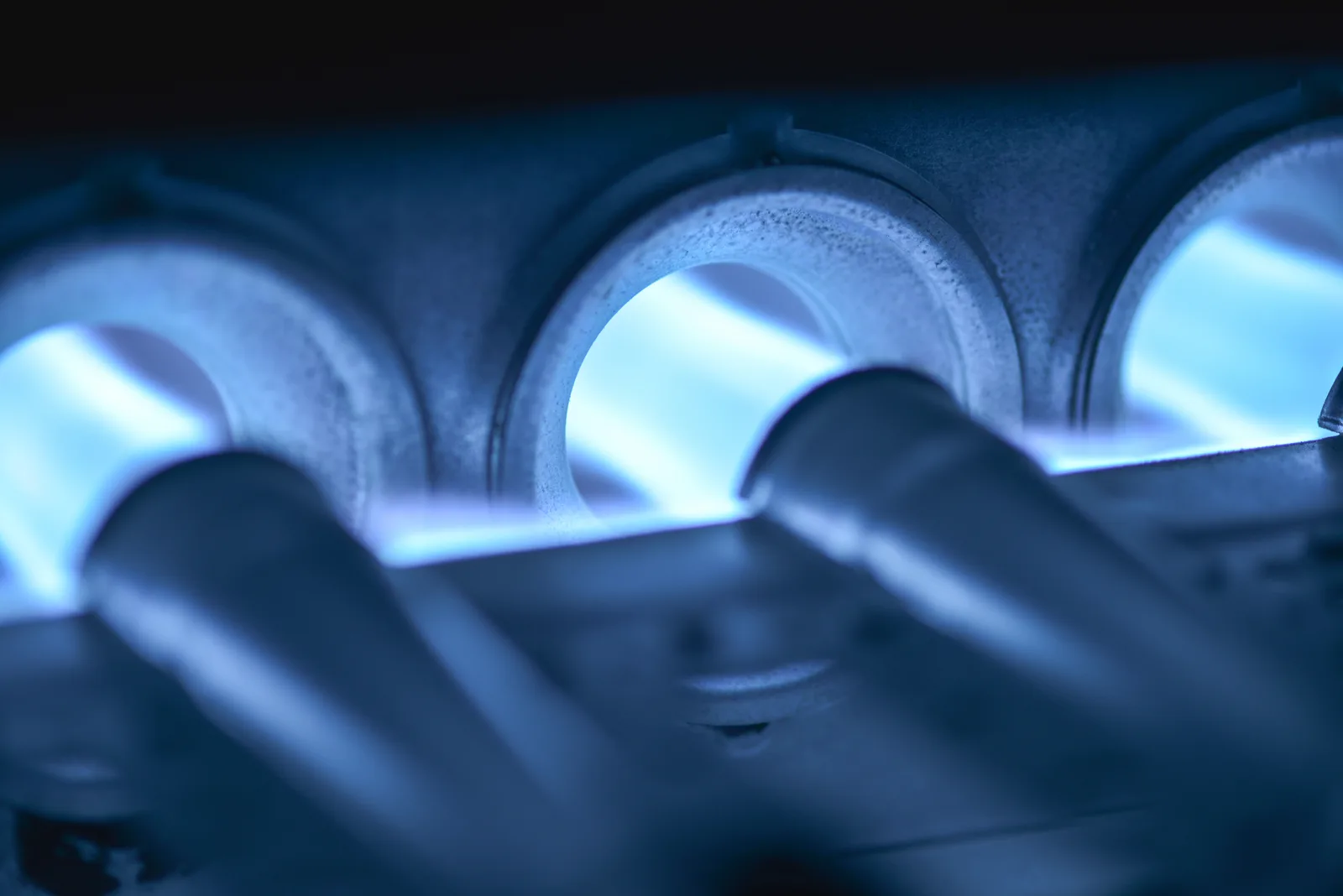
Single-stage vs two-stage vs modulating furnaces is the choice that decides how your house feels in February, not just what the invoice says. For most detached homes in Burlington, Oakville and Hamilton the answer is two-stage: modulating earns its premium in larger, multi-level or hard-to-balance houses, and single-stage still makes sense for small, tight homes and properties you will not hold long. A single-stage furnace fires at full output every time it runs. A two-stage furnace runs on a low setting of roughly 65–70% of capacity most of the time and steps up to full fire only when the house is losing heat quickly. A modulating furnace adjusts its flame in small increments between roughly 35–40% and 100% to match the heat loss minute by minute.
What Each Stage Actually Does
The difference is in the gas valve and the blower, not the heat exchanger. All three types are condensing furnaces in the 95–99% AFUE range, so the burner technology is close; what changes is how much gas the valve lets through and how the blower is told to move air.
- Single-stage: an on/off gas valve. Every cycle is full fire, so the furnace blasts hot air, satisfies the thermostat fast, shuts down, and waits for the house to cool a degree or two before repeating. Usually paired with a fixed-speed PSC blower or a basic constant-torque ECM.
- Two-stage: a gas valve with a low and a high position. The control board starts on low, and most cycles never leave it. High fire is held for cold snaps and recovery after a setback. Normally paired with a multi-speed or variable-speed ECM blower so airflow drops with the flame.
- Modulating: a gas valve that steps in tiny increments — Lennox and Carrier both advertise increments of about 1% — driven by a control that reads how far the house is from setpoint. Always paired with a variable-speed blower and, on most brands, a communicating thermostat.
Why Staging Matters More Than the AFUE Number
The efficiency gap between the three tiers is small; the comfort gap is large. A two-stage 96% furnace and a single-stage 96% furnace burn gas at almost the same efficiency, and a modulating 98% unit only adds a couple of points on top. Where staging pays is in run time: a furnace on low fire runs two or three times longer per cycle, which keeps the air moving, keeps the supply temperature steady, and stops the two-degree swing you feel with a single-stage unit.
Longer, gentler cycles also do three quiet jobs. More air passes through the filter each hour, so a good pleated filter or media cabinet catches more. A whole-home humidifier gets more furnace run time to work with, which matters in a dry Halton January. And a variable-speed blower on low draws a fraction of the electricity of a PSC motor running flat out, which shows up on your Burlington Hydro or Oakville Hydro bill rather than the gas bill.
The Oversizing Problem in 1970s–90s Subdivisions
Two-stage furnaces fix a mistake that was built into a lot of local houses. Subdivisions from the 1970s through the 1990s — Millcroft, Glen Abbey, River Oaks, Tyandaga, much of Stoney Creek — were routinely fitted with furnaces one or two sizes bigger than the house needed, because installers sized by rule of thumb and because a 100,000 BTU furnace was cheap insurance against callbacks. Then windows got replaced and attics got topped up, and the house needs even less heat than it did in 1988.
An oversized single-stage furnace short-cycles: a few minutes of blast, a shutdown, a wait, repeat, all winter. A two-stage furnace on low fire behaves like a correctly sized smaller furnace for most of the season, and only shows its full capacity on the handful of nights it is actually needed. If you are replacing an oversized unit, a properly sized two-stage furnace is usually a bigger comfort upgrade than any brand change — our furnace sizing guide explains why we insist on a heat-loss calculation first.
Which Halton and Hamilton Homes Benefit From Each
Free quotes, written pricing.
- Single-stage fits a small, tight house with one level and short duct runs: a 2000s+ Alton Village townhouse or a well-insulated 1950s Aldershot bungalow with the furnace near the middle of the trunk line. It also fits a rental or a house you plan to sell within a few years.
- Two-stage fits the typical two-storey from Millcroft, Orchard, Glen Abbey or River Oaks, where the upstairs bedrooms run warm in the afternoon and cool at night. Longer low-fire cycles even out the floors without ductwork surgery.
- Modulating fits split-levels and three-storey homes — Tyandaga's 1970s split-levels, Joshua Creek's 2000s+ three-storeys, Ancaster's larger lots — and any house with a media cabinet, a bypass humidifier and a smart thermostat where the owner wants everything working as one system. It is also the natural furnace for a hybrid setup with a heat pump.
Thermostat and Blower: The Parts of the Quote People Miss
A two-stage furnace can run from an ordinary single-stage thermostat, but you get more from a two-stage one. With a single-stage stat the furnace board decides on its own when to step up, usually on a timer after ten or fifteen minutes on low. A two-stage thermostat calls for high fire based on how far the room is from setpoint, which is smarter on a cold morning after a setback.
Modulating furnaces are more particular. Most do their best work with the manufacturer's own communicating control — Lennox iComfort, Carrier Infinity, Trane ComfortLink — and some can modulate on their own algorithm from a plain thermostat. Ask which thermostat is in the quote and whether it is the communicating one, because a modulating furnace wired to a basic stat can end up behaving like an expensive two-stage. The blower should be a true variable-speed ECM on any modulating unit; on a two-stage unit it is worth confirming whether you are getting variable-speed or a cheaper multi-speed motor.
What Each Type Costs Installed in the GTA
- Single-stage 95–96% AFUE furnace, standard replacement: the bottom of the $4,300–$7,000 band a new high-efficiency furnace lands in across the GTA
- Two-stage 96–97% AFUE furnace with ECM blower: where most replacements cluster, $4,500–$6,500 installed
- Modulating 97–99% AFUE furnace with variable-speed blower and communicating thermostat: the top of that band, at or near $7,000 once the control is included
- Premium-badge models at any tier (Lennox Signature, Carrier Infinity, Trane S9V2) typically add $500–$1,500 over an equivalent value brand
Those bands assume the furnace sits where the old one did, the venting is straightforward and the ductwork is sound. Chimney liners, gas-line changes and duct repairs are extras on any tier; the GTA furnace cost guide lists what tends to show up as a change order.
Verdict: Who Should Choose Which
Two-stage wins for most homeowners. It solves the oversizing and short-cycling problems that plague 1970s–90s houses, it is quieter than single-stage, and the extra cost over single-stage is modest against a 15–20 year life.
- Choose single-stage if the house is small and tight, the budget is fixed, it is a rental, or you expect to move within five years.
- Choose two-stage if you own a typical two-storey, you are replacing a furnace that short-cycles, or you want quieter and more even heat without paying for communicating controls.
- Choose modulating if the house has three or more levels, you already have or want a full media filter, humidifier and smart-control package, you plan to stay 15+ years, or you are building a hybrid system around a heat pump.
We install and service all three types across Burlington, Oakville and Hamilton, and the first thing we do at any quote is a heat-loss calculation so the stage question is answered by your house rather than by a brochure. See our heating installation service, read the answer page on whether a two-stage furnace is worth it, or book a free written quote.
Frequently asked questions
Is a two-stage furnace worth the extra money over single-stage?
For a typical two-storey detached home, yes. The cost difference is typically a few hundred dollars on a purchase that lasts 15–20 years, and in return you get longer, quieter low-fire cycles, more even temperatures between floors and less short-cycling if the old furnace was oversized. In a small, tight bungalow or townhouse the benefit is smaller and single-stage is a fair choice.
Does a modulating furnace need a special thermostat?
Usually. Most modulating furnaces reach their full range only with the manufacturer's communicating thermostat, which lets the furnace and the control share data. Some models can self-modulate from a standard thermostat using the control board's own logic. Confirm in writing which thermostat is included, because it changes both the price and how the furnace behaves.
Is a modulating furnace more efficient than a two-stage furnace?
Slightly. Modulating furnaces top out at 98–99% AFUE, against 96–97% for most two-stage units, so the gas saving is a couple of percent. The bigger gains are electrical, from the variable-speed blower running slowly most of the time, and comfort, from the steady supply temperature. Buy modulating for comfort and control, not for the AFUE difference.
Can I put a two-stage or modulating furnace on old ductwork?
Yes, and it often helps. Low-fire cycles move less air at lower pressure, which is gentler on undersized or leaky trunk lines than a single-stage furnace pushing full airflow. The furnace still needs enough return air to run safely, so we check static pressure on the existing ducts before quoting and tell you if a return needs to be added.