
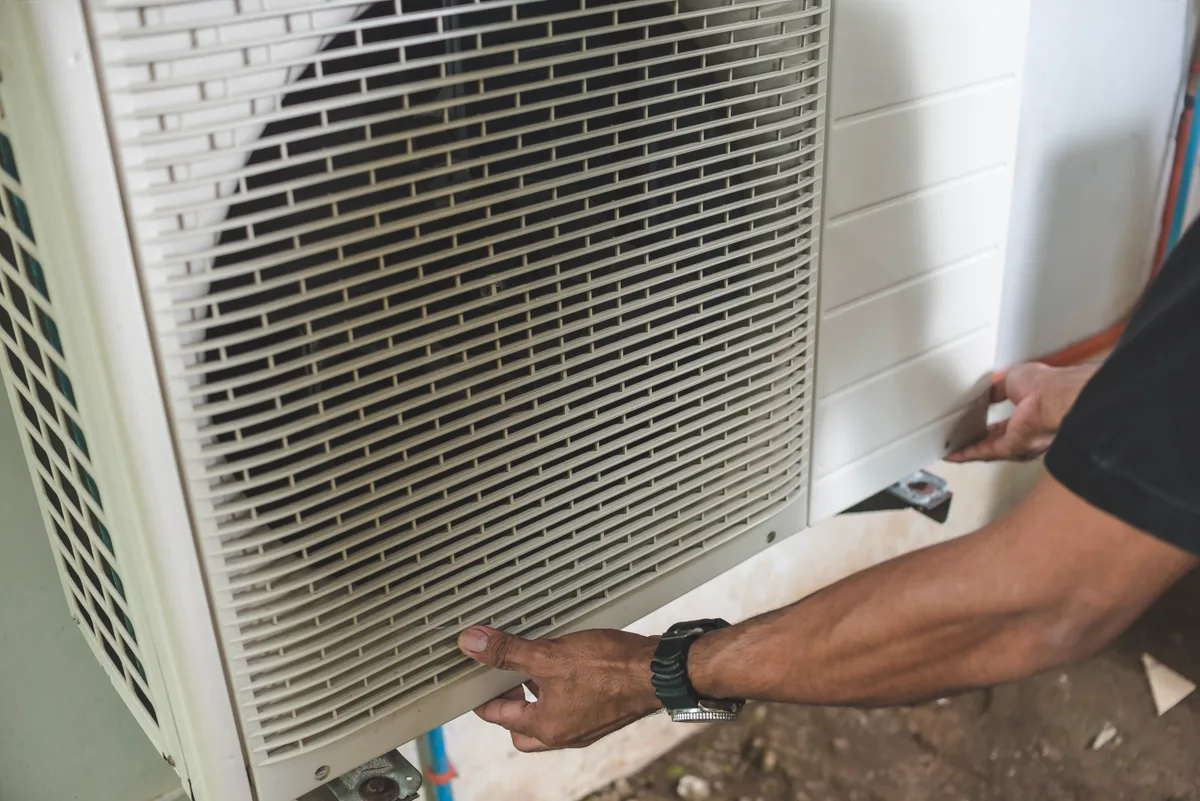
Side-discharge vs top-discharge AC and heat pump units differ in shape first and in everything else second. A side-discharge unit is a slim, inverter-driven cabinet that sits close to the wall and blows air out the front; a top-discharge unit is a cube that pulls air through its sides and blows it straight up. Choose side-discharge for a side yard narrower than about 1.2 metres, for most heat pumps and wherever noise matters. Choose top-discharge for a low-cost air conditioner on a lot with open space around it.
How much room each style needs beside the house
A side-discharge unit takes less than half the depth of a cube. Cabinets are commonly 30 to 40 cm deep and about a metre wide, and they sit 10 to 30 cm off the wall on a pad, a stand or a bracket. A top-discharge cube is commonly 60 to 90 cm on each side and needs open air on every face that has coil, so it ends up standing well clear of the wall. The installation manual for the quoted model has the real figures.
That difference decides the job on narrow lots. Beside 2000s+ townhouses and semis in Milton, north Oakville and Brampton, the strip along the house is often both the only spot for the unit and the only route to the back garden. A cube with its clearances can block that path, while a slim unit leaves room to walk past with a lawn mower. Older city lots have the same squeeze, covered in our guide to AC and heat pump placement for Toronto semis.
The catch is the air leaving the front. A side-discharge unit throws its exhaust horizontally and needs open space ahead of the fan, commonly half a metre or more in the manual. Aim it at a fence or the neighbour's wall at close range and the hot air curls back into the coil, which costs capacity on the hottest afternoon of the year. Municipal setbacks apply to both shapes, and AC unit placement rules in Ontario covers those.
Why side-discharge units are quieter at part load
Side-discharge units are inverter-driven, and an inverter is quiet because it rarely runs flat out. An inverter compressor and its fan slow down to match the load, so on a 24°C evening the unit may be turning at a fraction of full speed. A single-stage cube has one speed and one sound level every time it starts. Published sound ratings follow that pattern.
- Entry single-stage top-discharge air conditioners: typically in the low to mid 70s dB(A).
- Two-stage and variable-speed top-discharge units: typically from the mid 50s to the low 70s dB(A), depending on the tier.
- Side-discharge inverter units: typically from the mid 50s to the mid 60s dB(A) at rated output, and lower at reduced speed.
Read the fine print before comparing two brochures. North American central units are usually rated in sound power, while ductless-style outdoor units often publish sound pressure measured a metre away, and pressure figures look lower for the same machine. Ask each contractor for the sound rating on the specification sheet for the exact model, and which measurement it is. Our comparison of the quietest central air conditioners sorts the options by tier.
Direction matters as much as the number. A cube sends fan noise upward, toward a bedroom window above it. A side-discharge unit sends it forward at ground level, toward whatever it faces.
Heat pumps in winter: snow stands, wall brackets and defrost water
Free quotes, written pricing.
For a heat pump, side-discharge is the more practical shape in an Ontario winter because it is easy to lift off the ground. A heat pump works through January, so it has to sit above the snow line with room underneath for defrost water to drain and freeze without reaching the coil.
- Ground stand: a steel stand on a pad or patio stones. It is the simplest to service and keeps vibration out of the house, so it is our default.
- Wall bracket: clears the snow completely and frees the ground. Fastened to brick or a foundation wall with rubber isolators it is quiet; on a framed, sided wall it can carry a hum into the room behind, so keep it off bedroom walls.
- Top-discharge heat pumps: these go on risers too, but the fan faces the sky, and snow and freezing rain settle on the guard and blades while the unit is off.
- Defrost water: every heat pump sheds meltwater that refreezes below the unit. Keep either style away from walkways and steps, or you build an ice sheet where people walk.
- Roof edges: do not set any outdoor unit under a dripping eave or a valley that dumps snow.
Service differences a technician notices
Top-discharge units are simpler and cheaper to fix; side-discharge units are harder to clean when they are crowded against the wall. Both last when they are kept clean and level, but the service calls look different.
- Coil cleaning: a cube's coil wraps the outside and is washed from the inside out with the top removed. A side-discharge coil faces the wall, and the gap behind it collects leaves, cottonwood fluff and dryer lint, so ask the installer to use the larger end of the allowed rear clearance.
- Common parts: a single-stage cube runs on a capacitor and a contactor, the usual failures at $150–$350 each. An inverter unit replaces them with a drive board, and control board repairs run $400–$800 with brand-specific parts.
- Diagnosis: an inverter unit reports fault codes that need the manufacturer's service information to read properly, and its board is more often ordered than pulled from the truck.
- Indoor match: many side-discharge systems require their own matched coil or air handler, and some need a brand-specific control. Ask whether your existing thermostat stays.
- Airflow in front: shrubs, stored bins and snowbanks in front of the fan choke a side-discharge unit the way a clogged coil chokes a cube.
What each style costs installed
The shape does not set the price; the inverter does. A side-discharge unit costs more than an entry single-stage cube because it is variable-speed equipment, and a variable-speed cube sits in the same price tier.
- Central air conditioner on existing ducts: $3,500–$7,500 installed, with single-stage cubes toward the bottom and inverter units of either shape toward the top
- Cold-climate heat pump, 3-ton: $9,500–$15,000 installed, before any rebate
- Stand or wall bracket for a heat pump: priced into the written quote, and worth confirming as a line item
Verdict: which discharge style to choose
- Choose side-discharge if the side yard is under about 1.2 metres wide, the unit sits below a bedroom or near a neighbour's patio, or you are buying a heat pump that has to clear the snow.
- Choose top-discharge if you want the lowest installed price for cooling only, the unit has open space on all sides, and you value common parts any technician carries.
- Choose a variable-speed top-discharge unit if you want inverter comfort and have the room, and the yard in front of a slim unit would face a fence at close range.
- Whichever you pick, get the clearances from the installation manual written into the quote, not estimated on site.
We measure the side yard, the path to the gate and the distance to the nearest window before recommending a shape, because the lot decides more than the brochure does. See air conditioner installation and replacement for how we quote, or send us the model numbers you were quoted and we will tell you whether they fit the space.
Frequently asked questions
Can a side-discharge unit replace my old top-discharge air conditioner?
Yes. It sits on the same pad, which will be larger than it needs, and it usually reuses the electrical disconnect location. Expect a new matched indoor coil, because most inverter outdoor units are approved only with specific coils, and a check of the breaker size and line set diameter. The contractor should confirm both before quoting a straight swap.
How close to the wall can a side-discharge unit sit?
The installation manual for the model sets the minimum, and it is commonly between 10 and 30 cm at the back. Closer is not better. A unit set at the minimum is hard to clean behind, and debris trapped in that gap blocks the coil. Where the yard allows it, use the larger clearance and keep the front open.
Does a side-discharge unit blow hot air at my neighbour?
It blows forward, so where it points matters. In cooling mode the air leaving the fan is warm, and in heating mode a heat pump blows air colder than outdoors. Turning the unit so it discharges along your own yard rather than across the lot line avoids both the complaint and the recirculation problem that a nearby fence causes.
Are inverter side-discharge units less reliable than single-stage cubes?
The shape has no bearing on reliability; the electronics do. An inverter unit has a drive board that a single-stage cube lacks, and boards are sensitive to power surges and moisture. In return the compressor starts gently and avoids the hard starts that wear out a single-stage unit. Register the warranty and ask about the labour coverage on the board.