
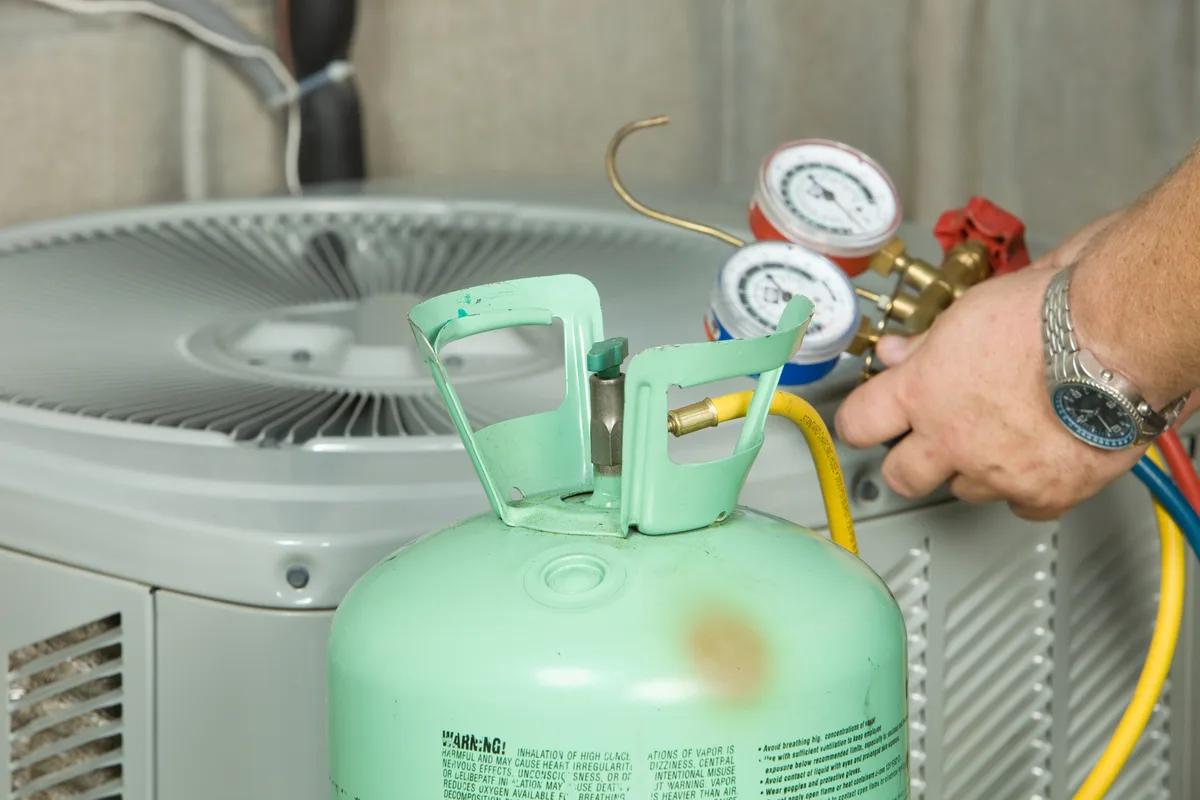
R-410A vs R-454B: which AC should you buy now? Buy the R-454B system in almost every case. R-454B has a global warming potential of 466 against 2,088 for R-410A, and Canada's phase-down cuts the supply of high-GWP refrigerant to 30% of the baseline in 2029 and 15% in 2036, inside the 15–20 year life of a unit installed today. Take leftover R-410A stock only when you are matching a healthy R-410A indoor coil, or when the written discount is larger than the $300–$800 a leak repair and recharge costs now.
R-410A and R-454B compared: the numbers that matter
The two refrigerants cool a house equally well; they differ in climate impact, flammability class and how long cheap service refrigerant will be around. Here is the comparison in the terms a quote uses.
- Global warming potential: R-410A is 2,088 and R-454B is 466, about 78% lower.
- Make-up: R-410A is a blend of R-32 and R-125. R-454B is a blend of R-32 and R-1234yf, sold under trade names such as Opteon XL41 and Puron Advance.
- Safety class: R-410A is A1, non-flammable. R-454B is A2L, which means lower toxicity and mildly flammable.
- Cooling performance: close enough that you will not feel a difference. Capacity and efficiency come from the equipment tier, and the 13.4 SEER2 federal minimum for split air conditioners applies to both.
- Service gear: each refrigerant has its own cylinders, and R-454B needs gauges and a recovery machine rated for A2L. The technician needs an ODP card to handle either one.
Is R-410A banned in Canada? What the federal rules say in October 2026
No. Canada has not set a date after which an R-410A residential air conditioner cannot be installed. The federal Ozone-depleting Substances and Halocarbon Alternatives Regulations cap how much HFC refrigerant can enter the country and set product limits for items such as refrigerators, chillers and vehicle air conditioning, but not for home air conditioners or heat pumps. We read the consolidated regulation on October 1, 2026 to confirm that.
The supply cap is the part that reaches your wallet. It allows 60% of the baseline through 2028, 30% from 2029, 20% from 2034 and 15% from 2036. Every kilogram of R-410A put into a home system after those dates comes out of a smaller pool shared with every other HFC user in the country.
The United States went further and stopped manufacturers building new R-410A residential systems at the start of 2025. The same factories supply both countries, so the R-410A units a contractor can offer you here are what is left in distributor warehouses, not a current product line. Rules change, so ask the contractor to confirm the position on the day you sign.
What mildly flammable means inside an R-454B system
A2L refrigerant is hard to ignite and burns slowly, and the equipment is built on the assumption that a leak will happen one day. The indoor coil cabinet carries a refrigerant sensor wired to a mitigation control. When the sensor detects refrigerant, the control runs the indoor blower to dilute it through the ductwork and shuts the compressor down. The installation manual for each model lists exactly what else it locks out.
- The sensor and mitigation board are parts, and they should appear as a line on the quote.
- The rating plate ties the refrigerant charge to a minimum floor area, which matters for a furnace in a small closet in a townhouse or a condo.
- A failed sensor can leave the blower running and the compressor locked out. A fan that will not stop and an AC that will not start points at that circuit before anything else.
- The existing line set is reused only if it is the right size, clean inside and holds a pressure test.
None of this changes how you live with the system. It runs from the same thermostat, uses the same filter and gets the same spring tune-up.
Free quotes, written pricing.
Why you cannot mix an R-410A coil with an R-454B outdoor unit
The indoor coil and the outdoor unit must be a matched pair listed for the same refrigerant. The oil, the metering device, the charge and the safety listing are specific to it, and an R-454B system needs the leak sensor an R-410A coil never had. Topping up an R-410A system with R-454B is not a repair: it contaminates the charge and leaves a system nobody can service properly.
That rule cuts both ways, and it is the one good reason to buy R-410A today. If the outdoor unit has failed on a system whose furnace coil is only a few years old, a remaining R-410A condenser of the right size keeps the coil and often the line set. An R-454B outdoor unit means a new coil as well. Some coils sold during the changeover are listed for both refrigerants, and the rating plate on the coil settles it.
What an R-410A recharge costs later, and the discount that has to beat it
A sealed system that never leaks never needs refrigerant, so a well-installed R-410A unit can run its whole life on the factory charge. The risk is the leak in year eight or twelve: a rubbed-through line, a pinhole in the coil, a failed service valve. That repair will draw on a refrigerant supply sitting at 30% of the baseline or less.
- New central air conditioner on existing ducts: $3,500–$7,500 installed with either refrigerant, depending on size and efficiency tier
- Refrigerant leak repair and recharge today: $300–$800+, with finding and sealing the leak the larger share
- Diagnostic visit: $90–$150, credited toward the repair if you go ahead
Use those figures as the test. A discount smaller than one leak repair is not worth 15 years of dearer refrigerant. A discount several times that size, on a new matched coil and condenser with the manufacturer's warranty registered, is a fair trade for a house you expect to sell within a few years. Our pricing page shows the bands, and what an AC refrigerant recharge costs explains where that bill comes from.
Questions to ask when a quote lists R-410A
- Is this new, sealed stock with the full manufacturer's warranty, and who registers it?
- What is the price of the same-tier R-454B model from you, in writing, on the same day?
- Are the coil and the outdoor unit both new, and what is the AHRI reference number for the matched pair?
- What is the manufacture date on the rating plate of each piece?
- What labour warranty do you give on a refrigerant leak, and for how many years?
Verdict: R-454B for a full replacement, R-410A only to save a good coil
- Buy R-454B if you are replacing the whole system, plan to stay more than five years, or want the unit that future technicians will stock refrigerant and parts for.
- Buy R-410A if only the outdoor unit has failed and the indoor coil is recent, leak-free and listed for R-410A alone.
- Consider R-410A if the discount is in writing, is worth several leak repairs, and you expect to sell within about five years.
- Walk away from any quote that pairs components for two different refrigerants, or that will not name the refrigerant at all.
We install R-454B equipment and still service R-410A systems across Burlington, Oakville, Milton and Hamilton, and a written quote from us names the refrigerant, the model numbers and whether the line set is reused. The background on the changeover is in our A2L refrigerant guide and the R-410A glossary entry. For a price on your house, see air conditioner installation or ask for a written quote.
Frequently asked questions
Can R-454B be added to an R-410A air conditioner?
No. The two refrigerants are not interchangeable and must never be mixed. An R-410A system uses components and a charge matched to that refrigerant, and it has no leak sensor. A technician repairing an R-410A system finds and fixes the leak, then recharges with R-410A, which remains available for servicing existing equipment in Canada.
Will my existing R-410A air conditioner become illegal in Canada?
No. The federal regulations limit how much HFC refrigerant is imported; they do not require anyone to remove working equipment, and R-410A can still be used to service it. What changes over time is the price and availability of the refrigerant, which is why a leaking older system becomes a worse candidate for repair each year.
Is R-454B safe in a basement with a gas furnace and water heater?
Yes, when the system is installed to the manufacturer's instructions. R-454B is classed A2L: it needs a sustained ignition source and a specific concentration to burn, and it burns slowly. The coil cabinet has a sensor that starts the blower and stops the compressor if refrigerant is detected, which keeps a leak diluted well below that concentration.
Do R-454B air conditioners cool as well as R-410A models?
Yes. Manufacturers designed R-454B equipment to deliver the same capacities and efficiency tiers as the R-410A lines it replaced, so a 2.5-ton unit is still a 2.5-ton unit. Comfort depends on correct sizing, airflow and whether the unit is single-stage, two-stage or variable-speed, not on which of these two refrigerants is inside.