
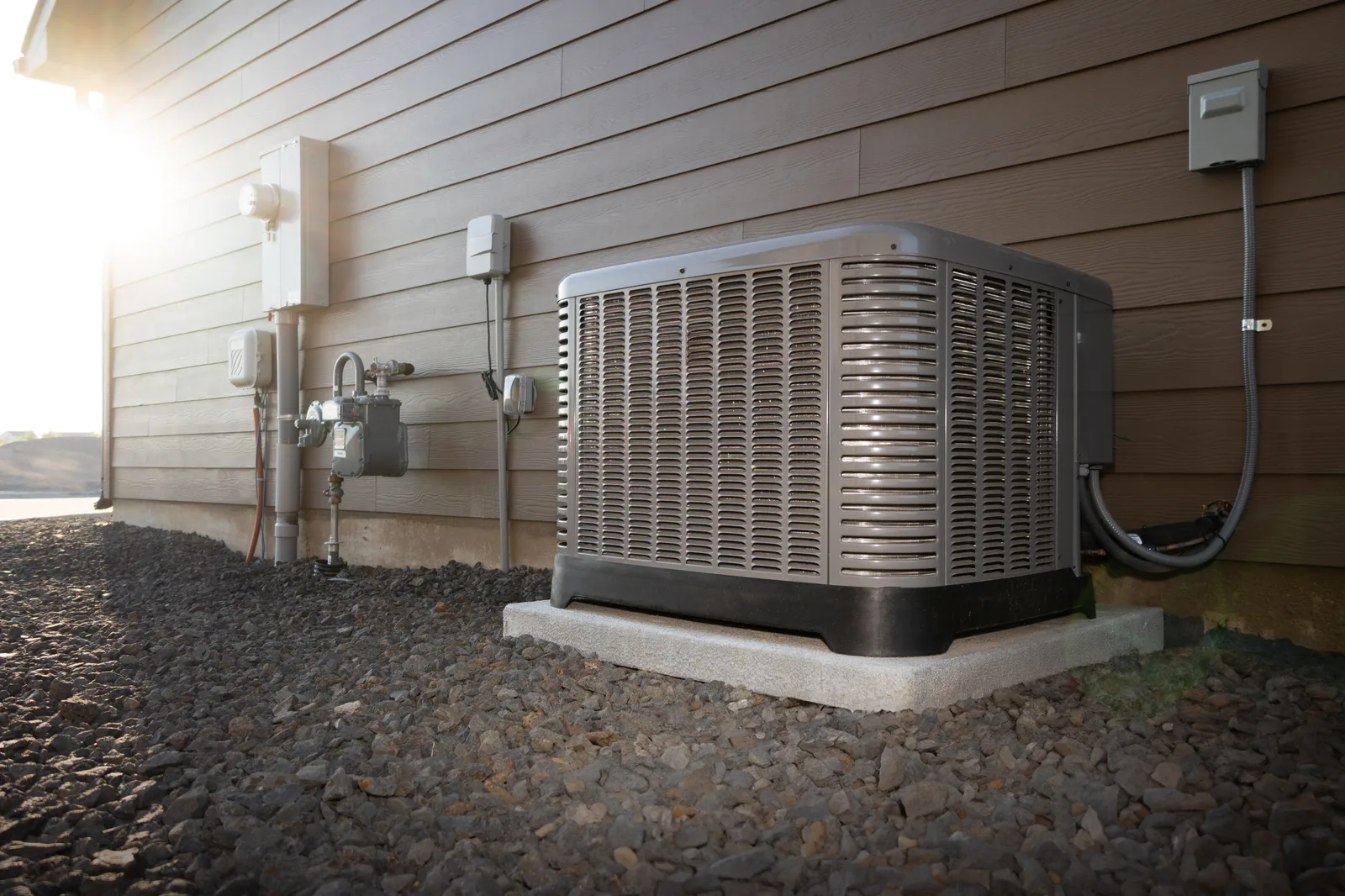
Shopping for the quietest central air conditioners for Ontario homes means shopping for variable-speed inverter models: their published sound ratings run 55 to 60 dB(A) at minimum speed, against roughly 67 for two-stage units and 71 to 75 for single-stage builder-grade ones. Every 10 dB sounds about twice as loud, so the gap is plain from a bedroom window. Placement counts as much as the model: doubling the distance from the unit takes off about 6 dB, which is about what one step up in equipment tier buys.
Published sound ratings by compressor type
Sound ratings come from a standard laboratory test of the outdoor unit and are quoted in A-weighted decibels. Manufacturers' current listings group like this:
- Variable-speed inverter: 55 to 60 dB(A) on the quietest models, measured at the lowest compressor speed.
- Two-stage: around 67 dB(A).
- Single-stage: 71 to 73 dB(A) on most current models, with older and builder-grade units reaching the mid-70s.
For scale, ordinary conversation at arm's length is about 60 dB(A). A unit rated 72 is louder than two people talking at the fence, and a unit rated 55 is quieter than they are.
The rating is taken at minimum speed, so read it carefully
A claim of 'as low as 55 dB' describes the unit at its slowest speed on a mild evening. On a 32°C afternoon the same unit ramps toward full speed and gets louder, though it usually stays below a single-stage unit because of its compressor blanket and fan design. The low-speed figure is the one that matters at night, when the cooling load is small and the street is quiet.
Variable-speed does not guarantee quiet either. Lennox lists its Signature SL25KCV at 58 dB and its Elite EL22KCV at 60 dB, but its variable-capacity Elite EL18KCV at 67 dB, no quieter than a two-stage unit from another brand. Ask for the sound rating of the exact model and tonnage on your quote, because the brochure figure is the lowest in the series and larger sizes can rate higher.
Which tier carries the low-sound rating in each brand
- Carrier: the Infinity variable-speed unit is listed as low as 55 dB. The Performance units are listed at 67 dB and the Comfort units at 71 to 72 dB.
- Lennox: the Dave Lennox Signature SL25KCV at 58 dB and the Elite EL22KCV at 60 dB. Single-stage Elite and Merit units are listed at 72 to 73 dB.
- Trane: the 18 and 20 TruComfort variable-speed units, which wrap the compressor in a sound enclosure. Trane puts most of its air conditioners between 55 and 75 dBA, and the 18 TruComfort has a Quiet Mode that limits compressor speed.
- Daikin, Goodman and Amana: the inverter models are the quiet tier, including the side-discharge Daikin Fit. Check the submittal sheet for the figure on the size you are quoted.
These are manufacturer figures, and they change with each model generation. Sister brands such as KeepRite and American Standard follow their parent's pattern: the low number belongs to the inverter tier, and the entry single-stage unit is 15 dB or so louder.
What makes a condenser loud
Free quotes, written pricing.
- The compressor: the main source of low-pitched hum. Quiet models wrap it in an insulating blanket or a full enclosure.
- The fan: blade shape and speed set the rush of air. Inverter units slow the fan along with the compressor.
- Start-up: a single-stage unit goes from silent to full output in a second, with a clunk from the contactor. An inverter ramps up over a minute or more, which is far less noticeable at night.
- The cabinet: thin louvred panels and loose screws rattle. Heavier cabinets and swept grilles do not.
- Vibration: a compressor on a tilted pad, or copper lines strapped hard against a joist, carries a hum into the house.
A unit that has grown louder over the years is a repair question, not a shopping one. A worn fan motor bearing, a bent blade or a failing compressor all announce themselves, and our answer on why an AC is so loud sorts normal sounds from faults.
Placement matters as much as the model
Where the unit sits can be worth more decibels than the upgrade. In open air, sound falls about 6 dB each time the distance doubles, so a unit 4 m from a window is roughly 6 dB quieter there than one at 2 m. Hard surfaces work the other way and reflect the sound back.
- Bedroom windows: keep the unit off the wall below any bedroom, yours or the neighbour's, when another wall is available.
- Side yards: a narrow passage between two brick houses bounces sound back and forth. The same unit is noticeably louder there than on an open rear wall, which is a common problem in 2000s+ subdivisions and on semi-detached lots.
- The lot line: the municipal noise by-law is judged at the neighbour's property, and the zoning by-law decides how close to the line a condenser may sit. Burlington, Oakville, Milton, Hamilton and Mississauga each write their own.
- Pad or wall bracket: a level pad on a compacted base keeps vibration in the ground. Wall brackets save space and lift the unit clear of snow, but bolted to wood framing they can carry a hum indoors; on a foundation wall with rubber isolators they are fine.
- Line set: the copper lines need cushioned clamps and a gentle bend at the unit, so compressor vibration is not passed to the framing.
- Discharge direction: a top-discharge unit throws fan noise upward toward second-floor windows, and a side-discharge unit throws it forward. Our side-discharge vs top-discharge comparison covers which suits a tight yard.
Setbacks and noise limits differ by municipality and by zone, and our guide to AC unit placement rules in Ontario shows how to check yours. If the existing spot is the problem, AC unit relocation can be done as part of the replacement, while the line set is being renewed anyway.
What a quiet air conditioner costs
Central air runs $3,500–$7,500 installed when the ducts are in place, and the quiet inverter tier sits at the top of that band. Many of these units also need a matched communicating furnace, and a combined furnace and AC replacement typically runs $7,500–$11,500. Moving the unit to a better wall often costs far less than moving up a tier, so price both before deciding.
Verdict: when to pay for the quiet tier
- Pay for variable-speed if the only workable location is under a bedroom window, in a side yard a couple of metres from the neighbour's wall, or beside a patio you use every evening.
- Choose two-stage if the unit can sit on an open rear wall several metres from any window. It runs on low most of the time and the distance does the rest.
- Single-stage is fine at the back of a deep lot, on a solid pad, away from bedrooms.
- Whatever the tier, get the sound rating for the exact model in writing and agree on the location before installation day.
Location is part of a ZK Mechanical quote, not an afterthought: ask us to show where the unit, the pad and the line set would go before you sign. See air conditioner installation, or book a site visit and written quote.
Frequently asked questions
How many decibels is a quiet air conditioner?
The quietest central units are rated 55 to 60 dB(A) at their lowest speed, about the level of normal conversation or a little under. A typical single-stage unit is 71 to 73 dB(A). Because loudness roughly doubles every 10 dB, a 55 dB unit sounds about a third as loud as a 72 dB one from the same spot.
Why is my new variable-speed AC louder in the afternoon than at night?
Because it is working harder. The published rating is taken at minimum speed, which is where the unit runs on mild evenings and overnight. In the heat of the afternoon the compressor and fan speed up to meet the load, and the sound level rises with them. That is normal. A new rattle, buzz or grinding noise is not, and should be checked.
Will a fence or a sound blanket quieten my existing unit?
A solid fence or screen between the unit and the listener can cut the sound that reaches a window, provided it leaves the airflow clearances in the installation manual; boxing a condenser in makes it run hot and louder. A compressor blanket helps only where the manufacturer approves one for that model. Neither fixes a worn fan motor or loose panels.
Is the indoor side of a quiet system quieter too?
Usually. Variable-speed outdoor units are paired with variable-speed blowers that spend most of their time at low airflow, so the rush at the registers drops. Duct noise still depends on the ducts: if static pressure is high, a whistling return grille stays noisy at any equipment tier until the return air is improved.