
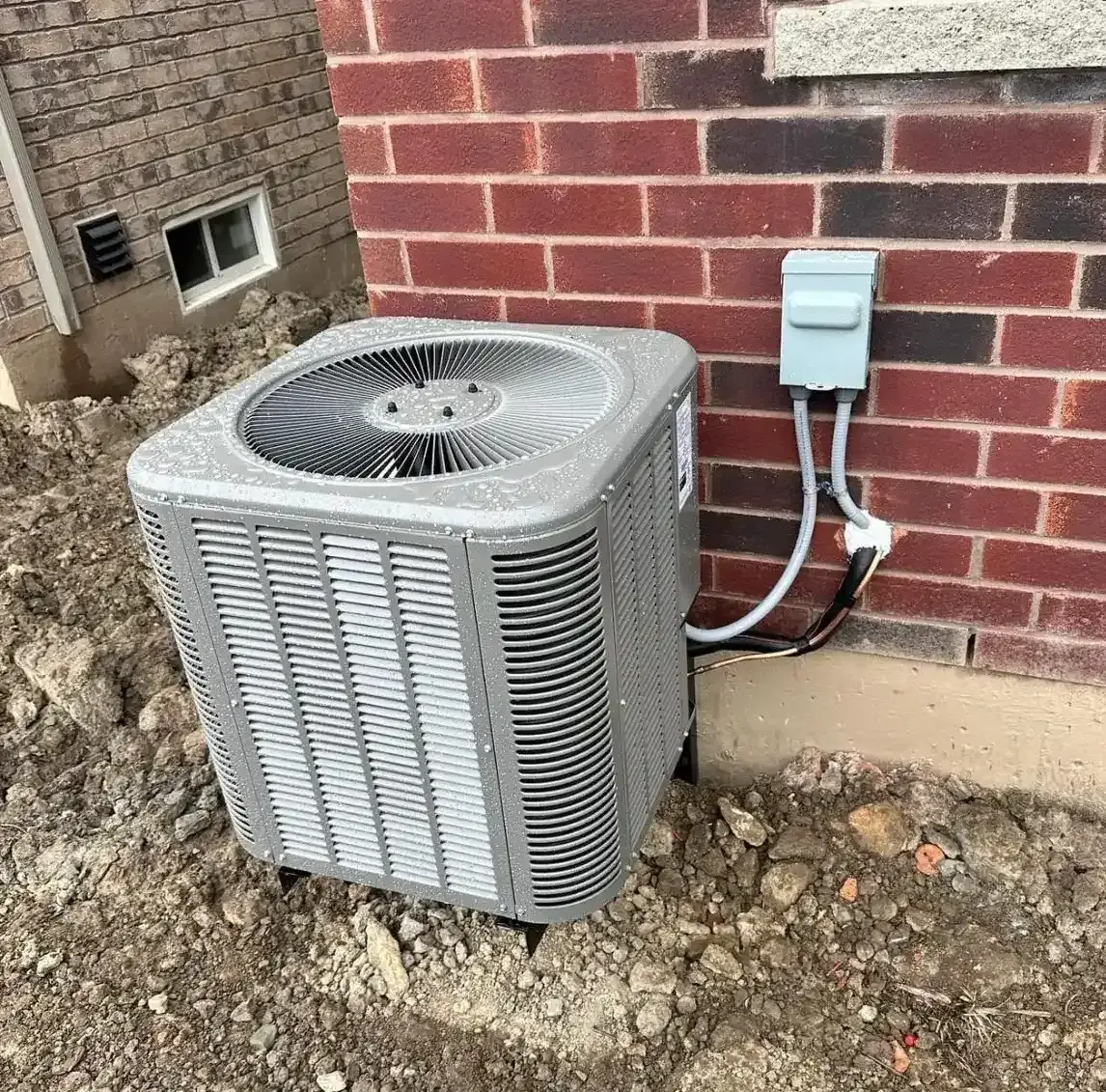
There is no single province-wide setback for an air conditioner in Ontario, and anyone quoting you one number for the whole province is guessing. Where the condenser can legally sit is decided by your municipality's zoning by-law, which Burlington, Oakville and Hamilton each write separately, and then constrained by four other things: the manufacturer's installation manual, the Ontario Electrical Safety Code, the gas clearances in CSA B149.1, and the local noise by-law. Ask your installer which wall the unit is going on, and confirm the by-law with your municipality before the pad is poured.
The Five Rulebooks That Decide Where It Goes
- The municipal zoning by-law. It says whether a condenser counts as a permitted encroachment into a required side or rear yard, how close it may come to a lot line, and whether it is allowed in a front yard at all. This varies between cities and between zones inside one city, so check yours rather than a neighbour's.
- The manufacturer's installation manual. It gives minimum clearances for airflow at the sides and above, plus service access on the panel side. Ignore it and you have a warranty problem as well as a performance one.
- The Ontario Electrical Safety Code. It requires a means of disconnect within sight of and readily accessible at the unit, and the working space in front of that disconnect has to stay clear — not behind a cedar hedge or a stack of patio stones.
- CSA B149.1, the gas code TSSA enforces. It sets clearances around the gas meter and its regulator vent and around furnace and water heater vent terminations. A condenser must not block meter access or sit where it will inhale flue gas.
- The municipal noise by-law. Whether a residential condenser falls under it depends on how each by-law is written, so check with your municipality before placing a unit a few metres from a bedroom window.
Why Most Ontario Condensers End Up in the Side Yard
The side yard is the default because it is close to the electrical panel and the furnace, it keeps the lineset run short, and it hides the unit from the street. On a typical 1970s to 1990s subdivision lot in Millcroft, Glen Abbey or River Oaks it is often the only practical option.
It is also where most placement mistakes happen. The unit ends up directly under a bedroom window, or under the eaves in the drip line where roof runoff and sliding snow land on it, or hard against the neighbour's fence with no room for a technician to open the service panel. Every one of those is fixable at design time and expensive to fix afterwards.
- Airflow: a condenser rejects heat upward and draws air in through the coil on the sides. A solid fence or tight lattice screen too close recirculates that hot air straight back into the coil, raising head pressure and cutting capacity on the hottest day of the year.
- Screening: keep any decorative screen open on the intake faces and leave the discharge above the unit completely unobstructed. Follow the manual's clearance rather than eyeballing it.
- Snow and ice: if the unit sits under a roofline that sheds, raise it on a stand rather than leaving it on a slab. We do this routinely wherever drifting snow is a factor.
- Ground: a level pad on undisturbed ground or a proper stand. A condenser set on soft lawn settles, which stresses the lineset and pulls the unit out of level.
Noise: The By-Law and the Neighbour
Every condenser has a published sound rating in decibels, and it is on the spec sheet if you ask. Two-stage and variable-speed units run at low capacity most of the time and are meaningfully quieter than a single-stage unit that is always at full output. If the placement is going to be tight, spend the difference on the quieter machine.
Beyond the by-law there is the practical rule that keeps the peace on a street: do not put the unit under a bedroom window, yours or theirs, when another wall is available, and avoid a narrow side yard between two brick walls, which behaves like a sound channel and reflects noise straight into the neighbouring house. Our page on why an air conditioner is so loud covers which noises are normal for a condenser and which ones are a fan bearing, a loose panel or a compressor telling you something.
Front Yards, Corner Lots and Heritage Streets
Free quotes, written pricing.
Three situations narrow the options sharply, and all three are worth checking before you book an install date.
- Front yards: many by-laws do not permit mechanical equipment in a required front yard. If the only wall with room faces the street, you need to confirm rather than assume.
- Corner lots: a corner lot has a flankage yard that is often treated much like a front yard, which can eliminate the side you were counting on. This catches a lot of homeowners in Alton Village and Waterdown.
- Heritage properties: designated houses in Old Oakville, Westdale and Hamilton's older streets can carry additional rules about equipment visible from the street. Ask the municipality's heritage planner.
- Townhouses, semis and stacked units: the builder's original condenser location was approved as part of the site plan. Moving it can create a compliance problem that did not exist before.
- Condominiums: the corporation's declaration and rules govern, and common-element walls and balconies are not yours to drill.
Do You Need a Permit to Put In an AC?
For a house, several municipalities say outright that no building permit is needed: Burlington lists a like-for-like air conditioner replacement as exempt, and Toronto, Halton Hills and Caledon list air conditioning for a house among the work that does not require one. Others, Oakville and Milton among them, do not say on their permit pages. New ductwork or structural work to accommodate the system is a different matter and is confirmed with the building department. The electrical connection is a separate matter: it is done by a licensed electrical contractor who files notification with the Electrical Safety Authority.
Because this genuinely differs between municipalities, confirm with yours. We have written a local walkthrough for HVAC permits in Burlington, and the short province-wide version is on do I need a permit to install an AC in Ontario.
A Placement Checklist to Walk With Your Installer
- Level pad on undisturbed ground, or a stand if snow slides off the roof above.
- Out of the drip line, or a gutter installed above it.
- Enough room to open the service panel fully and lift the fan deck out.
- Disconnect within sight, mounted where the working space in front of it stays clear year-round.
- Not blocking the gas meter, the regulator vent, or any furnace or water heater vent terminal.
- Lineset route short, protected where it runs at ground level, and the wall penetration sealed and sloped so water sheds outward.
- Not under a bedroom window on either property, and not boxed into a corner where two walls and a fence trap the discharge air.
- For a heat pump, somewhere for defrost water to drain that will not turn a walkway into ice — the same unit runs all winter.
Verdict
Treat placement as a design decision, not a delivery-day decision. The by-law question takes one phone call to your municipality, the manual's clearances take one page of reading, and both are far cheaper before the concrete is down. If a contractor tells you the location does not matter, or quotes you a setback figure that applies everywhere in Ontario, get another quote.
We check the meter, the vent terminations, the roofline and the neighbour's windows before we set a condenser, and we put the location on the quote so there are no surprises. See our air conditioner services, our cooling work in Oakville, or book a site visit and we will walk the yard with you.
Frequently asked questions
How far from the property line does an air conditioner have to be in Ontario?
There is no single provincial number. Each municipality's zoning by-law sets whether a condenser may encroach into a required side or rear yard and how close it may come to the lot line, and the answer can differ between zones in the same city. Call your municipality's zoning counter with your address before you commit to a location.
Can I put my AC unit in the front yard?
Often not. Many zoning by-laws exclude mechanical equipment from a required front yard, and a corner lot's flankage yard may be treated similarly. If the front is the only wall with room, confirm with the municipality first — moving a condenser after the fact means new pad, new lineset and new electrical.
How much clearance does a condenser need around it?
The manufacturer's installation manual gives the numbers for your specific model, covering the intake sides, the discharge above, and service access at the panel. Those clearances protect capacity as well as compliance: a unit recirculating its own hot exhaust loses performance exactly when you need it most.
Can my neighbour complain about the noise from my air conditioner?
They can, and municipal noise by-laws are the mechanism. Whether a residential condenser falls within a given by-law depends on how it is written, so check locally. Practically, the way to avoid the complaint is placement — away from bedroom windows and out of a narrow side yard — plus choosing a quieter two-stage or variable-speed unit.