
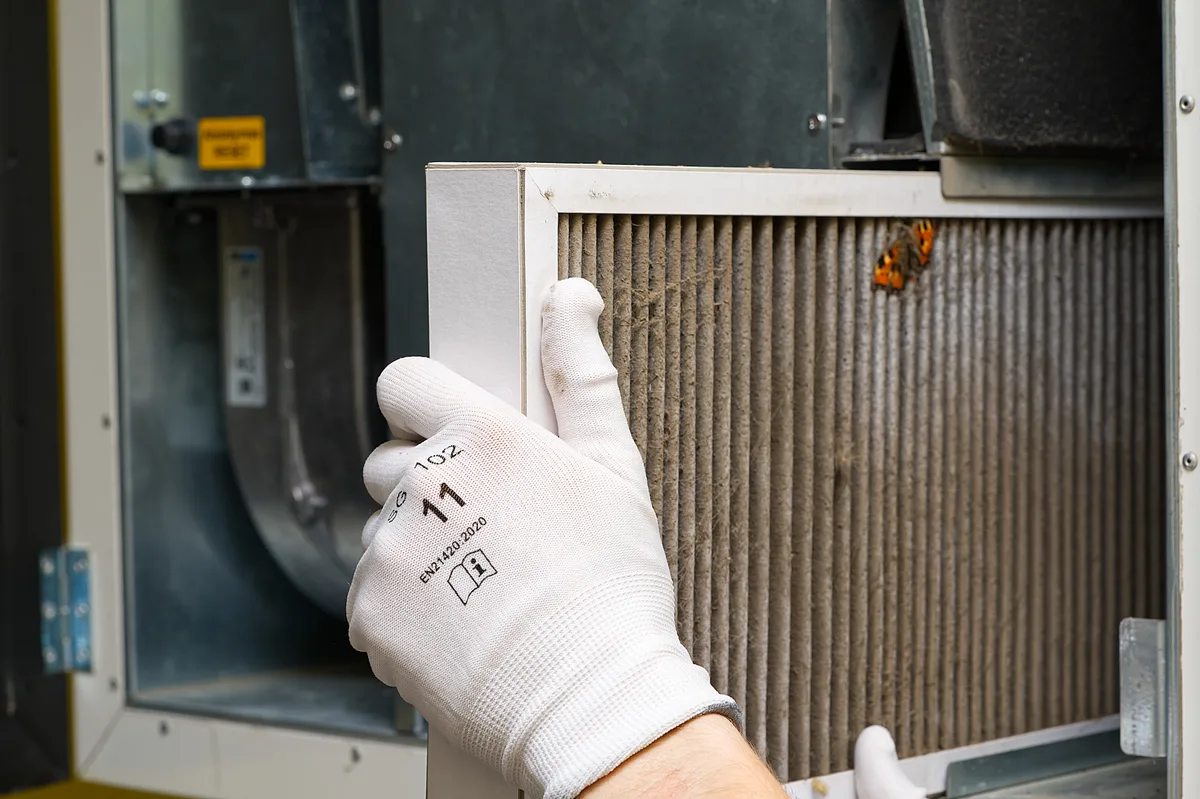
The best air conditioner for a home with small ducts is a correctly sized two-stage or variable-speed unit paired with an ECM blower, and it is often half a ton smaller than the one first quoted. Start with a static pressure test: if total external static reads above about 0.5 in. w.c., the ducts cannot move the airflow a larger unit needs. Above that line, the money goes to return air, a bigger filter rack or a ductless head upstairs before it goes to tonnage.
Test static pressure before choosing any air conditioner
Static pressure is the resistance the blower pushes against, measured in inches of water column. Most residential furnaces are rated for a total external static pressure of about 0.5 in. w.c., and the figure is on the rating plate. A technician reads it with a manometer and two probes, one on the return side ahead of the blower and one in the supply plenum, with the blower at cooling speed. The test needs two small holes and about fifteen minutes.
The reading tells you what the ducts can carry. An air conditioner needs roughly 350 to 400 CFM of air per ton, so a 3-ton unit wants about 1,200 CFM across its coil. A cooling coil adds resistance of its own, so a furnace that reads 0.5 with no coil above it will read higher once one is installed. Our glossary entry on static pressure explains the measurement in more detail.
- At or under about 0.5 in. w.c. with the coil in place: the ducts can carry the size the load calculation gives, in any stage type.
- Between about 0.5 and 0.8: workable with fixes. Add return air or a larger filter, size to the load and not above it, and choose two-stage or variable-speed.
- Above about 0.8: the duct system is the problem. Fix it first, or cool the hard-to-reach floor another way.
Why older Ontario houses have ducts too small for cooling
Many local duct systems were built for heating alone. A furnace needs less airflow than an air conditioner sized for the same house, so a 1950s–60s bungalow could get by on small round branch runs and a single return grille in the hallway. Central air came later, bolted onto ducts that were never sized for it.
- 1950s–60s bungalows: one central return, small supply branches, and often a newer furnace sitting on the original trunk line.
- Pre-war brick two-storeys: supply runs squeezed into wall cavities and joist bays during a retrofit, with few or no returns upstairs.
- 1970s–90s subdivisions: adequate supply trunks but a single return per floor, and a 1-inch filter slot that chokes the return side.
- 2000s+ new builds: long runs to third-floor or bonus rooms in flexible duct, which loses capacity wherever it is kinked or crushed.
What happens when the air conditioner is too big for the ducts
The coil gets too little air and runs too cold. Moisture freezes on the fins, the ice blocks what airflow is left, and liquid refrigerant can return to the compressor, the one part that does not get a second chance. Our guide to why an AC freezes up covers the other causes of an iced coil.
- Registers that whistle and a return grille that roars.
- A second floor that stays 3 or 4°C warmer than the main floor.
- Ice on the large refrigerant line, or water around the furnace after the coil thaws.
- Short cycles: the area near the thermostat cools fast and the unit shuts off before the far rooms catch up.
- A blower that has become loud since the air conditioner was added.
The blower type changes how the problem shows. A PSC blower delivers less and less air as pressure rises. A constant-airflow ECM blower speeds up to hold its target, so it gets louder, draws more electricity and wears faster. Neither one makes a small duct bigger.
Free quotes, written pricing.
Equipment that copes with restrictive ductwork
Smaller and slower wins. A two-stage unit on low runs at roughly two-thirds capacity and needs about two-thirds of the airflow, so a 2.5-ton two-stage unit spends most of the summer asking the ducts for 650 to 700 CFM where a single-stage unit demands 1,000. It also runs longer, which mixes the air between floors and pulls out more humidity.
- Size from a load calculation, then resist rounding up. A 2-ton unit that runs steadily cools a restricted house better than a 3-ton unit that freezes.
- Choose a two-stage or variable-speed outdoor unit, so most hours are spent at low airflow.
- Pair it with a furnace that has an ECM blower set up for the measured static, or replace the furnace if its old PSC blower cannot deliver cooling airflow.
- Ask for a cooling coil selected for low pressure drop, which usually means a physically larger coil than the smallest one that fits.
- Fit a 4- or 5-inch media filter cabinet in place of a 1-inch slot.
What does not help: a higher-SEER single-stage unit of the same tonnage, a stronger blower forced into the same ducts, or duct cleaning. Cleaning removes dust; it does not add cross-section.
Duct fixes that unlock capacity
The return side is usually the cheapest place to gain airflow. A restricted system is more often short of return air than of supply, because many houses were built with one return where they needed several.
- Add a return: a second return drop at the furnace, or a new grille on the second floor, through return air duct installation.
- Enlarge the filter rack: a media cabinet has several times the surface of a 1-inch filter and a lower pressure drop at equal airflow.
- Replace the choke points: a crushed flex run, an undersized return boot, or a sharp transition above the furnace.
- Seal and balance: return leaks pull in basement air, and closed dampers push the pressure up.
- Stop asking the ducts to do the upstairs: a single-zone ductless head for the second floor is $4,000–$7,000 installed and lets the central unit be sized for the main floor alone.
The ductless route suits pre-war houses where the upstairs runs are sealed inside plaster walls and cannot be enlarged without demolition. One wall-mounted head in the upper hall or the primary bedroom takes the load the ducts never could, and a heat pump version of a ductless mini-split also heats that floor in spring and fall.
Duct changes are priced on a written quote after the test, because the cost depends on access, whether the basement ceiling is finished and how far a new return has to travel. The central air conditioner itself runs $3,500–$7,500 installed.
Verdict: test, fix the return, then buy smaller and staged
- If static is at or under 0.5 in. w.c.: buy the size the load calculation gives. Stage type is then a comfort choice, not a duct one.
- If it is moderately high: add return air and a media filter, then install a two-stage unit on an ECM blower, half a ton smaller if the load allows.
- If it is very high and the ducts are buried in finished walls: keep the central unit small for the main floor and put a ductless head upstairs.
- In every case, turn down a quote that upsizes the air conditioner to fix a hot second floor without a static reading written on it.
ZK Mechanical checks static pressure on the existing ducts before quoting an air conditioner, and you can ask for the reading in writing. See air conditioner installation for how we size and commission a system, or book the test and a free quote.
Frequently asked questions
Can I install a bigger air conditioner to cool the upstairs?
No. A larger unit needs more airflow than small ducts can deliver, so the coil runs too cold, the system short-cycles, and the upstairs still gets too little air. The result is often a frozen coil and a higher bill. The fix is more return air, better supply runs to that floor, or a separate ductless head upstairs, with the central unit sized to the load.
Is a high-velocity system the answer for small ducts?
Only if you are starting without usable ducts. A small-duct high-velocity system uses its own 2-inch flexible supply tubes and a special air handler, and it suits radiator-heated houses with no ductwork. It does not connect to existing furnace ducts or fix them. For a house with undersized conventional ducts, the options are duct changes, a smaller staged unit, or ductless.
How much airflow does a 2-ton air conditioner need?
About 700 to 800 CFM, based on 350 to 400 CFM per ton. A 2.5-ton unit needs roughly 875 to 1,000 CFM and a 3-ton unit 1,050 to 1,200. If the ducts cannot deliver that at or near 0.5 in. w.c. of total external static, the unit is too large for the duct system as it stands.
Will closing vents downstairs push more air upstairs?
A little, and at a cost. Partly closing one or two main-floor registers shifts some air to the second floor, but every closed register raises static pressure, and on ducts that are already restrictive that means less total airflow and a colder coil. Closing more than a couple makes things worse. A balancing damper adjustment by a technician with a manometer is the safer version.