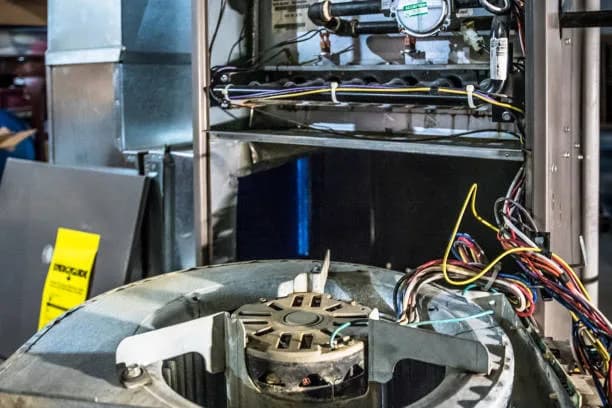
Ice on the evaporator coil, on the copper suction line, or on the outdoor unit means the coil is running below 0 °C — and there are only two families of cause: airflow across the coil dropped, or refrigerant charge dropped. Shut cooling off at the thermostat, set the fan to ON, and let it thaw for 4–8 hours while you change the filter. If ice comes back after a full thaw with a clean filter, stop running the system: a frozen coil sends liquid refrigerant back to the compressor, and the compressor is the one part on a residential AC that isn't worth replacing.
What to do in the next ten minutes
- Turn cooling off at the thermostat but leave the fan set to ON — moving room-temperature air over the coil is what thaws it
- Give it 4 to 8 hours. Surface ice melts fast; ice packed between the fins does not.
- Put a shallow pan or towels under the indoor coil — a slab of melting ice can overrun the drain pan and trip the float switch, or worse, wet the ceiling below
- Replace the filter with the correct size, seated the right way round, with the arrow pointing toward the blower
- Open every supply register and pull furniture, laundry baskets and boxes away from the return grilles
- If ice returns once cooling restarts, leave it off and book a technician — running it is what turns a repair into a replacement
Restricted airflow is the first cause to rule out
An air conditioner cools by pulling heat out of the air moving across the evaporator coil. Starve the coil of air and there is not enough heat arriving to keep the refrigerant boiling, so coil temperature slides below freezing, the condensation on the fins turns to frost, and the frost blocks what airflow was left. The failure feeds itself, which is why a small restriction ends up as a solid block of ice.
- A clogged filter — far and away the most common cause, and the one you can fix without a service call
- A filter too restrictive for the blower: a 1-inch MERV 13 dropped into a system built around a PSC blower chokes it from day one
- Supply registers closed off in unused rooms, which raises static pressure across the whole system
- Undersized or blocked returns — routine in 1950s bungalows around Roseland and central Hamilton that were ducted for heating only and had cooling added decades later
- A dirty blower wheel: dust builds on each blade until the wheel is spinning at full speed and moving almost nothing
- Crushed, kinked or disconnected flex duct in an attic or crawlspace
Low refrigerant means a leak, not consumption
Refrigerant is not fuel — a sealed system does not use it up, so if the charge is low there is a leak. Low charge drops the pressure in the coil, which drops the boiling temperature below freezing, and you get the same ice for a completely different reason. The tell is that the system runs constantly without cooling much, and you may see oily residue at a joint or at the service valves where refrigerant has been weeping out with the oil.
This one is not a homeowner job. In Canada only a technician holding a valid refrigerant-handling certification may open the system, and the leak has to be located and repaired rather than topped up. Budget $300–$800 or more for finding, sealing and recharging, depending on where the leak is. New equipment now ships with A2L refrigerants like R-32 and R-454B, which change how leaks are handled — our A2L refrigerant guide explains what that means for repairs.
A dirty coil, a failing blower or a stuck metering device
Free quotes, written pricing.
Three mechanical faults produce the same symptom. A years-dirty evaporator coil insulates the fins from the air passing over them, and cleaning it properly is a technician's job because bent fins are worse than dust. An aging blower motor turning at reduced speed under-supplies air even behind a brand-new filter — the tell is that the system sounds quieter than it used to. A thermostatic expansion valve stuck partly closed starves the coil and frosts it unevenly, beginning right at the distributor.
Running the air conditioner when it's too cool outside
Residential condensers aren't rated to cool when it's much below roughly 15 °C outdoors. Head pressure falls, the coil runs colder than it should, and the compressor oil gets thick enough that lubrication suffers. GTA homeowners hit this on cool May and September nights when the thermostat is still in cooling mode. If the house feels stuffy on a 14 °C evening, open a window or run the fan on circulate instead.
If it's a heat pump, winter ice is normal
Frost on the outdoor coil of a heat pump during heating season is expected, not a fault — the outdoor unit is the cold side in winter, and the defrost cycle reverses briefly every half hour or so to shed it. What is not normal is a unit encased in solid ice that never clears, or one sitting in a pool of refrozen meltwater because the pad has no drainage under it. Both point at the defrost board, the sensor or the reversing valve. See cold-climate heat pumps in Toronto.
Repair or replace after a freeze-up?
One freeze-up on a system under 10 years old, traced to a filter or a blocked return, is a maintenance event and nothing more. A second refrigerant leak on the same coil is a different verdict: coil leaks tend to be formicary corrosion across the whole coil rather than one repairable spot. And any leak on an R-22 system tips straight to replacement — R-22 has not been manufactured or imported into Canada since 2020, and what's left is reclaimed and priced accordingly. Our AC repair cost guide has the part-by-part numbers.
When to stop troubleshooting and call
- Ice has been there more than a day, or won't fully clear after 8 hours with the fan running
- Ice returns as soon as cooling restarts, behind a clean filter and open registers
- You can see oily residue on the copper lines or at the outdoor service valves
- The system runs continuously and the house never reaches setpoint
- Water is showing up around the indoor unit each time the ice melts
ZK Mechanical takes freeze-up calls across Burlington, Oakville, Hamilton and the wider GTA, and most of them are diagnosed and corrected on the first visit. See what our air conditioning service covers, or book a diagnostic visit.
Frequently asked questions
Why is my air conditioner freezing up?
Either airflow across the evaporator coil dropped or the refrigerant charge dropped. Both push coil temperature below freezing, so condensation turns to frost and the frost chokes off what airflow was left. Filters, closed registers, undersized returns and dirty blower wheels cover the airflow half; a refrigerant leak covers the other. A fresh filter and a full thaw settles the common case.
Can I keep running my AC if it's frozen?
No. A frozen coil cannot boil off the liquid refrigerant reaching it, so liquid returns to the compressor — the one part on a residential system that is rarely worth replacing. Turn cooling off, set the fan to ON, wait 4 to 8 hours for a complete thaw, replace the filter, then restart. If it freezes again straight away, leave it off and book a technician.
How long does it take an AC to thaw?
Complete thaw takes 4 to 8 hours with the blower fan running and cooling off. Visible ice may melt faster, but ice inside the coil and accumulated water in the drain pan need the full window. Running the AC again before complete thaw causes immediate refreeze and damages the system.
Is freezing up a sign I need to replace my AC?
Not on its own. A first freeze-up traced to a filter or a blocked return is a maintenance event. Repeat leaks on the same evaporator coil are a different story, because coil leaks are usually corrosion across the whole coil rather than one repairable spot. Any leak on an older R-22 system tips toward replacement, since R-22 has not been made or imported in Canada since 2020.
Can low refrigerant just be topped up?
Topping up without repairing the leak buys a season at most, and Canadian refrigerant-handling rules require the leak be repaired rather than the system repeatedly recharged. A proper repair means pressure-testing, locating the leak, sealing it, evacuating the system and weighing in a fresh charge to the nameplate. Expect $300 to $800 or more depending on where the leak turns out to be.

