
Quick answer
An AC refrigerant recharge in the GTA costs $300–$800+ when done properly, because the price includes finding and repairing the leak, not just adding gas. Refrigerant is a sealed loop; if it is low, it leaked. A top-up alone is cheaper up front but leaks out again, and on an older R-22 system the refrigerant itself is scarce enough that replacement often makes more sense.
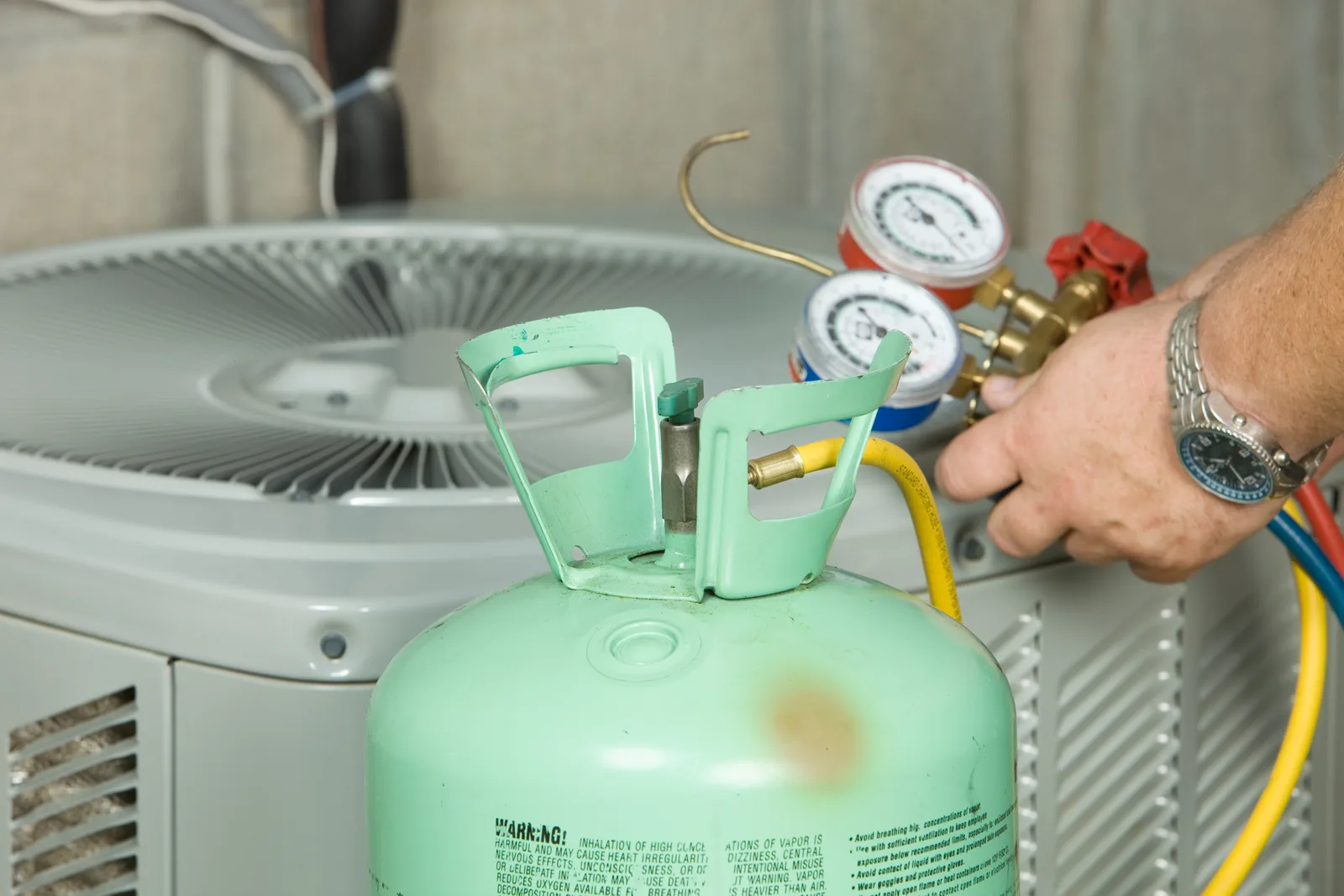
The honest answer to how much an AC refrigerant recharge costs starts with a correction: an air conditioner does not use up refrigerant. It circulates the same charge for the life of the unit inside a sealed copper loop, so a system that is low has a leak. A proper recharge in the GTA runs $300–$800+ and most of that is the leak search and repair; the refrigerant is the smaller line on the invoice, though on older systems it is not a small one.
What the price covers
- Diagnostic and pressure readings: $90–$150 to confirm the charge is actually low, rather than the coil being dirty or the airflow restricted, both of which mimic low refrigerant.
- Leak search: an electronic detector at every joint, a nitrogen pressure test if nothing shows, and UV dye for the slow ones that only reveal themselves after a week of running.
- The repair: tightening or replacing a Schrader valve core, re-brazing a joint, or replacing a section of line set. A leaking coil is a larger repair discussed below.
- Evacuation and recharge: pulling a deep vacuum to remove air and moisture, then weighing in the charge and setting it by superheat or subcooling measurements, not by watching a gauge.
Refrigerant is sold by weight and a residential system holds several pounds, so the type of refrigerant is what moves the price. That is why the same job can sit at the bottom or the top of the $300–$800+ range.
The refrigerant type sets the price: R-22, R-410A or the new A2L blends
If your air conditioner was installed before about 2010 there is a good chance it runs on R-22; the data plate on the condenser says which. New R-22 has not been manufactured or imported into Canada for years; what remains is reclaimed stock, and it is priced accordingly. A leak on an R-22 unit in a 1990s Millcroft or Glen Abbey house is usually the point where we talk about whether a 10-year-old AC is worth repairing, because the same money is a real down payment on a new system.
Units from roughly 2010 to 2025 use R-410A, which remains available for servicing. New equipment is moving to the mildly flammable A2L refrigerants R-32 and R-454B, which need matching tools and training. Our guide to the A2L refrigerant transition explains what that means if you are choosing between repair and replacement this year.
Why a top-up without a leak repair is a bad deal
Adding refrigerant to a leaking system gets you cold air for a while, then the same failure, plus another bill. A slow leak might buy a full summer; a coil leak can be gone in weeks. Every pound that escapes is also a pound that has to be bought again, and venting refrigerant to the air is illegal in Ontario. Anyone charging your system must hold an Ozone Depletion Prevention (ODP) certificate, and a contractor who offers to just gas it up without a leak test is telling you something about how they work.
Where AC systems actually leak
- Schrader valve cores at the service ports: the cheapest and most common leak, often just a worn core or a missing cap.
- Brazed and flare joints on the line set, especially where it was bent to fit through a wall.
- The evaporator coil, through formicary corrosion: pinholes in the copper caused by household chemicals such as cleaners and off-gassing from new furnishings. It is especially common on the thin-walled copper coils made over the past 20 years, and a coil replacement is priced closer to a new unit than to a recharge.
- The condenser coil, from string trimmer damage, hail or a fence panel leaning on the fins.
Signs your system is low, and what looks the same
Low refrigerant shows up as warm air from the vents, ice on the copper suction line or the indoor coil, long run times and a hissing at the coil. A clogged filter or a blocked return produces the same ice, which is why the diagnostic comes first; the causes are laid out in why an AC freezes up. A system that has never been low and suddenly is almost always has a new leak, not a gradual one.
For the full picture of what other repairs cost, see how much AC repair costs in the GTA. ZK Mechanical carries the equipment to leak-test and recharge on the first visit for AC repair in Oakville, Burlington and Hamilton, and the diagnostic fee goes toward the work; book here or call (647) 801-1252.