
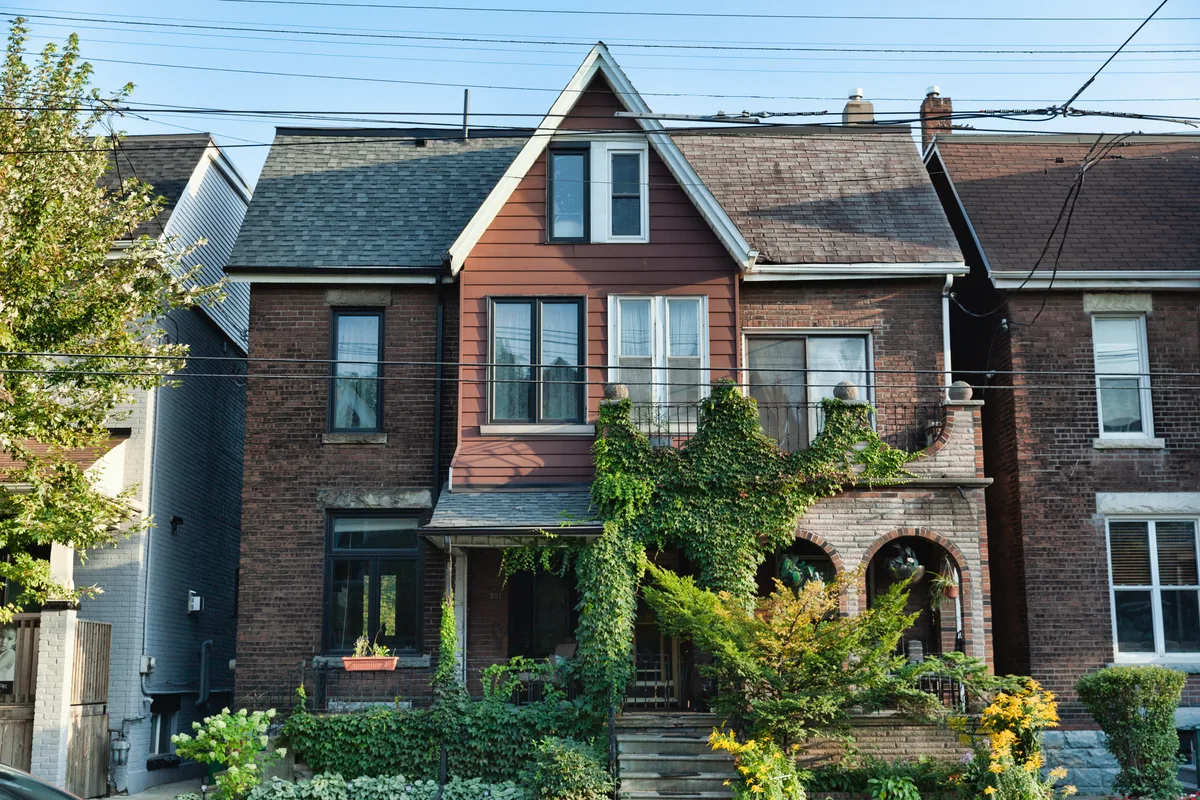
AC & heat pump placement for Toronto semi-detached homes usually ends up at the back of the house, within 2.0 metres of the rear wall, because that is where the City's zoning bylaw and a narrow lot agree. A ground-mounted unit in the side yard can sit no closer to the side lot line than 0.9 metres or the lot's required side yard setback, whichever is less, and the noise bylaw limits what reaches a neighbour's outdoor living area to 50 dB(A) by day and 45 dB(A) from 11 p.m. to 7 a.m. On a west-end semi with one open side and a walkway about a metre wide, that means a slim side-discharge unit behind the house, or on a low wall bracket, with the line set run along the open side.
Where Toronto Zoning Lets the Outdoor Unit Sit on a Semi
Toronto's Zoning By-law 569-2013 treats a condenser or heat pump as a heating or air-conditioning device and sets a different rule for each yard. A semi has only three exposed walls, since the fourth is the party wall shared with the house next door, so the options narrow quickly. The provisions below are what the residential chapter of the bylaw said when we read it on October 1, 2026.
- Rear yard: a ground-mounted unit may be no more than 2.0 metres from the rear main wall of the house. This is the default spot on most semis.
- Side yard: a ground-mounted unit may be no closer to the side lot line than the lesser of 0.9 metres or the required minimum side yard setback for the house on that lot.
- Front yard: allowed only if the unit is at least 6.0 metres from the front lot line, which rules it out on most pre-war streets where the porch is a few steps from the sidewalk.
- Wall-mounted: an air conditioner on the building may project up to 0.9 metres into the required rear yard setback, or into the side yard setback if it is not above the first storey, and must stay at least 0.3 metres from any lot line.
Older lots also carry site-specific exceptions, so the bylaw text is the starting point, not the last word. If the only workable spot breaks one of these rules, the route is a minor variance through the Committee of Adjustment, and redesigning the install is usually the faster fix. Our general guide to AC unit placement rules and setbacks in Ontario covers how other municipalities handle the same question.
What Toronto's Noise Bylaw Allows at the Neighbour's Property
Toronto's noise bylaw (Municipal Code Chapter 591) covers residential air conditioners and heat pumps as stationary sources, and it measures the sound where the neighbour is, not at your unit. The City's published limits are 50 dB(A) from 7 a.m. to 11 p.m. and 45 dB(A) from 11 p.m. to 7 a.m. in an outdoor living area, and 45 dB(A) by day and 40 dB(A) overnight inside the neighbour's home, averaged over an hour.
The overnight number matters more for a heat pump than for an air conditioner. An air conditioner mostly runs on hot afternoons; a heat pump runs through January nights, when the 45 dB(A) limit applies and the bedroom windows of the attached house are only a few metres away. Compare the sound rating on the quote to that limit, ask for an inverter model that runs at low speed most of the time, and keep the fan discharge pointed away from the neighbour's windows and patio.
Why a Slim Side-Discharge Unit Suits a Narrow Side Yard
A side-discharge unit is the shape that fits a semi. It is a shallow cabinet, roughly 35 to 40 cm deep, that draws air through the back and blows it out the front, where a top-discharge cube is usually 75 cm or more on each side and needs open sky above it. Set parallel to the wall, a side-discharge unit leaves the walkway passable for bins, bikes and the meter reader.
The catch is airflow. The unit needs the manufacturer's clearance behind it for intake and open space in front for discharge, and if it blows straight at a fence or the neighbour's wall a short distance away, the air recirculates and capacity drops. In a passage that tight we turn the unit to blow down the length of the walkway or move it to the rear. The side-discharge vs top-discharge comparison goes through the equipment trade-offs.
Wall Brackets, Stands and the Shared Party Wall
Lift the unit off the ground when the ground is the problem: a sloped walkway, a basement window well, or a heat pump that has to stay above the snow. A heat pump defrosts in winter and sheds meltwater, so it needs a stand that keeps the coil clear of drifts and a place for that water to go that is not the shared walkway, where it refreezes into a sheet of ice.
Brackets come with a cost in a semi. Double-brick walls carry compressor vibration into the structure, and the structure is shared with the neighbour. We bolt brackets into solid masonry with rubber isolators, keep them at first-storey height, which is also what the zoning encroachment rule asks for in a side yard, and choose a ground stand on a level pad whenever there is room. Nothing mounts on the party wall side, so the line set, drain and wiring all run to the rear or the open side of the house.
Furnace and Water Heater Vents Compete for the Same Wall
Free quotes, written pricing.
On a semi the open side wall is also where a high-efficiency furnace and a power-vent water heater exhaust, and the gas code decides where those pipes can end before the condenser gets a spot. CSA B149.1 sets minimum clearances for a sidewall vent termination, and they apply to openings in any building, the neighbour's included.
- At least 12 inches (30 cm) from a window or door that opens, for an appliance up to 100,000 BTU/h; 3 feet (91 cm) for a larger one.
- At least 6 feet (1.8 m) from a mechanical air supply inlet, such as an HRV intake.
- Not directly above a paved walkway or driveway that sits between two houses and serves both, which describes many shared west-end passages.
- At least 12 inches (30 cm) above grade, and above the snow line in practice.
- Clear of the gas meter's regulator. The meter also needs about a metre of separation from an ignition source such as a condenser's electrical disconnect, so its location can rule out a spot too.
The furnace manufacturer's installation manual can be stricter than the code, and the stricter one wins. Keep the condenser out of the exhaust plume as well: furnace exhaust is wet and mildly acidic, it corrodes an aluminum coil over time, and on a heat pump it freezes onto the coil in winter. A vent that sags, has been knocked loose or ends too close to a window gets repaired before any new outdoor unit goes in.
No Ducts? Where Mini-Split Heads and Line Sets Go
Many pre-war semis in the Junction, Roncesvalles, Parkdale and around High Park are heated by a boiler and radiators, so there are no ducts for central air. A ductless heat pump is the usual answer: one outdoor unit at the rear, with the line set running up the back wall or the open side in a painted cover to a head on each floor. A ductless mini-split also needs a condensate drain from every head, and a head hung on the party wall needs a small pump, because there is no outside wall behind it to drain through.
Where the house does have ducts, the furnace often sits mid-basement or against the party wall, and the refrigerant lines have to cross a finished ceiling to reach the back. Line length and the route through the joists are the main reasons two semis on the same street get different quotes.
What Placement Adds to the Price
Placement changes the labour, not the equipment band. Central air on existing ducts runs $3,500–$7,500 installed, a single-zone ductless system $4,000–$7,000, and a ducted cold-climate heat pump $6,000–$16,000 before rebates. Within those bands, a semi lands higher when the job needs any of the following.
- A long line set from a mid-basement furnace to the rear yard, or up two storeys to a third-floor head
- A wall bracket or snow stand with vibration isolators in place of a simple ground pad
- A condensate pump for a head or coil with no gravity drain
- A new exterior electrical disconnect and circuit, which needs an ESA notification
- Moving a vent termination or an existing condenser that sits in the wrong place
We put each of those on the written quote as its own line, so you can see what the lot is costing you. The pricing page lists the base bands.
Verdict: The Placement That Works on Most West-End Semis
Put the unit at the rear, within 2.0 metres of the back wall, on a stand, with a side-discharge cabinet blowing into your own yard. That placement meets the zoning rule without measuring a side setback, keeps the fan farthest from both neighbours' bedroom windows, and leaves the side passage free for the furnace and water heater vents that have to be there.
- Choose the side yard only if the walkway is wide enough to keep the unit 0.9 metres from the lot line, or the lot's required setback if that is less, and still leave the airflow clearances.
- Choose a wall bracket when the ground slopes, floods or sits over a window well, and keep it at first-storey height.
- Choose a heat pump only with a sound rating you have checked against the 45 dB(A) overnight limit and a plan for the defrost water.
- Rule out the front yard unless the house sits 6.0 metres or more back from the front lot line.
ZK Mechanical installs central air, heat pumps and ductless systems on Toronto's west side and in Etobicoke, and we measure the yard, the vents and the meter before we quote. See air conditioner installation for what is included, or book a site visit and written quote.
Frequently asked questions
Do I need my neighbour's permission to put an AC beside a shared walkway?
The zoning bylaw does not ask for a neighbour's signature, but the unit has to sit on your side of the lot line, meet the setback, and stay under the noise limit measured on their property. Some west-end semis also have a registered right-of-way over the shared passage, and nothing can block it. Check your survey, then tell the neighbour before installation day; it prevents most complaints.
Can the outdoor unit go on a flat roof or a rear addition roof?
It can, but we rarely recommend it on a semi. A roof-mounted unit puts vibration into joists that bedrooms sit on, needs safe access for every future repair, and makes the refrigerant lines and drain longer. The roof also has to carry the weight and stay watertight around the supports. Ground or low wall mounting at the rear is cheaper to install and to service.
How loud is 45 dB(A) in practice?
About as loud as a refrigerator humming in a quiet room. Manufacturers publish sound ratings measured close to the unit, and sound fades with distance but bounces between two brick walls in a narrow passage. A unit rated in the mid-50s at full speed can still meet 45 dB(A) at a neighbour's patio if it sits at the rear, faces your own yard and runs at low inverter speed overnight.
Will a heat pump work in a semi with radiators and no ducts?
Yes, as a ductless system. One outdoor unit at the rear feeds a head on each floor, and the boiler stays as backup for the coldest nights. Two zones typically run $7,500–$11,000 installed and three to four zones $10,000–$16,000+, depending on line set length and how the lines reach each floor. The heads also give you air conditioning the radiators never could.