
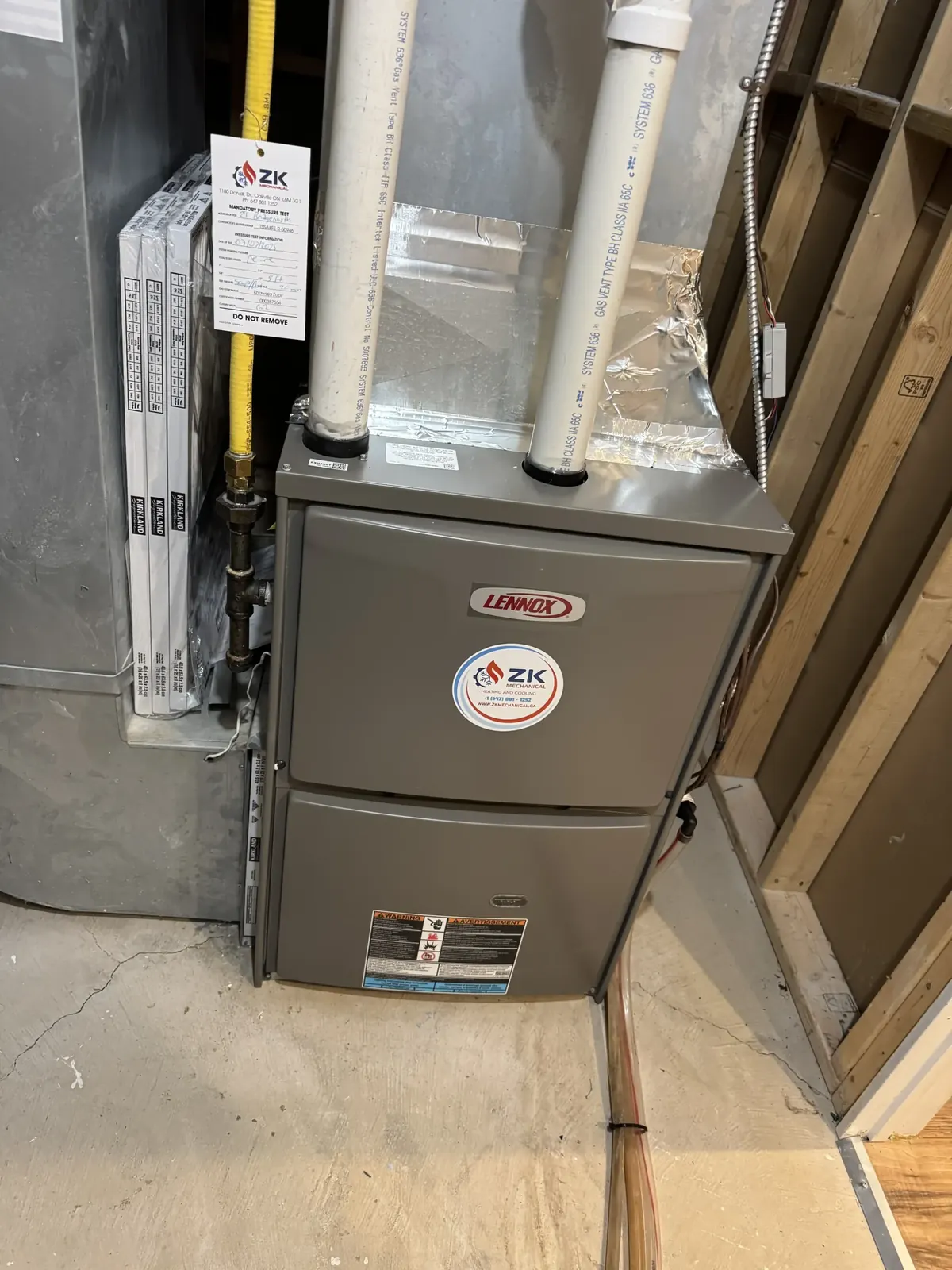
Furnace venting types reduce to three families: an old natural-draft furnace drifting its exhaust up a chimney, a mid-efficiency induced-draft furnace pushing into metal B-vent or a lined chimney, and a condensing furnace venting through certified plastic pipe out a sidewall or up through the roof. Every furnace a licensed contractor can install in Ontario today is the third kind, and it runs either as a direct vent with two pipes — one exhaust, one combustion-air intake — or as a single-pipe install that takes its air from the room. Which one your house ends up with is decided by where the furnace sits, what the outside wall looks like, and what else is still using the chimney.
The Three Vent Categories in Plain Terms
- Natural draft, no fan (Category I): the pilot-light furnaces of the 1970s and early 1980s. Hot flue gas rises on its own through a draft hood into B-vent or masonry. Very few remain in service, and any that do are living on borrowed time.
- Induced draft, non-condensing (still Category I): the 78 to 82 percent furnaces built from roughly 1987 to 2009. A small inducer fan pulls the exhaust through a single heat exchanger, but the gas is still hot and still leaves through B-vent or a lined chimney.
- Condensing (Category IV): everything sold new. A second heat exchanger strips so much heat out of the exhaust that water condenses from it. The gas leaves at roughly 40 to 55°C, under positive pressure and mildly acidic — too cool and too corrosive for metal vent or masonry, so it goes out in plastic, and the condensate goes down a drain.
Direct Vent Versus Single-Pipe: Why We Default to Two Pipes
Direct vent means the furnace draws combustion air from outdoors through a second pipe and is sealed from the room it sits in. Single-pipe, sometimes called non-direct vent, exhausts outside but pulls its air from the basement — which means it is competing with your dryer, your range hood, your bathroom fans and anything else moving air out of the house.
- Two pipes when the furnace is in a closet, a small utility room or under the stairs, where there is not enough room volume to feed it.
- Two pipes in a tight new build, or an older house that has been air-sealed and insulated properly.
- Two pipes wherever a worst-case depressurisation test is marginal, or where a wood fireplace shares the house.
- Two pipes in a Waterdown or Alton Village build with an HRV, because pulling combustion air from indoors works against the ventilation system you paid for.
- Single pipe is acceptable in a large, leaky basement with plenty of makeup air, and it is cheaper. It is not what we quote unless the two-pipe route is genuinely impossible.
Vent Material: ULC S636 Is the Line Between Legal and Not
In Canada, the plastic venting on a condensing furnace has to be certified to ULC S636, the standard for Type BH venting systems. That is a system certification, not a pipe certification: the pipe, the fittings, the primer and the cement are approved together, and the pipe carries the S636 marking printed along its length so an inspector can read it without a flashlight.
Certified systems come as PVC, CPVC or polypropylene, and polypropylene uses gasketed push-fit joints rather than solvent cement. What is not acceptable is ordinary hardware-store drain pipe, which is made for waste water at room temperature and is the most common thing we find on an unlicensed install. If you are reviewing a quote, ask which certified vent system is being used and confirm it appears on the invoice.
Sidewall Termination: The Clearances That Decide Where the Hole Goes
The wall penetration is not a free choice — the gas code and the manufacturer both constrain it, and the stricter of the two wins. These are the constraints that shape most Halton and Hamilton installs.
Free quotes, written pricing.
- At least 300 mm (12 inches) above grade, and above the snow that actually accumulates there. A buried terminal starves the burner and trips the pressure switch, which is why a January thaw and a plough windrow produce so many no-heat calls — see what to do if the furnace vent is blocked by snow.
- Clear of openable windows and doors. The gas code sets the separation by the appliance's input rating, and manufacturers routinely ask for more than the code minimum, so have the installer state the figure they are building to.
- At least 1 m (3 feet) above any forced-air inlet within 3 m (10 feet), so the exhaust cannot be drawn straight back into a fresh-air intake or an HRV port.
- Clear of the gas meter and its regulator vent, and clear of the neighbour's intake — a genuine constraint on the narrow lots in Kerr Village, Bronte and Westdale where the side yard is two or three metres wide.
- Not under a deck, a soffit vent or into a window well, where the plume collects instead of dispersing.
- Intake below exhaust, spaced by the manufacturer's dimension, so the furnace is not breathing its own flue gas.
Concentric Kits and Roof Terminations
When the side yard is too tight for two terminals, a concentric vent kit solves it: the exhaust runs inside a larger intake pipe and both terminate through one hole, with the separation between them fixed at the factory. It is the usual answer on narrow pre-war lots, on townhouse end walls, and any time you would rather make one neat penetration in a brick wall than two.
Where there is no usable outside wall at all — an interior utility closet in a stacked townhouse, or a basement where every wall is blocked by a deck, a window well or the meter — the vent goes up vertically through the roof, with its own clearances to the roof surface and to any nearby roof vent. An abandoned masonry chimney can sometimes be used as a chase to carry certified vent pipe up to the roof, but the flue itself is never the vent.
Length, Elbows and Slope: Why a Two-Year-Old Furnace Locks Out
Every condensing furnace publishes a maximum equivalent vent length for each pipe diameter and firing rate, and every elbow eats into it as though it were several feet of straight pipe. Run past that allowance and the pressure switch will refuse to make, most often on the coldest morning when the air is densest.
The other detail installers get wrong is slope. The exhaust must fall back toward the furnace — about a quarter inch per foot — so condensate drains to the trap rather than pooling in a sag between joists. A gurgling vent and intermittent lockouts on a nearly new furnace usually trace to a sagging horizontal run or a low spot at a change of direction. Our answer on furnace pressure switch failures covers how that presents on a service call.
Verdict: Which Venting Your House Will End Up With
- Two-pipe direct vent through a sidewall: the default for most replacements in Burlington, Oakville and Hamilton. Choose it unless the wall genuinely cannot be used.
- Concentric kit: narrow side yards, tight lot lines, or where a single tidy penetration matters more than the cost of the kit.
- Vertical through the roof: interior closets, stacked townhouses, and basements where the deck, the window wells and the meter have taken every wall.
- B-vent into a lined chimney: not for the furnace any more, but for whatever is left behind on the chimney — usually an atmospheric water heater. That is its own decision, covered in do you need a chimney liner when replacing a furnace.
Every quote we write names the vent route, the certified pipe system and the terminal location before anyone drills a wall, because that is where replacement prices in older houses move. Have a look at our furnace installation service or ask for a written venting plan with your quote.
Frequently asked questions
Can a high-efficiency furnace vent into my old chimney?
Not into the flue itself. Condensing exhaust is cool, wet and acidic, and a masonry flue will deteriorate quickly if you push it there. What is sometimes done is using an abandoned chimney as a chase — a hollow route to carry certified plastic vent pipe up to a roof termination when no sidewall is available. That is a design decision for the installer, not a shortcut.
Is one pipe or two pipes better for a furnace?
Two, in almost every case. Sealed combustion means the furnace is not fighting your dryer and range hood for air, it is not pulling dusty basement air through the burners, and it does not depressurise the room around it. One pipe costs less and is acceptable in a big leaky basement, but it is the option we quote around rather than toward.
Why does my furnace vent drip and form icicles outside?
Condensing exhaust carries a lot of water vapour, and in cold weather some of it condenses at the terminal and freezes on the wall below. A little staining and a light icicle is normal. A growing ice mass that reaches the terminal is not — it can block the vent and shut the furnace down, and it usually means the terminal is too low, too close to the wall, or angled wrongly.
Can the furnace exhaust terminate under my deck?
No. A deck traps the plume underneath it instead of letting it disperse, which risks re-entry into the house and, in cold weather, a slick of ice on the boards. The same logic rules out window wells, soffit vents and tight corners between two walls. If the only convenient wall is under a deck, the honest options are a longer run to a different wall or a roof termination.
Does new furnace venting need a permit and an inspection?
The gas work itself must be done by a TSSA-licensed technician working for a registered contractor, and that is not optional anywhere in Ontario. Whether a municipal permit is also required varies by municipality and by what the job includes — our [Burlington HVAC permits guide](/blog/hvac-permits-burlington) explains how it works locally and who is supposed to pull it.