
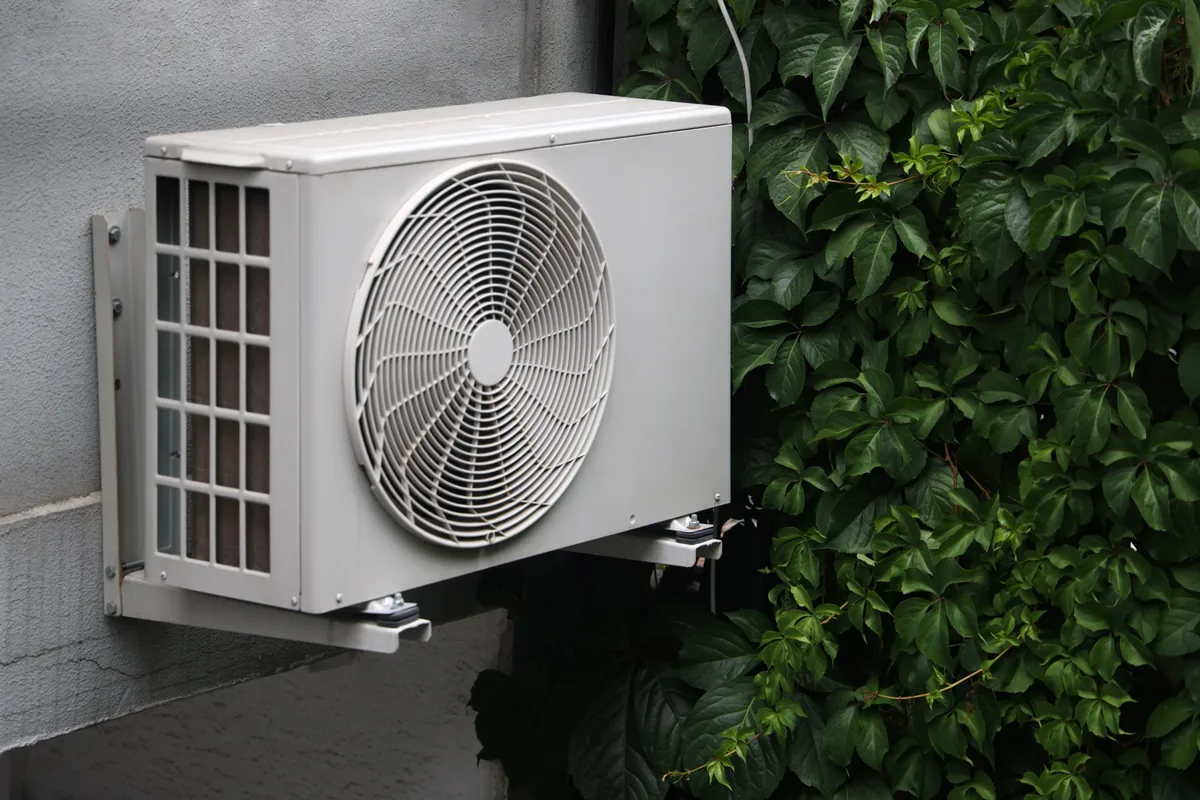
The heat pump defrost cycle is why your unit steams and stops, and it alarms almost every homeowner in their first winter. In heating mode the outdoor coil has to run colder than the outdoor air to pull heat out of it, so moisture freezes onto the fins. Every so often the unit briefly runs itself backwards to send hot gas out to that coil and melt the ice off, which is what produces the plume of vapour and the short pause in warm air indoors. It is a designed behaviour, and along the Halton lakeshore you will see it most in the damp weather between roughly -2°C and +5°C.
What Happens in Those Few Minutes
- The control decides frost has built up. Older units defrost on a timer combined with a coil temperature reading; current cold-climate units use demand defrost, comparing coil temperature against outdoor temperature so they only defrost when frost is actually there.
- The reversing valve switches. You will often hear a solid thunk or a long whoosh as the high and low sides swap and pressures equalise.
- The outdoor fan stops. Nothing is blowing cold air across the coil now, so the hot refrigerant can do its work — and the melt water flashing off a warm coil is what you see as steam.
- Indoors the picture flips: your indoor coil is now the cold one. So either the indoor fan stops, or backup heat is energised to temper the air. That is why aux, em or backup heat flashes onto the thermostat for a few minutes.
- The cycle ends when the coil sensor reports the ice is gone, or on a maximum time limit if it never gets there. The valve switches back, the fan restarts, and heating resumes.
Why Lake Ontario Gives Us More Defrosts Than Deep Cold Does
Frost needs two things at once: a coil below freezing and moisture in the air. Cold, dry air holds very little water, so a still week at -15°C often produces fewer and shorter defrost cycles than a damp week hovering near zero.
That matters here because the lakeshore strip — Aldershot, downtown Burlington, Bronte, Old Oakville — spends a large share of the winter within a few degrees of freezing with humid air moving off open water, and freezing drizzle and wet snow load a coil quickly. Up the escarpment in Waterdown and on the Hamilton Mountain the air runs colder and drier, though squall days bring their own loading. Expect several defrosts in a wet thaw and almost none in a dry cold snap.
Normal Defrost Behaviour
- A plume of vapour off the outdoor unit for a few minutes, sometimes visible from the street.
- A thunk or whoosh at the start and end of the cycle.
- Water running out of the base of the unit and soaking into the gravel underneath.
- A pause in warm air at the registers, and backup heat showing briefly on the thermostat.
- A light coat of frost on the coil face between cycles — that is the unit working, not failing.
- Cycles spaced anything from half an hour to a couple of hours apart in wet weather near freezing.
Signs It Is Not Defrost — It Is an Icing Problem
- The coil is encased in solid clear ice rather than white frost, or the whole cabinet is glazed.
- Ice is building on the top panel and around the fan grille. That is almost always water dripping from a roof edge, a valley or a leaking gutter above, not the defrost cycle.
- A slab of ice under the unit grows week after week because meltwater has nowhere to go and refreezes.
- Defrost fires every 15 or 20 minutes, or a cycle starts and never terminates.
- Backup heat is on for hours rather than minutes, and the electricity bill shows it.
- Only the bottom third of the coil is iced, which usually points at drainage rather than at the refrigeration circuit.
If any of those describe your unit, treat it as a service call rather than a curiosity. Our page on why a heat pump ices up walks through the causes, which range from a failed coil sensor or reversing valve to low charge and a blocked drainage bed.
Drainage: Where Most Ontario Defrost Trouble Actually Starts
Free quotes, written pricing.
Every defrost turns frost into several litres of water, and that water has to leave. This is the single biggest difference between mounting an air conditioner and mounting a heat pump, and it is where corner-cutting shows up in the second winter.
- The unit sits on a raised stand or wall brackets, with the base clear of the snow line — around here we want at least 30 to 45 cm above grade, higher on the Mountain and on rural concessions.
- There is a gravel or drainage bed underneath, never a dished patio slab that ponds and freezes.
- The base pan heater the manufacturer supplies is fitted and wired, not left in the box.
- The unit is not under a dripping eaves, a roof valley or an unguttered edge.
- Nobody is piling driveway snow against it, and the clearances in the manual are respected — typically about 30 cm at the sides and considerably more on the service side.
Raising the unit on a stand above the expected snow line is standard practice on the installs we do here.
What Not to Do When You See Ice
Do not chip at it. A screwdriver or an ice scraper will fold the aluminium fins, and the coil, the sensor and the refrigerant tubing sit millimetres behind them — a puncture turns a nuisance into a compressor-level repair. Do not pour boiling water over the coil either; it refreezes lower down and the thermal shock helps nobody.
What you can safely do is brush snow off the top and sides by hand or with a soft broom, clear a path so meltwater can run away from the unit, and shut the system down at the disconnect if the coil is solidly encased. Resist the urge to leave the thermostat on emergency heat as a habit: that locks the compressor out and hands the entire load to electric elements or the furnace.
Settings That Make Defrost Cost Less
Two thermostat habits carry over from furnaces and cost money on a heat pump. The first is a deep overnight setback, because recovery in the morning calls on backup heat, which is the expensive way to make up the difference — heat pump thermostat settings explains why small setbacks or none at all usually win.
The second is switching to emergency heat the moment it gets cold. Cold-climate units are rated to keep producing useful heat well below the temperatures most people assume, and the temperature at which a heat pump stops working is lower than the number in most kitchen-table conversations. On a dual-fuel system, the balance point setting decides when the furnace takes over, and a backup that runs for hours instead of minutes usually means that setting or the staging is wrong, not the equipment.
Verdict: When to Watch and When to Call
- Watch and do nothing: steam, a whoosh, a few minutes of pause, water draining away, a light frost coat between cycles.
- Clear it yourself: snow drifted or piled against the unit, leaves in the coil, a plough windrow across the drainage bed.
- Call: solid ice on the coil, ice growing on the top panel or fan grille, defrosts under 20 minutes apart, a cycle that never ends, or backup heat running for hours.
- Call urgently in any weather: breaker tripping, a loud metallic sound from the fan hitting ice, or refrigerant oil staining on the base.
We service heat pumps across Burlington, Oakville and Hamilton, and the first winter is when most of the setup gets corrected — sensor location, balance point, drainage. If yours is behaving strangely, our heat pump repair team can look at it, or you can book a visit and we will bring the defrost history off the control board.
Frequently asked questions
How long does a heat pump defrost cycle last?
Usually a few minutes — long enough to clear the coil and no longer, because defrosting costs the system heat it would rather deliver to your house. A cycle that regularly runs to its maximum time limit, or one that repeats every 15 or 20 minutes, points at a sensor, a charge issue or a coil that is not draining, and is worth a service call.
Why is my heat pump steaming? Is something burning?
It is water vapour, not smoke. During defrost the outdoor coil is hot while the surrounding air is near freezing, so the melt flashes off as visible steam and the stopped fan lets it rise in a plume. It clears the moment the cycle ends. Smoke smells; steam does not, and if you can smell anything electrical or acrid, shut the system off at the disconnect and call.
Is it normal for backup heat to come on during defrost?
Yes. While the unit is defrosting, the indoor coil is absorbing heat rather than releasing it, so the control brings on electric elements or the furnace to keep the supply air from turning cold. A few minutes at a time is by design. Hours at a time is not, and usually means the balance point, the aux lockout or the staging needs setting.
Does frequent defrosting mean my heat pump is undersized?
Not by itself. Defrost frequency tracks humidity and temperature far more closely than it tracks sizing, which is why damp weather near zero produces the most cycles. Undersizing shows up differently: the house drifting below setpoint on cold days and backup heat carrying the load for long stretches. Those are worth investigating; a busy defrost schedule in a thaw is not.