
Quick answer
Turn the furnace off at its service switch, then clear snow and ice away from both plastic vent pipes by hand or with a soft broom until roughly a metre of open space surrounds each opening. Never chip at frozen pipe with a shovel or any metal tool. Restart the furnace and watch a full cycle. If it fails again, the vent needs re-terminating, not more shovelling.
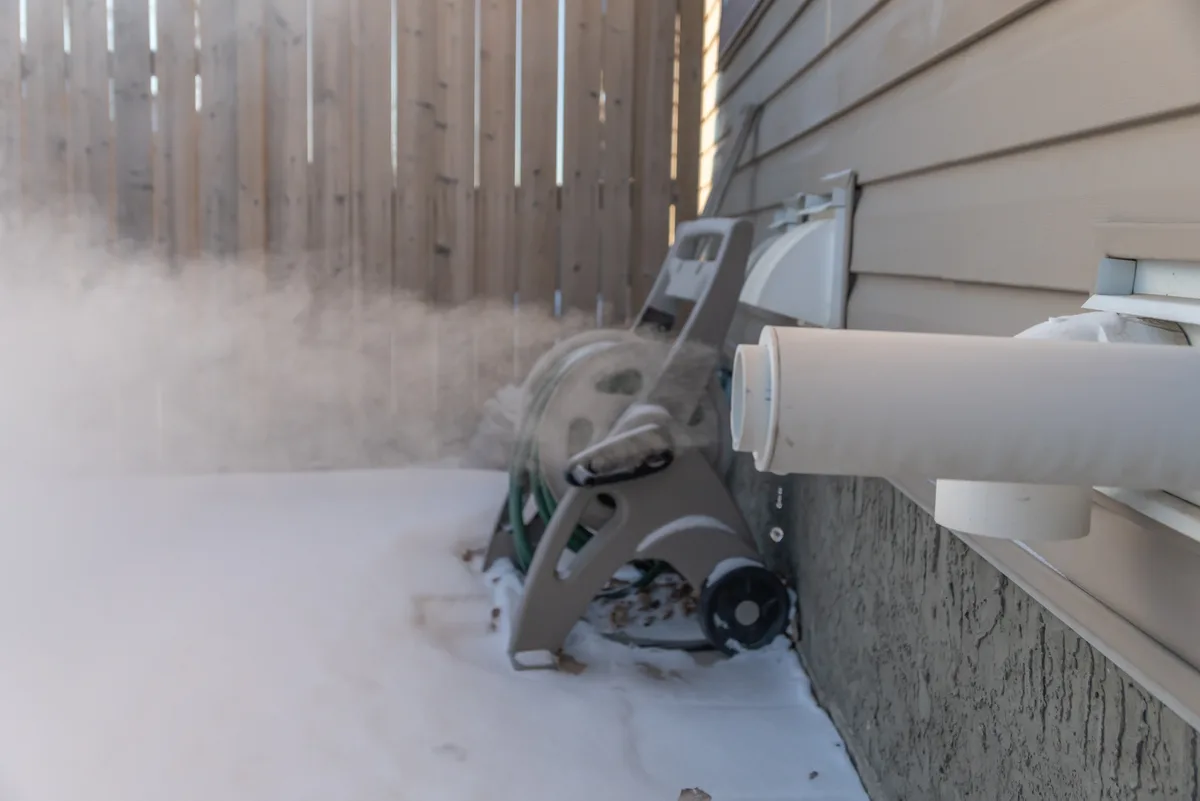
A snow-blocked furnace vent is a winter emergency in slow motion, and the fix itself takes about five minutes. On a high-efficiency furnace, two white plastic pipes come through an exterior wall: one draws in combustion air, the other pushes out exhaust. Both have to stay clear. If either is buried, the furnace either shuts down safely or, on older equipment, does something considerably worse.
How to clear a snow-blocked furnace vent, in order
- Switch the furnace off at the service switch beside it before going outside, so it cannot attempt to fire while you are working at the terminations.
- Dig by hand, or with a soft brush or broom. Plastic vent pipe is brittle at −15°C and a shovel edge cracks it, turning a free fix into a repair.
- Clear both pipes, not only the one that looks buried, and open out roughly a metre in every direction so drifting does not refill it within the hour.
- Check the openings for a plug of ice. Exhaust from a condensing furnace is wet and can build a collar of ice on the pipe end and on the wall beneath it. Warm water poured slowly frees it; nothing sharp goes near it.
- Look at the dryer vent and the water heater termination while you are out there — they usually sit within a metre or two on the same wall.
- Restart the furnace and watch one full cycle, from ignition through to the blower shutting off.
Why a blocked vent shuts the furnace down
A blocked intake or exhaust stops the draft inducer from producing the vacuum the pressure switch needs, and without that proof the board never opens the gas valve. That is the system behaving correctly. You will see a pressure switch code on the status light, and it is the same code a plugged condensate trap produces — why a pressure switch keeps failing explains how the two get told apart.
The dangerous case is the older mid-efficiency furnace vented into a masonry chimney instead of out through a wall. Those have no sealed intake and a much shorter safety chain, and a chimney capped with ice or fouled by a collapsing liner can spill combustion products indoors. If that describes your setup, do not run it: read whether a furnace can run with a blocked exhaust, and treat a sounding CO alarm as an evacuation rather than a nuisance.
How the vent ended up in the snow
The gas code sets a minimum height for a sidewall termination above grade or the anticipated snow line — commonly measured as 12 inches, with the exact clearance depending on the appliance and the installation. The failure mode is that the word anticipated gets interpreted generously on a mild October afternoon. Add a plough throwing driveway snow at the wall, a roofline dumping melt on the same spot, and a north or west elevation catching wind-driven drift, and 12 inches disappears in one storm.
Geography matters more here than people expect. Lakeside Burlington and Oakville — Bronte, Aldershot, Old Oakville — often take rain and slush from a system that drops accumulating snow on the higher ground west of the escarpment brow in Waterdown, Ancaster and up on the Mountain. A termination height that has never caused trouble in Kerr Village can be an annual event on a Binbrook side road.
Signs the vent was blocked before you looked
- The furnace runs for well under a minute, stops, and repeats that a few times before falling silent.
- A flashing pressure switch code on the control board — reading the status light shows how to count it.
- Frost or a white rime on the wall below the terminations.
- A whistling or fluttering noise from the furnace cabinet as the inducer fights a restriction.
- Water on the floor near the furnace, because exhaust condensate that cannot leave the pipe drains back the way it came.
Stopping it from happening again
The permanent fixes are all straightforward: extend the terminations higher up the wall, relocate them off the plough line or out from under a roof valley, or reconfigure the pipe ends so they stand clear of the drift. That is a modest job when it is planned work rather than something attempted at two in the morning. Put a driveway marker or a garden stake beside the pipes in November so whoever clears the walk can see where they are.
A fall tune-up is the sensible moment to have the terminations assessed, since the technician is already on site: a $120–$250 tune-up includes a look at the venting along with the burners and safeties.
If both pipes are clear and the furnace still will not stay lit, something else sits in the draft path and it needs a gauge, not another shovel. ZK Mechanical runs no-heat calls across Burlington, Oakville, Hamilton and the wider region at any hour, with no overtime surcharge attached. Call (647) 801-1252 for emergency service, book furnace repair in Burlington, or message us here.