
Quick answer
No. A blocked exhaust sends combustion gases back into the house instead of outdoors, and on an older natural-draft furnace nothing stops that from happening. Shut the furnace off at its service switch, clear the outdoor termination only if you can reach it safely from the ground, and have a licensed technician check the vent and the pressure switch before it runs again.
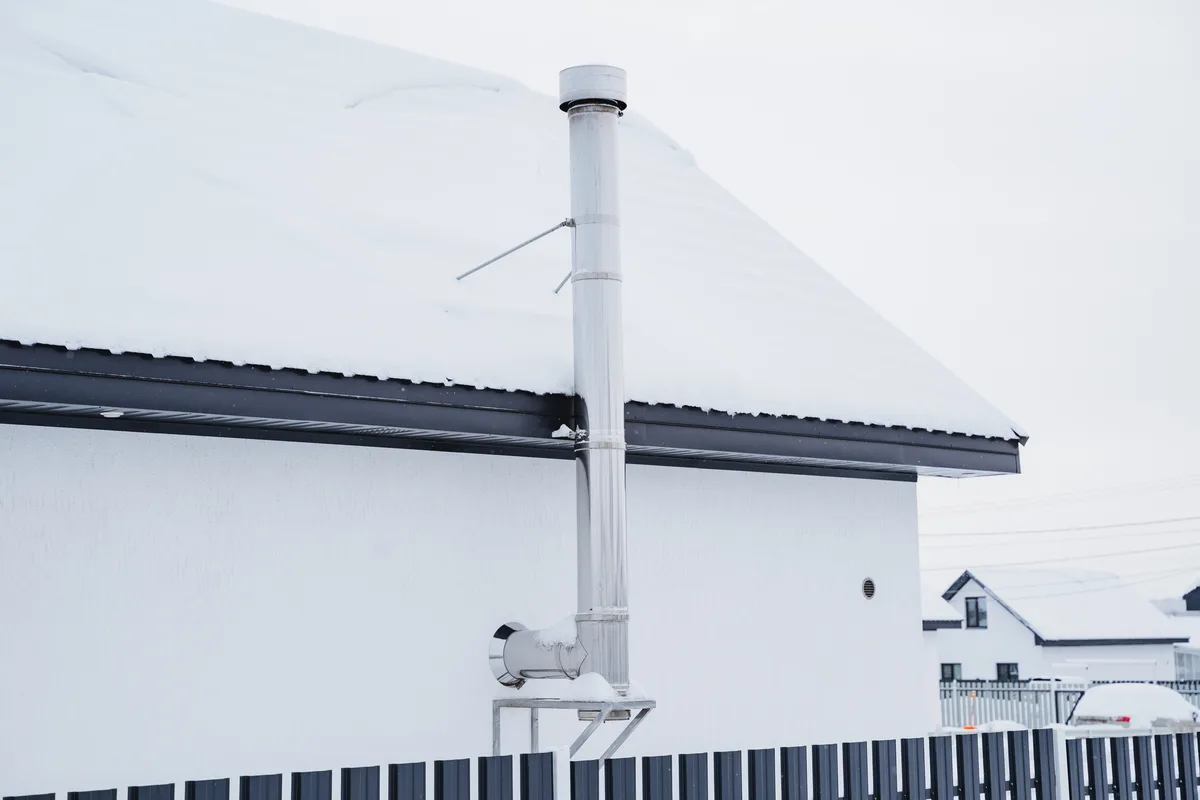
You cannot safely run your furnace with a blocked exhaust. The vent is how the products of combustion leave the building, and when it is obstructed those gases have two options: back down into the mechanical room, or nowhere at all, in which case the burner is starving and combustion goes bad. A modern furnace will usually refuse to start. An older one may keep firing and spill quietly for hours. Shut it off at the service switch and get eyes on the vent.
What a modern furnace does when the vent blocks
A high-efficiency condensing furnace — the kind with two white PVC pipes through the side wall — has an inducer fan and a pressure switch. The switch senses the draught the inducer creates through a small rubber hose. Block the exhaust or the intake and the switch never closes, so the control board refuses to open the gas valve and locks out. Most boards flash a dedicated code for it, and the legend is printed on the label inside the blower door; what a flashing furnace light means explains how to read yours. That lockout is the safety system working exactly as designed.
Mid-efficiency and older natural-draft furnaces are the ones that worry us. They vent through a metal B-vent or a masonry chimney and depend on hot gas rising on its own. There is no pressure switch standing between the burner and a blocked flue, so if the chimney is stopped by a nest, a fallen liner or an ice plug, exhaust rolls out of the draught hood into the room. Plenty of houses in older Hamilton and in Burlington's post-war streets still run this arrangement, often with the water heater sharing the flue.
Never bypass the switch to get heat back
This is the shortcut we ask people not to take. Jumping the pressure switch terminals, taping the hose so the switch stays made, or fitting a switch of a different rating removes the only thing standing between a restricted vent and a house full of exhaust. When a switch keeps opening it is usually reporting something real: condensate standing in a sagging exhaust run, an ice ring at the termination, a plugged trap, or an inducer losing speed. Our page on a pressure switch that keeps failing walks through the causes in order.
What actually blocks a vent around here
- Drifted snow against a side-wall termination on the north or west face. Squalls coming off Lake Ontario can bury a pipe set low to the ground in one afternoon — details in what to do if the vent is blocked by snow.
- Ice the furnace made itself. Condensing exhaust is full of water vapour, and through a long cold snap it can build a collar of ice at the pipe mouth. Installers here set terminations well clear of expected snow depth for that reason.
- Nests. Starlings and wasps find a warm three-inch pipe or an open chimney irresistible in spring, and a mid-efficiency chimney without a rain cap is an open invitation.
- Dryer lint. Where the dryer vent terminates near the furnace intake, lint mats across the intake screen — an easy thing to check from the yard.
- Renovation debris and landscaping. New builds sometimes leave shipping plugs or construction plastic nearby, and a deck, hedge or window well added later can bury a termination that was clear on install day.
- A collapsed clay liner or crumbling mortar in a pre-war chimney, which drops debris down onto the flue.
The orphaned water heater problem
One blockage risk belongs specifically to partly upgraded houses. When a mid-efficiency furnace is replaced with a condensing model, the furnace comes off the chimney and vents out the wall, leaving the gas water heater alone on a flue that was sized for two appliances. An oversized, cold chimney draws poorly, and that water heater can spill exhaust into the basement — worse in a tight house with a powerful range hood running. The fix is a correctly sized liner or a change to the water heater's venting, and it should have been part of the furnace quote. If your furnace was upgraded and nothing was done to the chimney, have it looked at.
Questions homeowners ask about blocked venting
- Can I clear it myself? If you can see the termination from the ground and the obstruction is snow or leaves, yes — clear a generous space around both pipes by hand. Do not set a ladder on ice, and do not push anything up a chimney.
- It ran a few minutes and then quit. Is that the vent? It can be. A short run followed by a lockout is classic for a restriction that only builds enough back pressure once the inducer is up to speed.
- Should I check the CO alarms too? Yes. Anything vent-related deserves working alarms on every level, and if one sounds, leave and call 911 from outside.
- Is a blocked intake as serious? It is a different failure with the same phone call. A starved intake produces poor combustion and soot; on a two-pipe system the pressure switch normally catches it.
- How often should venting be inspected? Once a year at the tune-up, plus a quick look after any big storm and after roofing, siding or deck work.
A vent problem is a combustion problem, and combustion problems are what our licensed technicians are trained and equipped to measure rather than guess at. If your furnace is locking out, spilling, or you cannot find where the exhaust terminates, book it as a safety call — furnace repair and service throughout Burlington, Oakville, Hamilton and the wider GTA, or tell us what it is doing.