
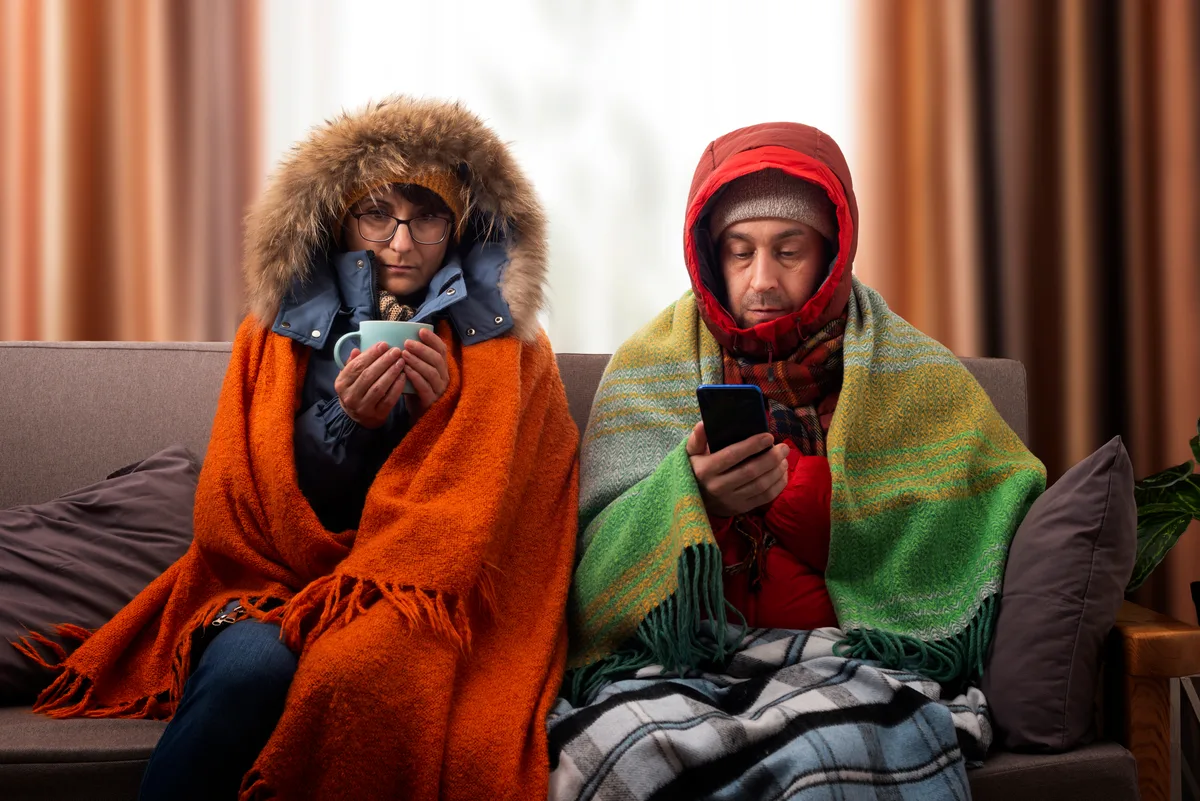
Quick answer
Put heat and moving air where the plumbing actually runs, keep a thin trickle flowing at the most exposed tap, and open the cabinet doors under sinks on outside walls. Close the garage door and any crawl-space vents. If the house will be cold for more than about a day, shut the water off at the main and drain the lines.
To keep pipes from freezing if your furnace fails, aim the effort at the plumbing rather than at the room you are sitting in, keep water moving through the most exposed line, and set yourself a deadline for winterizing. Pipes do not freeze evenly. They freeze in exterior walls, crawl spaces, garages and unheated additions while the thermostat in the hallway still shows a number that sounds fine.
Know which pipes are actually at risk
- Kitchen and bathroom sinks on an outside wall. In the 1950s and 1960s bungalows across Aldershot and Roseland, supply lines often run up inside that wall with little insulation behind them.
- The rim joist at the top of the basement wall, wherever a water line crosses on its way to the front of the house.
- Unheated additions, three-season sunrooms, and cold cellars tucked under a front porch.
- Laundry taps on a shared garage wall, and any line running through a garage ceiling to a bonus room above — common through the 1990s and 2000s subdivisions.
- Outdoor hose bibs, especially with a hose still attached, because the hose holds water right against the valve.
- Anything in a crawl space whose foundation vents were never closed for the season.
The first few hours
- Open the cabinet doors under every sink on an exterior wall so room air can reach the pipes. Move cleaning products somewhere safe first.
- Start a thin, steady trickle of cold water — roughly the thickness of a pencil lead — at the fixture furthest from where the water enters the house. Moving water is far harder to freeze, and an open tap gives expanding ice somewhere to go.
- Open interior doors and keep air circulating. A fan aimed at an exterior wall does more good than one aimed at you.
- Close the garage door, shut crawl-space vents, and stuff a rolled towel against the obvious draughts at the rim joist.
- Place certified electric heat near the vulnerable wall rather than in the middle of the living room, following the rules in running a space heater safely.
- Do not heat the house with an oven, a barbecue, a camp stove or an unvented propane heater. A properly vented gas fireplace with its own controls is fine to run.
The temperature that matters, and the point of no return
Try to hold indoor air above about 13 °C. Once the middle of the house settles near 10 °C, the pipes tucked into outside walls are already colder than the thermostat suggests, and wind is the variable people underestimate: a −8 °C night with a hard northwest wind drives cold through a rim joist far more effectively than a calm −15 °C. Homes on the escarpment side of Burlington and along the exposed streets above Dundas feel that difference first.
If heat will not be restored within a day, or you have to leave the house, stop babysitting it and winterize instead. Shut the main valve, open the lowest and highest taps to drain the lines, and flush the toilets. Your inside shut-off is usually on the basement wall facing the street where the service enters. In Burlington and Oakville the valve at the property line belongs to Halton Region and is theirs to operate; in Hamilton it belongs to the city. Find your inside valve tonight rather than at 2 a.m.
If a pipe is already frozen
- Open the tap that line feeds so meltwater has somewhere to escape.
- Warm the pipe from the tap end back toward the frozen section using a hair dryer, a heat gun on its low setting, or hot towels.
- Never use a torch, a salamander or anything with an open flame. That is how frozen-pipe calls turn into house fires.
- If the frozen section is inside a wall, if you cannot find it, or if a line has already split, shut the main off and call a licensed plumber.
- A break between the street and the house is a call to the municipality, not a do-it-yourself project.
Questions homeowners ask when the heat is out
- Will insurance cover a burst pipe? Often, if the home was heated and occupied. Policies commonly exclude freezing damage in a house left unheated or unattended, and the wording varies by insurer — what home insurance covers sets out the general shape.
- Should I drain the water heater? Leave the tank alone unless a plumber is winterizing the house properly. A gas water heater keeps working when the furnace is dead and puts a little heat into the basement while you wait.
- What if I am away when it quits? A Wi-Fi thermostat that sends a low-temperature alert is the cheapest insurance available, and a neighbour with a key is the second cheapest.
- How cold does it need to get outside? Air below roughly −6 °C is enough to freeze a badly exposed pipe overnight, while sheltered lines take much longer. Assume the worst spot in your house is worse than you think.
- How fast can the heat come back? Nobody can promise a clock time on a cold night, but most no-heat faults are small parts — igniter, flame sensor, pressure switch — that a stocked truck carries, and our line runs 24/7 with no overtime surcharge.
A cold house on a January night is the call we take most often, and it is the one where an hour matters. ZK Mechanical answers 24/7 emergency service across the GTA and Hamilton, with no weekend or holiday premium, and we handle furnace repair in Burlington and across Halton — call (647) 801-1252 or message us.