
Quick answer
An AC that won't start after winter usually has its power still off: the outdoor disconnect pulled or the breaker switched off in the fall, or the thermostat left in Heat. Next most likely are a winter cover left on, a low-voltage wire chewed by mice, or a capacitor that failed over the cold months, a $150–$350 repair.
When your AC won't start after winter, assume it is something that was switched off, covered or chewed while the unit sat idle, because that accounts for most first-day no-starts. Work from the easy items to the hard ones, and pick a day when it is at least 16 °C outside. Testing on a cold morning tells you nothing and is hard on the compressor.
Left in winter mode: disconnect, breaker, thermostat and humidifier damper
The most common cause is a system that was deliberately shut down in the fall and never switched back on. There are four places to look.
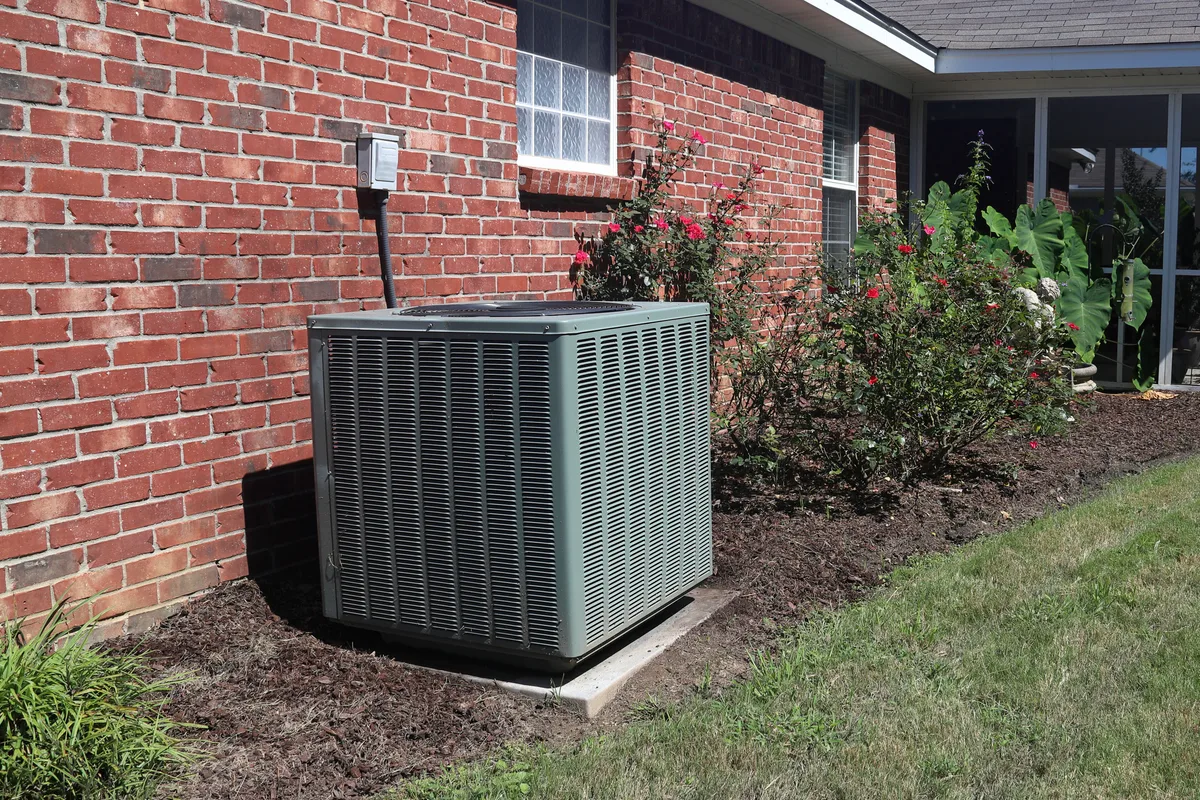
- The outdoor disconnect, the grey box on the wall beside the unit. A pull-out handle may have been removed or put back upside down in the OFF position; a switch type may be down.
- The double-pole AC breaker in the electrical panel, often turned off for the winter.
- The thermostat: Cool mode, fan AUTO, setpoint below room temperature. A thermostat still in Heat never calls the outdoor unit.
- The furnace switch and filter. The blower and the 24-volt control power come from the furnace, so it has to be on, with a clean filter in place.
One more winter setting is worth changing while you are at the furnace. A bypass humidifier has a damper on the round duct between the supply and return plenums, marked winter and summer; left on winter, it lets cooled air loop straight back to the return without reaching the house. It will not stop the AC from starting, but it cuts airflow to the rooms and can help ice the coil. Turn the damper to summer and close the humidifier's water supply valve.
Why the power should be on for a day before the first start
If the breaker or disconnect was off all winter, restore power and wait before calling for cooling. Many outdoor units have a crankcase heater, a small element that keeps the compressor warm so liquid refrigerant does not settle in its oil. Installation manuals for units that have one commonly call for power to be on for up to 24 hours before the first start of the season. Starting a cold-soaked compressor with refrigerant in the oil washes the lubrication off the bearings.
Not every unit has a crankcase heater, and the manual or the wiring diagram inside the panel will say. If you cannot tell, waiting a day costs nothing.
Take the winter cover off and look for nests and chewed wire
A cover left on blocks the airflow the condenser needs. The unit may start, run hot for a few minutes and shut down on its internal overload, which looks like an AC that will not stay on. Take the cover or plywood off completely, clear leaves out of the base, and keep about 60 cm of open space around the cabinet.
Full-length covers also make a dry, sheltered home for mice and chipmunks. Look for nesting material, shredded insulation and droppings in the base and around the corner where the wiring enters. Do not reach into the electrical compartment; a capacitor can hold a charge with the power off.
A thin two-conductor cable runs from the furnace to the outdoor unit and carries the 24-volt signal that pulls in the contactor. Rodents chew its insulation. If the conductors are bitten through, the indoor blower runs and the outdoor unit never starts, the pattern described in an outside unit that is not running while the inside is. If they are chewed bare and touching, the 3-amp or 5-amp fuse on the furnace control board blows and the thermostat may go blank.
Follow the exposed cable to where it enters the unit. Chewed wire should be replaced, not taped, and the fuse replaced with the same rating once the short is gone.
Parts that fail over winter: capacitor and fan motor
If power and signal are both present and the unit only hums, a part has failed while it sat. Capacitors weaken with age and often give up on the first hot start of the year. Fan motor bearings that took in water over winter can seize, leaving a fan that is stiff or will not turn.
- Capacitor replacement: $150–$350.
- Condenser fan motor: $300–$700.
- Contactor, where insects or corrosion have fouled the contacts: $150–$350.
- Diagnostic visit: $90–$150, applied to the repair when you approve it.
Call for service if the first start goes like this
- The outdoor unit hums or buzzes and the fan does not spin.
- The breaker trips as soon as cooling is called.
- The fuse on the furnace board blows a second time.
- It runs, but the air at the registers is not cold after 15 minutes.
A spring AC tune-up at $120–$250 catches most of these before the first hot weekend, and the spring start-up checklist lists the homeowner steps. If the unit is already refusing to run, ZK Mechanical handles AC repair in Burlington, Oakville, Milton, Hamilton and Georgetown: phone (647) 801-1252 or request service online. Every question in this series is indexed under cooling answers.