
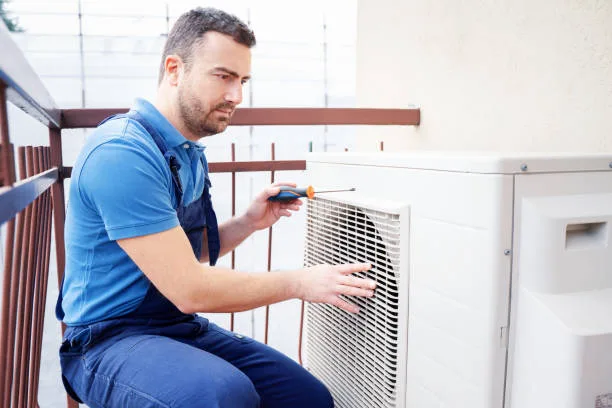
A spring AC startup checklist for Ontario homes has one rule that outranks all the others: restore power at the outdoor disconnect at least 24 hours before you ask the system to cool. Everything after that — filter, coil, drain, clearances — takes an afternoon and heads off the two failures that fill a May schedule: a condenser coil packed with winter debris, and a condensate trap that dried out over the heating season. Work through it in April, before the first 28°C day makes every phone in the trade ring at once.
Why the 24-Hour Power Rule Comes First
Because of the crankcase heater. Many condensers carry a small heater that keeps liquid refrigerant from migrating into the compressor oil while the unit sits cold and idle. If you shut the outdoor disconnect off for the winter — which is a good habit — that heater has been off all winter too. Starting a compressor with refrigerant dissolved in cold oil is how a working unit becomes a replacement quote.
So the sequence is: flip the disconnect on, walk away for a day, then call for cooling. The same applies to the indoor switch beside the furnace and the AC breaker in the panel. If both have been off since October, turn both on and leave them alone.
Do Not Test the Air Conditioner Below 15°C Outside
A test run on a 9°C April morning tells you nothing useful and can cost you a compressor. Below roughly 15°C outdoors, head pressure never builds properly, oil does not circulate the way the design assumes and the indoor coil can frost over while you stand there listening to it. If you want to know whether the system works before the heat arrives, wait for a mild afternoon in the mid-teens, or have it verified during a tune-up with gauges connected.
The Outdoor Unit: Ten Minutes With a Garden Hose
- Pull the winter cover, plywood or bin lid off completely. Anything left sitting over the top blocks the fan discharge.
- Rake out the leaves, maple keys and mulch that drifted around the base over winter. The coil breathes through its sides, not its top.
- Rinse the coil from the inside out with a garden hose. No pressure washer — spraying inward from outside drives debris deeper into the fins and flattens them.
- Straighten obviously bent fins with a fin comb, and look for shovel or hail damage along the face nearest the driveway.
- Restore clearance. Most manufacturers want roughly 30 cm clear on the sides and about 1.5 m above, and the cedar hedges in Roseland and Old Oakville close that gap a little more every growing season.
- Check the pad is level. Halton clay heaves over winter, and a condenser sitting on a tilt drains oil away from where the compressor needs it.
The Cottonwood Problem in Late May
Plan a second coil rinse in June, because the April cleaning does not survive the seed drop. Along Bronte Creek, Sixteen Mile Creek and the ravine lots through Aldershot, cottonwood and poplar fluff peaks in late May and early June and mats onto a condenser coil like felt. A unit that was spotless in April can be running high head pressure by the middle of June.
It is a leading cause of the my-AC-just-stopped-cooling call during the first real heat wave, and the fix is usually a garden hose rather than a technician. Look at the coil in mid-June even if nothing seems wrong yet.
Indoors: Filter, Drain and Registers
Free quotes, written pricing.
- Fresh filter, correct size, arrow pointing toward the furnace. If the size on the frame is unreadable, our furnace filter size guide explains how to read the label and what the numbers mean.
- Open every supply register and clear whatever is stacked in front of the returns. Rooms closed off for winter starve the evaporator coil in summer.
- Prime the condensate trap. Pour a litre of water slowly into the drain pan opening and watch it leave — a dry trap lets air pull through, and a blocked one backs up onto the basement floor.
- Test the condensate pump if there is one. Lift the float by hand and listen for it to run, discharge and shut off cleanly.
- New thermostat batteries, and set the fan to Auto for the first few weeks so you can hear exactly what the system is doing.
- Move the humidifier bypass damper to the summer position and close the humidifier's water valve for the season.
The Numbers a Technician Checks That You Cannot
Three of them: refrigerant charge, temperature split and capacitor health. A proper spring visit puts gauges on the system, measures superheat or subcooling against the manufacturer's target for that model, and confirms the supply-to-return temperature split lands in the 8–11°C band at normal indoor humidity. A weak run capacitor reads low on a meter weeks before it strands you on the hottest afternoon of July, and replacing one costs $150–$350.
Standalone AC tune-ups in the GTA run $120–$250, and a maintenance plan bundles the spring visit with the fall furnace visit. Either way, book it in April. By the third week of June most shops from Burlington through Hamilton are working through a backlog, and air conditioning service in Burlington is no exception.
Startup Order, Start to Finish
- Turn on the outdoor disconnect and the indoor furnace switch, then wait a full 24 hours before doing anything else.
- Change the filter and open the supply registers and returns.
- Clear and rinse the outdoor coil, then restore the clearances around it.
- Prime the condensate trap and test the condensate pump.
- On a mild afternoon above 15°C, set the thermostat 3°C below room temperature and let the system run for 15 minutes.
- Feel the supply air at a register, listen at the condenser for grinding or buzzing, and confirm the condensate drain is flowing.
- Anything odd — warm supply air, frost on the copper lines, a hum with no fan rotation — shut it down and book service before running it again.
If the Unit Is From the Early 2000s, Startup Is a Different Conversation
Find the refrigerant type on the data plate before you spend anything. Condensers installed through the 1990s and into the mid-2000s run on R-22, which has been phased out of production, so a leak on one of those units is not a top-up conversation — it is a replacement conversation, and the arithmetic rarely favours repairing a system of that age.
At the other end, systems going in now use the A2L refrigerants R-32 and R-454B, which are mildly flammable and carry their own leak-detection and handling requirements. Neither situation changes your spring checklist, but both change what a technician can do when the gauges come out, so knowing which one you own before the first hot day saves a wasted service call.
The data plate also gives you the manufacture date, which is the honest measure of the unit's age. Homeowners routinely guess low by five years, and a condenser stamped 2007 sitting behind a 2019 furnace tells you where the next expense is coming from.
If the system is more than a dozen years old and the startup turns up a refrigerant leak or a struggling compressor, spring is the sane time to have the repair-or-replace conversation, not the middle of a July heat wave. The decision framework is in AC repair vs replacement. For a startup visit anywhere we cover, book a time and we will arrive with the gauges already on the truck.
Frequently asked questions
When should I start my air conditioner in Ontario?
Energize the outdoor disconnect in early April so the crankcase heater has time to work, then do the first real test run on a mild afternoon once outdoor temperatures reach the mid-teens. Booking a tune-up in April rather than June also means you find problems while parts and appointments are still easy to get.
Do I need refrigerant added every spring?
No. A sealed refrigeration circuit does not consume refrigerant. If a system needs a top-up to cool properly, it has a leak, and adding refrigerant without finding the leak simply means paying for it again next year. Ask for the leak search, not the recharge.
Why does my AC smell musty when I first turn it on?
Usually biological growth on the evaporator coil and in the drain pan, where moisture sat all winter. A coil cleaning and a flushed drain line normally clears it. If the smell persists after that, look at the ductwork and the filter cabinet — [why an AC smells musty](/answers/why-does-my-ac-smell-musty) works through the sources in order.
Can I hose down the outdoor unit myself?
Yes, with the power off at the disconnect and a normal garden hose. Spray from the inside outward so debris is pushed back out through the fins, keep water away from the electrical compartment, and never use a pressure washer — flattened fins cost you more airflow than the dirt did.
How long should the AC run on the first hot day?
Long cycles are normal and desirable. On a 30°C afternoon, a correctly sized system may run for most of the hour and still be doing its job, because long runs remove humidity. Short bursts every few minutes are the symptom worth investigating, not continuous operation.