
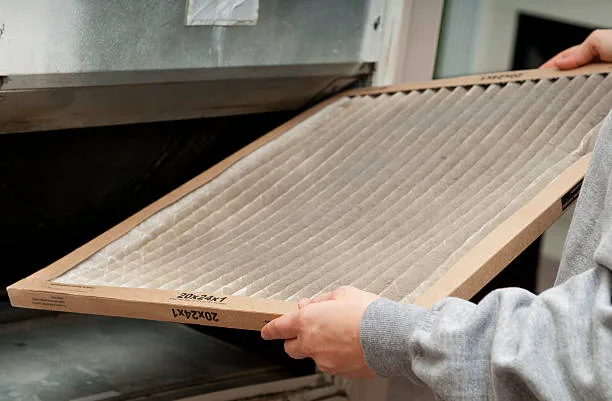
Finding your furnace filter size takes about a minute: shut the system off at the thermostat, slide the old filter out, and read the three numbers printed on its cardboard frame — width, height and depth, in that order, something like 16x25x1. If the print has worn off or somebody trimmed a filter to fit, measure the opening it came out of and round up to the nearest standard size. The rest of this page covers where the filter hides, why the printed size never matches a tape measure, and what to do when the slot is a size nobody stocks.
Nominal Size vs Actual Size
Filter sizes are nominal, meaning rounded. A filter labelled 16x25x1 typically measures about 15.5 by 24.5 inches, and its depth is closer to three-quarters of an inch than a full inch. That is deliberate: the filter has to slide into a slot of the nominal dimension with a little clearance.
So when you measure, expect to be roughly half an inch short of the number you should buy. If your tape reads 19.5 by 24.5, the filter you want is a 20x25. If you measure the slot opening instead of the filter, measure the opening and buy the nominal size that matches it, not the opening's exact reading.
Where the Filter Hides in Four Common Setups
- A slot in the side of the furnace cabinet, right where the return duct connects. Standard on most furnaces installed in the last three decades. There is usually a metal or plastic cover clipped over it.
- Inside the blower compartment, on a rack under the blower. Common on older equipment and on furnaces installed with a bottom return. You have to pull the lower door off to reach it, and the door often has a safety switch that kills power when removed.
- A media cabinet — a boxy metal housing bolted to the return duct beside the furnace, with a hinged door. This holds a four- or five-inch cartridge and is the one setup where the size is printed inside the cabinet door as well as on the media.
- A filter grille in a wall or ceiling, usually a large return register on the main floor of a house with only one or two returns. The filter is the same shape but much larger, and people frequently do not know it exists.
It is possible to have two of these at once — a filter grille upstairs and another filter at the furnace — and a system running two filters in series is one of the more common causes of low airflow we find. If you locate one, keep looking for a second.
If the Printed Size Is Gone: Measure the Slot
- Turn the system off at the thermostat before opening anything, and if you have to remove a blower door, note that pulling it usually cuts power at the door switch.
- Measure the width and height of the opening the filter slides through, then round to the nearest inch. Those two numbers are your nominal width and height.
- Measure how deep the slot or rack is — one inch, or four to five inches for a media cabinet. Depth is not something you can substitute.
- Note which way the arrow on the old filter pointed. The airflow arrow always points toward the furnace and blower, that is, in the direction the air is travelling on its way to the equipment.
- Write the three numbers on the furnace cabinet with a marker. Every technician who follows you will appreciate it, and you will never measure again.
Common Sizes and Media Cartridges
One-inch filters in local houses cluster around a handful of sizes: 16x20, 16x25, 20x20, 20x25 and 14x25 cover most of what we pull out of furnaces in Burlington, Oakville and Hamilton. Filter grilles run larger, often 20x30 or bigger, because a single return grille has to pass the whole system's air.
Free quotes, written pricing.
Media cabinets from Honeywell, Aprilaire, Lennox and Carrier most commonly take a 16x25x5 or 20x25x5 cartridge, but they are not interchangeable between brands and the cabinet's own model number is what you should shop by. That number is on a label on the cabinet door or on the inside face of the door. Photograph it once and the annual reorder becomes trivial.
When the Slot Is an Odd Size
Older Hamilton and Burlington basements are full of hand-fabricated sheet metal, and some of those plenums were built with filter openings that match no standard size. Two bad habits follow. The first is cutting a larger filter down, which destroys the frame's seal and lets air slip past. The second is dropping in a smaller filter and leaving a gap.
Both are worse than they look, because air takes the path of least resistance. A one-inch gap around a filter can let a large share of the return air bypass filtration entirely, which is why a house with a high-rated filter can still be dusty. The proper fixes are a custom-sized filter ordered to the actual opening, or a sheet-metal adapter that reduces the opening to a standard size — usually a small job worth doing once.
The Clearance Trap in Newer Mechanical Closets
In new builds where the furnace is squeezed into a closet or a corner behind the water heater, the filter slot can be perfectly standard and still be unusable, because a 25-inch filter needs 25 inches of clear space beside the furnace to come out. We see this in tight mechanical rooms in newer subdivisions, where the homeowner has been bending filters to remove them for years.
The usual solution is a different orientation — a 16x20 in place of a 20x25, if the slot allows both — or relocating the filter to a media cabinet on a more accessible section of return duct. If you are bending a filter to get it out, the answer is not a stronger filter, it is a layout change.
Which Size and Depth Should You Buy
- Buy the nominal size printed on the old filter, or the nominal size matching the slot opening. Do not buy a size that has to be forced, trimmed, or that leaves a visible gap.
- Stay with the depth your equipment has. You cannot put a four-inch cartridge in a one-inch slot, and a one-inch filter loose in a media cabinet is worse than either.
- If you want better filtration than a one-inch slot can carry without restricting airflow, add a media cabinet rather than a denser panel — the reasons are in our guide to MERV ratings.
- Buy a year's worth at once in the size you have confirmed. The most common reason a filter goes six months without changing is that there was not a spare in the basement.
- Check the arrow every time. A filter installed backwards still filters, but the frame is not braced for the airflow and can collapse into the blower.
How often to swap it depends on depth, rating and household, and that is covered in how often to change a furnace filter. If dust keeps returning no matter what you buy, the answer on why a house is so dusty is a better starting point than a more expensive filter. Our maintenance plans include the filter change with each visit, and you can always ask us to size and label yours.
Frequently asked questions
How do I know what size furnace filter I need?
Read the three numbers printed on the frame of the filter already in the system — width, height and depth, such as 16x25x1. If that print is gone, measure the opening the filter slides into, round to the nearest inch, and buy that nominal size. Filters measure about half an inch smaller than their labelled size, so a filter reading 15.5 by 24.5 on a tape is sold as a 16x25.
Why is my furnace filter smaller than the size printed on it?
Because filter dimensions are nominal, meaning rounded up to a whole number. A 16x25x1 filter actually measures roughly 15.5 by 24.5 inches and is a bit under an inch thick, so it slides into a 16 by 25 opening with clearance. Every manufacturer follows the same convention, which is why you should shop by the printed size rather than by tape measurements.
Can I use a smaller furnace filter if the right size is out of stock?
No. Air takes the easiest route, and a gap around an undersized filter lets a large share of the return air bypass filtration completely — which is why a house with an expensive filter can still be dusty. Cutting a larger filter down is just as bad, because it destroys the frame's seal. Order the correct size, or have a sheet-metal adapter fitted to bring an odd opening to a standard size.
Where is the filter on my furnace?
Most commonly in a slot on the side of the furnace cabinet where the return duct connects, behind a clip-on cover. Older systems often hold the filter inside the blower compartment on a rack, and homes with a media cabinet have a hinged metal box on the return duct. Some houses filter at a large return grille in a wall or ceiling instead, and a few have both — if you find one, check for a second.