
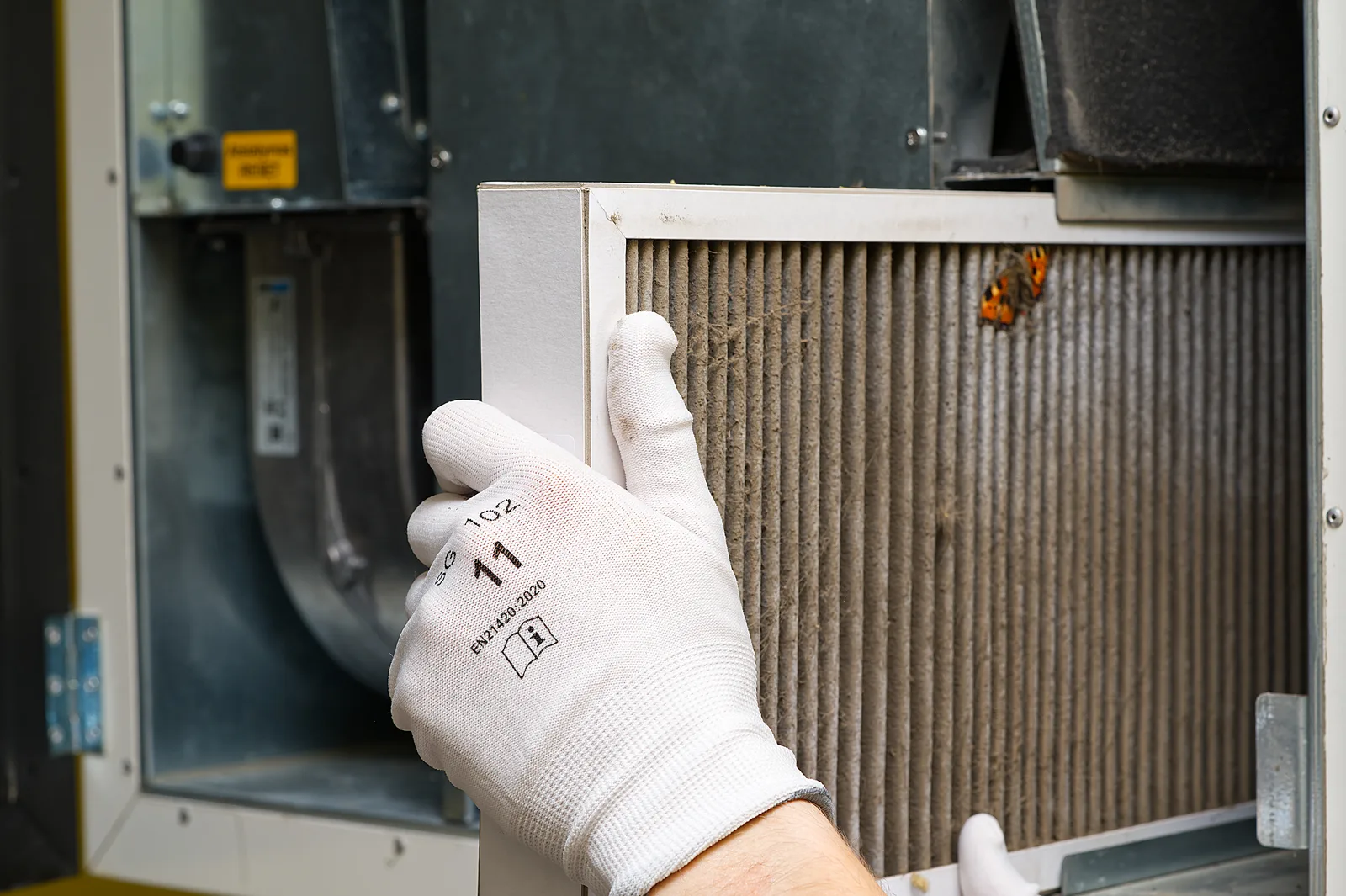
MERV ratings explained in one line: MERV is a standardized score from 1 to 16 for how much of the dust passing through a filter the filter actually catches, and higher is only better if your system can still move air through it. For most homes with a one-inch filter slot, MERV 8 to 11 is the safe range. MERV 13 is worth having, but it belongs in a four- or five-inch media cabinet rather than a one-inch slot, because surface area is what lets a fine filter breathe.
What the Number Measures
MERV comes from an ASHRAE test that pushes particles of known sizes through a filter and measures what fraction is captured in three size bands: the coarse band from 3 to 10 microns, a middle band from 1 to 3 microns, and the fine band from 0.3 to 1 micron. A filter's MERV rating reflects its worst performance across those bands, so a high number means it performs across all three, not just the easy one.
- MERV 1 to 4: washable and cheap fibreglass panels. They protect the blower from lint and do essentially nothing for air quality.
- MERV 8: catches most of the coarse band — house dust, pollen, lint, much of what makes a duct dirty. This is the baseline pleated filter most homes ship with.
- MERV 11: adds most of the 1 to 3 micron band, which is where pet dander and finer dust live. The usual recommendation for a household with pets or mild allergies.
- MERV 13: the first level that captures the majority of the fine 0.3 to 1 micron band, which includes smoke particles and many aerosols. This is the meaningful step up for air quality.
- MERV 14 to 16: commercial territory. In a residential system these need a deep media cabinet and a blower with headroom, or they will starve the system.
The Airflow Trade-Off Nobody Prints on the Box
Finer media resists airflow. Residential furnaces and air handlers are generally designed around a total external static pressure of about 0.5 inches of water column, and we regularly measure existing GTA systems already sitting well above that before anyone touches the filter. Drop a one-inch MERV 13 into a system like that and airflow falls, which shows up as a cold room upstairs, a furnace tripping on high limit, or an evaporator coil freezing in summer.
The fix is not a lower MERV — it is more media. A four- or five-inch cabinet filter has many times the surface area of a one-inch panel, so a MERV 13 cartridge in a deep cabinet often resists airflow less than a MERV 8 one-inch panel does. That is the single most useful thing to know on this page: depth buys you filtration for free.
Blower type matters too. A constant-torque or variable-speed ECM blower fights a restrictive filter by ramping up, which maintains airflow but consumes more electricity and gets noisier. An older PSC blower simply moves less air and says nothing about it. Neither is a reason to avoid good filtration; both are reasons to have static pressure measured once.
MPR, FPR and Other Store Scales
MERV is the ASHRAE standard. MPR is 3M's own scale and FPR is a retailer scale used on store-brand filters, and neither maps exactly onto MERV. As a rough orientation, filters marketed around FPR 7 or the mid-range MPR numbers sit near MERV 11, and the top-tier residential filters marketed at FPR 10 or the highest MPR numbers sit near MERV 13.
Free quotes, written pricing.
Two other labels cause confusion. HEPA is not a MERV rating and no filter that drops into a furnace slot is true HEPA; genuine HEPA in a house means a separate bypass unit with its own blower. And washable electrostatic filters, whatever the packaging claims, generally test in the low single digits of MERV — they are blower protection, not air cleaning.
What We Recommend by System
- One-inch slot, older PSC blower, no measured static pressure: MERV 8, changed on time. This is not a compromise worth arguing with until someone measures the system.
- One-inch slot, ECM blower, healthy static pressure: MERV 11 is usually fine and worth having with pets in the house.
- Four- or five-inch media cabinet: MERV 13, replaced once or twice a year. Best filtration available without hurting airflow.
- Heat pump: filters load faster because the system runs many more hours per season than a furnace did. Plan on checking monthly through winter.
- Anyone with a coil that has frozen before, a furnace tripping on high limit, or a room that has always been short of air: measure static pressure before increasing MERV.
What Loads Filters Fast Around Here
Two local patterns show up constantly. Houses backing onto the QEW, the 403 or the Lincoln Alexander Parkway pick up road grit and brake dust, and their filters look grey months before the calendar says to change them. And houses in subdivisions still under construction — the newer streets in Alton Village, Waterdown and Binbrook — take in fine construction dust for the first year or two, which is the one time we suggest checking a one-inch filter monthly regardless of its rating.
Summer smoke drifting into southern Ontario is the other case where the fine band matters, since smoke particles sit squarely in the 0.3 to 1 micron range that only MERV 13 and above capture in quantity. If that is a concern in your household, the media cabinet upgrade is the durable answer rather than forcing a dense filter into a shallow slot.
Which MERV Should You Choose
- Choose MERV 8 if you have a one-inch slot, an older blower and no particular air quality complaint. Changing it on schedule matters more than the rating.
- Choose MERV 11 if you have pets, mild allergies or a modern ECM blower, and you are staying with a one-inch filter.
- Choose MERV 13 if you have or can add a four- or five-inch media cabinet, or if smoke and fine particles are a real household concern.
- Choose a separate air cleaner, not a denser furnace filter, if you need HEPA-level filtration for a medical reason.
- Never cut a filter to fit or leave a gap around a loose one — air takes the easy path around a filter, and bypass beats any MERV rating.
Change intervals depend on rating, depth and household, and our post on how often to change a furnace filter breaks it down. If you are not sure what size to buy, we wrote a walk-through on finding your furnace filter size, and the airflow question is covered in the answer on whether a furnace filter can be too restrictive. To have static pressure measured and a media cabinet quoted, see our indoor air quality services or reach out.
Frequently asked questions
Is a MERV 13 filter bad for my furnace?
Not by itself — the problem is putting one in a shallow slot. A one-inch MERV 13 panel resists airflow enough to cause trouble in a system that already runs high static pressure, showing up as a frozen coil in summer or a furnace tripping on high limit in winter. The same MERV 13 media in a four- or five-inch cabinet has far more surface area and usually breathes easier than a one-inch MERV 8.
What MERV rating should I use at home?
MERV 8 is the safe baseline for a one-inch slot on an older system, MERV 11 is a sensible step up for households with pets or mild allergies, and MERV 13 is the right target if you have a four- or five-inch media cabinet. If you want better filtration than your slot allows, add depth rather than density — the cabinet upgrade solves both problems at once.
What is the difference between MERV, MPR and FPR?
MERV is the ASHRAE industry standard from 1 to 16. MPR is 3M's proprietary scale and FPR is a retailer scale on store-brand filters, and neither converts exactly. Roughly, mid-range MPR numbers and FPR 7 sit near MERV 11, while top-tier residential MPR numbers and FPR 10 sit near MERV 13. When in doubt, look for a MERV number printed alongside the marketing scale.
Do better furnace filters help with allergies?
They help with what the system actually pulls through them. MERV 11 captures most pet dander and finer dust, and MERV 13 adds the fine particle band. The limits are that a filter only treats air passing through the ductwork, so it does nothing while the blower is off, and it cannot address moisture, mould at the source, or dust already settled in the house.