
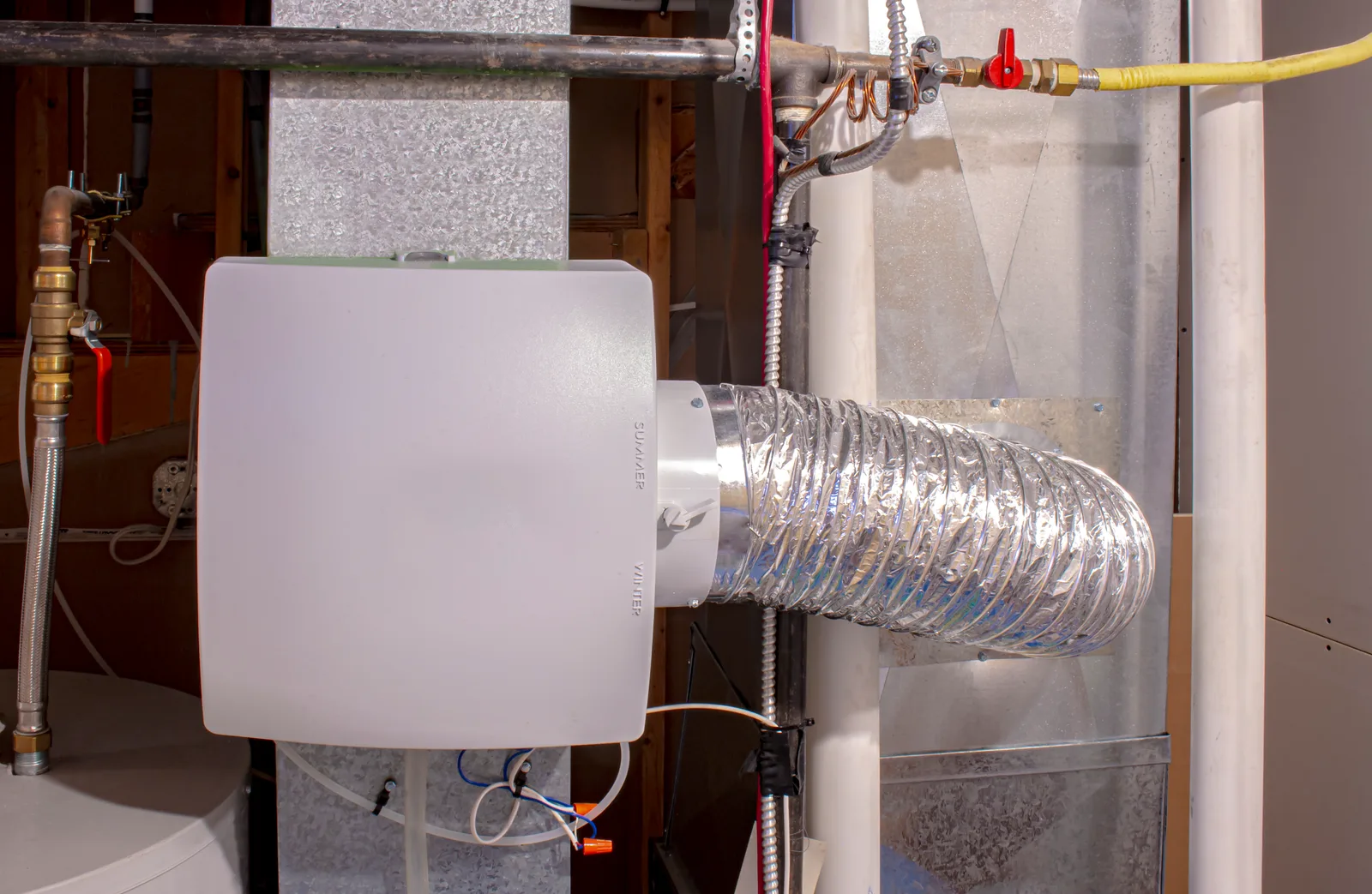
Bypass vs fan-powered vs steam humidifiers is a question of how much moisture the house needs and how the moisture gets made. A bypass humidifier borrows the furnace's own airflow to evaporate water off a pad. A fan-powered unit adds its own blower and pushes more air across a bigger pad, producing meaningfully more moisture in the same conditions. A steam humidifier boils water and injects vapour, which means it works regardless of how warm or how often the furnace runs. For most Ontario houses a bypass or fan-powered unit is enough; steam is the answer for large, leaky or heat-pump-heated homes.
How the Three Types Add Water
- Bypass: a small cabinet mounted on the supply or return plenum with a duct connecting the two, so furnace airflow is diverted across a wet evaporator pad and back into the system. No fan of its own, a damper that gets flipped between heating and cooling season, and the lowest output of the three.
- Fan-powered: same evaporative principle, but the unit contains a fan that pulls air across the pad itself. No bypass duct is required, which is why it fits mechanical rooms too tight for a bypass loop, and output is higher than a bypass unit of the same size.
- Steam: an electrode or resistance canister boils water and releases steam into the supply duct. Output is far higher, it is independent of furnace supply temperature, and it can run when the furnace is not heating at all, provided the blower moves air to carry the vapour away.
Sizing Beats Type
The most common humidifier complaint we get called about is not a broken unit — it is a correctly working unit that is too small for the house. Output has to match the volume of the home and, more importantly, how leaky it is, because every cubic metre of dry winter air that infiltrates has to be humidified again.
A 1920s brick house in Westdale or Dundas with original windows and no air sealing can go through several times the moisture of a 2015 build in Alton Village of the same square footage. That is why the same bypass unit that keeps one house comfortable leaves the other stuck below 25% all January. If you have already got a humidifier that cannot keep up, the fix is usually more output, not a new brand.
The Heat Pump Problem Nobody Mentions at the Showroom
Evaporative humidifiers — bypass and fan-powered both — rely on warm supply air to evaporate water off the pad. A gas furnace supplies air in the 40s of degrees Celsius, which does that job well. A heat pump supplies much cooler air, often in the low 30s, and evaporative output drops sharply as supply temperature falls.
So a house that switches from a furnace to a heat pump and keeps its existing bypass humidifier often ends up dry the following winter, with nothing actually broken. Steam is the reliable answer for a heat-pump-heated home because it makes its own vapour rather than borrowing heat from the air stream. This is worth planning for at the time of the heat pump quote rather than discovering in January.
Installed Cost and Yearly Upkeep
- Whole-home bypass humidifier: $500–$900 installed — uses furnace airflow, pad replaced annually, quiet and no daily effort.
- Whole-home powered or fan humidifier: $700–$1,200 installed — higher output for larger homes and tighter mechanical rooms.
- Steam humidifier: $1,500–$3,000 installed — precise output independent of furnace runtime, best for very dry or large houses.
- Portable units: $50–$300 — fine for one bedroom, but they need daily refilling and weekly cleaning or they become a mould source.
- Annual upkeep on an evaporative unit is a new pad, roughly $20–$40, plus flipping the bypass damper at season change. Steam units need their canister or cylinder serviced or replaced on the manufacturer's schedule.
Free quotes, written pricing.
Halton and Hamilton both run on Lake Ontario water, and mineral scale is what kills evaporative pads and steam canisters early. Plan on replacing pads every heating season rather than stretching them, and expect steam canister service to be a real line item in the ownership cost rather than an afterthought.
The Control Decides Whether You Get Wet Windows
Whichever type you buy, the control on the wall matters nearly as much as the box on the duct. A manual humidistat holds whatever number you dial in, which is fine in November and produces condensation running down the windows on the first -15°C night, because cold glass cannot tolerate the humidity that felt right a month earlier.
An automatic control with an outdoor temperature sensor solves that by walking the indoor target down as the outdoor temperature falls, and it is a small addition to any of the three types. On a steam unit it is effectively standard. If your existing humidifier has a dial marked simply from dry to wet, that dial is the thing to replace before you replace the humidifier.
Drains, Wiring and Where It Physically Fits
Every type except drainless bypass models needs a drain for the water that does not evaporate, which means a floor drain, a laundry standpipe or a condensate pump nearby. In a finished basement with the furnace boxed into a closet, that drain is often the constraint that decides the model.
Steam adds an electrical requirement. Residential steam humidifiers draw significant power and typically want a dedicated circuit, sometimes at 240 volts. In a 1960s bungalow with a full 100-amp panel there may be no space for it, which turns a humidifier decision into an electrical one. Check the panel before you commit to steam.
Verdict: Who Should Choose Which
For a typical detached Ontario house with a gas furnace, a bypass humidifier does the job at the lowest cost and the lowest fuss, and a fan-powered unit is the sensible step up when the house is larger, leakier, or the mechanical room has no room for a bypass duct. Steam is not a luxury upgrade for its own sake — it is the correct answer for specific houses, and overkill for the rest.
- Choose bypass for an average two-storey or bungalow with a gas furnace, a nearby drain and space for the bypass duct. It is the cheapest correct answer.
- Choose fan-powered for a larger home, a drafty older house, or a tight mechanical closet where a bypass duct cannot be routed cleanly.
- Choose steam if the house is heated by a heat pump, if it is large or very leaky, if humidity has to hold steady for hardwood or instruments, or if a fan-powered unit already failed to keep up.
- Choose a portable only for a single bedroom or a temporary situation, and commit to cleaning it weekly.
Set the target humidity before you shop — our guide to ideal indoor humidity in an Ontario winter explains why the number has to come down as it gets colder outside, and our answer on whether you need a humidifier in winter covers whether the problem is real. If an existing unit is not keeping up, start with why a furnace humidifier stops working, then look at our humidifier installation service or book a visit.
Frequently asked questions
What is the difference between a bypass and a fan-powered humidifier?
A bypass humidifier has no fan and relies on the furnace blower to push air through a duct across its evaporator pad. A fan-powered unit contains its own blower, so it needs no bypass duct and produces more moisture from the same pad area. Fan-powered units cost more to install, fit tighter mechanical rooms, and suit larger or leakier houses.
Is a steam humidifier worth the extra cost?
It is worth it in specific cases: a house heated by a heat pump, where cool supply air cripples evaporative units; a large or very leaky home where a fan-powered unit cannot keep up; or a house where humidity must stay steady for hardwood floors or instruments. In an average gas-heated home a bypass or fan-powered unit does the same job for far less.
Why does my whole-home humidifier not keep up in January?
Usually because it is undersized for how leaky the house is, not because it is broken. Cold outdoor air holds very little moisture, so every air change has to be re-humidified, and an older house exchanges far more air than a new one. Other common causes are a scaled pad that was never replaced, a closed bypass damper left in summer position, or a saddle valve that has partly clogged.
How often does a furnace humidifier need maintenance?
Replace the evaporator pad every heating season and flip the bypass damper at the change of season — the pad is a small part, roughly $20–$40. Local water is drawn from Lake Ontario and leaves mineral scale, so stretching a pad over two winters usually costs more in lost output than the pad saves. Steam units need their canister serviced on the manufacturer's schedule instead.