
The ideal indoor humidity in an Ontario winter is 30–40% relative humidity, but that is an average-of-the-season answer and the setting that actually works slides with the outdoor temperature. On a mild -2°C evening, 40% is comfortable and harmless. At -20°C, that same 40% will run water down the inside of your windows by morning. The number you want is the highest one that produces no condensation on the coldest glass in the house.
The Sliding Scale, by Outdoor Temperature
Set the humidistat against the weather, not against a fixed number written on a sticker. This is the relationship every whole-home humidifier dial is approximating, and it is why humidifiers with an outdoor temperature sensor outperform the ones without.
- Outdoor temperature above 0°C: aim for 40% indoors.
- 0°C down to -10°C: aim for 35%.
- -10°C down to -18°C: aim for 30%.
- -18°C down to -29°C: aim for 25%.
- Below -29°C: aim for 20%.
Halton and Hamilton spend most of the heating season between 0°C and -10°C, so 35% is the realistic everyday setting here. The days that catch people out are the two or three deep cold snaps in January and February, when nobody remembers to turn the dial down and the window sills are wet by breakfast.
Your Windows Are the Gauge, Not the Hygrometer
Condensation is the only feedback that accounts for your specific house. Glass is the coldest surface in any room, so it fogs first, long before moisture would show up anywhere you could see it inside a wall. Walk the house on a cold morning: if the bottom few centimetres of the coldest window are wet, you are too high, and the fix is to drop the setting five points and check again on the next cold morning.
Vintage decides how much room you have. A 1950s bungalow in Aldershot with original aluminum-framed sliders will sweat at 30% on a cold night. A 2000s build in Alton Village with low-E argon double glazing will hold 40% without a drop appearing. Same city, same weather, two genuinely different correct answers — which is why a single ideal humidity number circulating online is worth so little.
What Too Dry Actually Costs You
- Static shocks off every doorknob and a dog that flinches when you pet it. Usually the first sign, and usually below 30%.
- Cracked lips, dry eyes, nosebleeds and a scratchy throat that clears within an hour of leaving the house.
- Hardwood shrinkage. Flooring manufacturers generally want the house kept between 35% and 55% year round, and weeks below 30% open board gaps and telegraph the seams.
- Trim and door gaps widening in January and closing again in July, which is normal seasonal movement made obvious by very dry air.
- Pianos, guitars and solid-wood furniture drying out. Instruments prefer the upper end, closer to 40–45%.
- Air that feels colder than the thermostat reads, which pushes people to run 22°C and pay for the difference all winter.
What Too Wet Costs You, Which Is Worse
Water inside the building envelope. Moisture that condenses on glass runs onto the sill and rots the frame, and moisture that migrates into a cold wall cavity or up through an attic bypass condenses inside the assembly where nobody can see it. In January that shows up as black spotting on window frames, frost on the underside of an attic hatch and ice at the roof sheathing above the insulation. Chronically over-humidified houses also feed dust mites, which struggle below about 45%.
New builds are far more likely to be too humid than too dry. A tight 2010s house in Waterdown or Joshua Creek loses little air to leakage, so cooking, showering, laundry and breathing all stay inside. With the ventilation switched off or left on its lowest setting, the house climbs past 45% in midwinter with no humidifier connected at all.
Free quotes, written pricing.
The Fix Depends on Which Direction You Are Wrong
Too dry means a humidifier; too wet means ventilation. They are not interchangeable, and a surprising number of GTA houses are running the wrong one. Sort out which problem you have before spending anything.
- Too dry, forced air, average house: a whole-home bypass humidifier at $500–$900 installed, running on furnace airflow with a pad changed each fall.
- Too dry, large or leaky house: a powered fan humidifier at $700–$1,200 installed, which pushes considerably more output.
- Too dry, very large or high-end house: a steam humidifier at $1,500–$3,000 installed, which works independently of how long the furnace runs.
- Too wet in a new or tight house: run the ventilation. HRV vs ERV explains which one an Ontario home actually wants, and bath and range fans on timers do the rest.
- Too wet in one room only: that is usually air sealing or a cold exterior wall, not a whole-house humidity setting.
- Choosing between humidifier types: bypass vs fan-powered vs steam compares output, maintenance and running cost.
The Two Maintenance Jobs People Skip
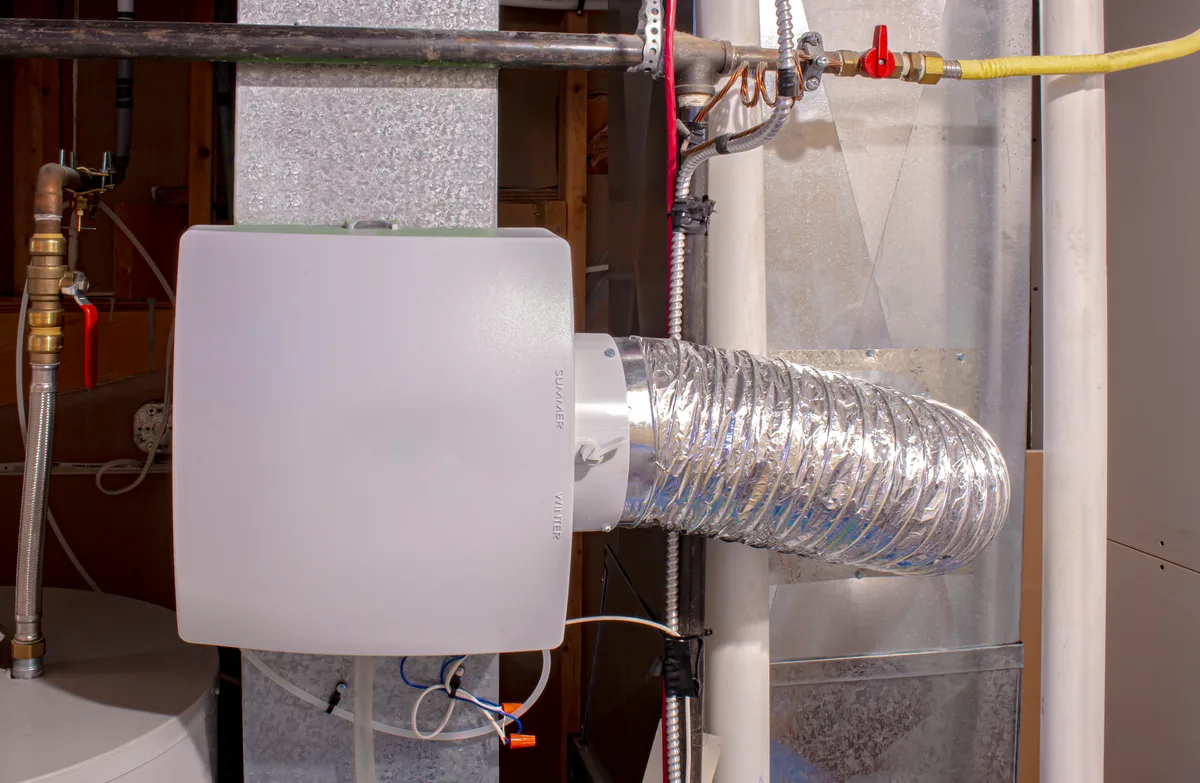
A new evaporator pad each fall and a damper flip at each season change. The pad in a bypass or powered humidifier scales up quickly on Halton's hard water and stops evaporating properly by its second winter, and a replacement runs about $20–$40 and takes ten minutes with a screwdriver.
The bypass damper on the duct has a summer position and a winter position. Left in the winter position through July, it dumps cooled air straight back into the return and costs you real money in the cooling season without anyone noticing.
Put a cheap digital hygrometer in a main-floor room, away from the humidifier and away from an exterior wall. Kitchens and bathrooms read high, and a spot near a supply register reads low. Keep it in the same place every winter and the readings actually become comparable year to year.
Where the Moisture Comes From Before You Add Any
A household generates a surprising amount of water on its own, and finding it is often cheaper than buying equipment. Showers, cooking, dishwashing, laundry, houseplants and simply breathing all release moisture indoors, which is why a full house reads higher than an empty one at the same setting.
- An open sump pit is a continuous source. A sealed lid with a gasket costs very little and takes a real bite out of basement humidity.
- A dirt-floor or partially finished crawl space, common under additions on older Dundas and Westdale houses, evaporates ground moisture into the house all winter.
- Firewood stacked indoors dries into your living space rather than outside it.
- A dryer venting into the basement instead of outdoors, which we still find, dumps every load of laundry into the air you breathe.
- Bathroom fans that vent into the attic rather than through the roof move the problem rather than removing it.
Readings also differ by floor, so measure where you live rather than where the equipment is. Basements read several points higher than the main floor because they are cooler and closer to the ground, and a closed bedroom with two sleepers reads higher again by morning. If your hygrometer sits in the basement beside the furnace, it is telling you about the basement.
If your windows run every cold morning, or the house never climbs past 25% no matter where the dial sits, there is a specific and findable reason. Do I need a humidifier in a Toronto winter is the short version of the decision, and humidifier installation is a half-day job when it turns out to be the right call. Book a look if you would rather have someone measure it.
Frequently asked questions
What humidity should I set my humidifier to in winter?
Start at 35% for typical Ontario winter weather, then adjust against your windows. Move up toward 40% during mild spells and down toward 25–30% during a deep cold snap. A humidifier with an outdoor temperature sensor makes those adjustments automatically, which is the main reason to pay for one.
Why do my windows fog up in winter?
Because the glass is colder than the dew point of the indoor air. That means either the indoor humidity is too high for the outdoor temperature, or the window itself is poor enough that it is cold even at reasonable humidity. Older aluminum-framed and single-glazed windows fog at humidity levels that modern sealed units handle without a mark.
Is 50% humidity too high in winter?
In an Ontario January, yes, for almost any house. At 50% you will see condensation on windows and risk moisture accumulating in wall and attic assemblies. 50% is a reasonable summer number; in winter it usually indicates a humidifier set too high or a tight house that needs ventilation.
Can a humidifier make the house feel warmer?
It genuinely helps. Moist air slows evaporation from your skin, so a room at 20°C and 35% humidity feels warmer than the same room at 20°C and 20% humidity. Many households find they can hold a lower thermostat setting comfortably once the humidity is corrected.
Do I need a humidifier if I have a heat pump?
Possibly, for the same reason as with a furnace. Neither system removes moisture in heating mode — winter dryness comes from cold outdoor air, which holds very little water, entering the house and warming up. The heat source is not what dries the house out, so the humidity decision is made the same way either way.