
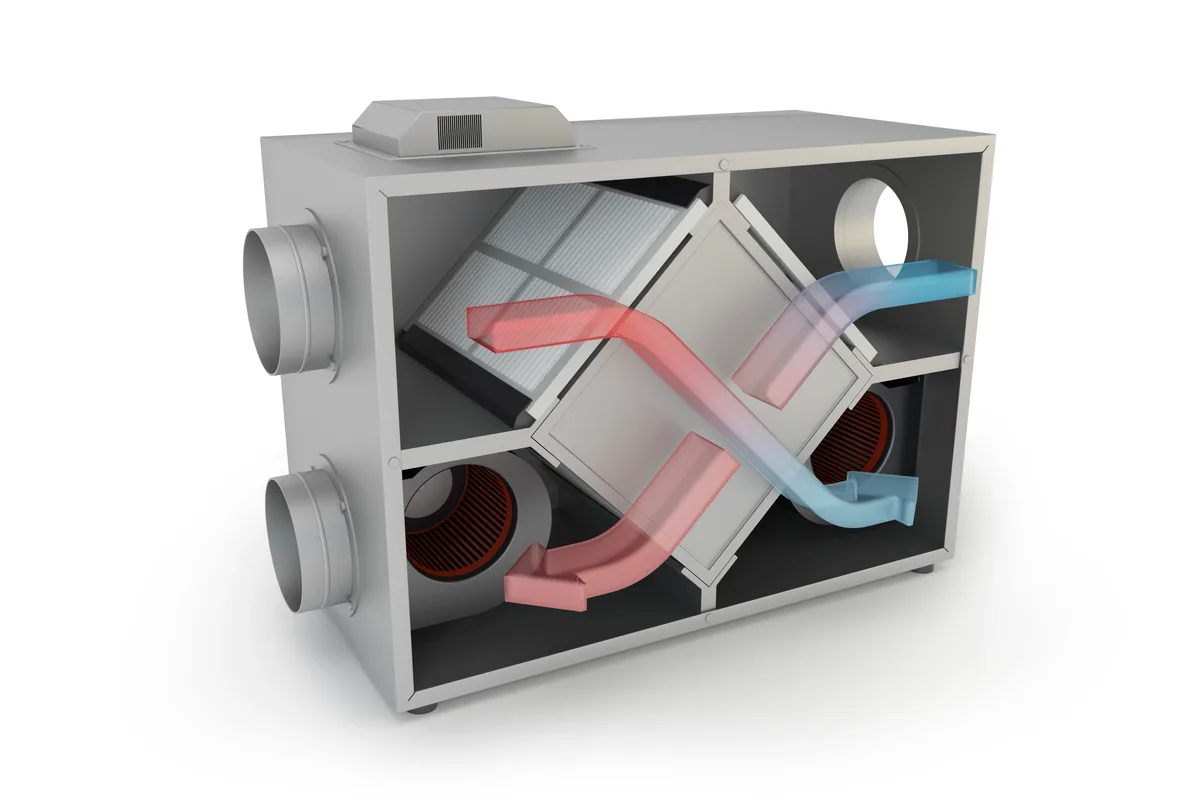
HRV vs ERV comes down to one question: do you want the incoming air to bring some of the outgoing air's moisture with it? An HRV, a heat recovery ventilator, transfers heat between the two air streams and nothing else. An ERV, an energy recovery ventilator, transfers heat plus a share of the moisture. For most Ontario houses the HRV is the right default, because our winter problem is usually too much indoor humidity, not too little. The ERV earns its place in very tight houses that dry out badly and in homes fighting summer humidity off the lake.
What Each Core Actually Does
Both units run two ducted air streams past each other through a core, so outgoing stale air preheats or precools incoming fresh air without the two mixing. The difference is the core material. An HRV core transfers sensible heat only. An ERV core is built from a material that also passes water vapour, so a fraction of the humidity in the outgoing stream crosses over to the incoming stream.
- Winter with an HRV: fresh air arrives tempered and dry. Indoor humidity drops, which is what you want in a house with condensation on the windows.
- Winter with an ERV: fresh air arrives tempered and holds some of the moisture you were about to exhaust. Useful in a very tight house that runs below comfortable humidity in January.
- Summer with an HRV: incoming humid air is cooled slightly but arrives with its moisture intact, adding to what the air conditioner has to remove.
- Summer with an ERV: some of that incoming moisture is shed to the outgoing stream, easing the latent load on the air conditioner.
Why Your New Build Already Has an HRV
If your house was built in the last decade or so in Alton Village, Waterdown, Binbrook or one of the newer Ancaster subdivisions, walk into the mechanical room and look for a metal box hanging from the joists with two insulated ducts going to the exterior wall. Ontario's Building Code requires balanced mechanical ventilation in new houses, and an HRV is how builders meet it.
That box is also the most ignored appliance in the house. We routinely find them switched off at the main switch, running with cores that have never been washed, or with the exterior hood packed with dryer lint from a vent installed too close. A builder-installed ventilator should be commissioned and balanced, not simply hung and wired, and an unbalanced one is worth raising with the builder while your Tarion warranty is still open.
When an ERV Is the Better Choice Here
- A very tight house — spray-foamed, blower-door tested, few occupants — that sits below 30% relative humidity through January despite a humidifier working hard.
- A lakeshore house in south Burlington, Bronte or Old Oakville where summer humidity is the year's real comfort complaint and the air conditioner already struggles to keep up with latent load.
- A home where the ventilation supply dumps into a bedroom and dry incoming air is noticeable at the pillow.
- A house with a large humidifier that runs constantly all winter — an ERV reduces how hard it has to work by not exhausting as much moisture in the first place.
The counter-case is just as important. If your windows stream with condensation on cold mornings, if the basement smells damp, or if there are four or more people, long showers and a lot of cooking in the house, you want moisture out. That is an HRV, and holding moisture back with an ERV would make things worse. Our post on ideal indoor humidity in an Ontario winter covers the targets to aim for before you pick a core.
Free quotes, written pricing.
What Ruins Either One: Ducting and Balancing
The unit matters less than how it is connected. A fully ducted installation gives the ventilator its own stale-air pickups in bathrooms and the kitchen area and its own fresh-air supplies to bedrooms and living space. A simplified installation ties both sides into the furnace ductwork, which is cheaper and only works when the furnace fan is running — so the furnace blower has to be interlocked to run with the ventilator, and in a house with a modulating furnace that hardly runs in shoulder season, ventilation quietly stops happening.
Then there is balancing. Supply and exhaust flows have to be measured and set equal at commissioning. An unbalanced unit either pressurizes the house, pushing moist indoor air into wall cavities, or depressurizes it, pulling air down any available flue. Ask whether the installer measured flows and wrote them down. If the answer is vague, the unit is not commissioned.
What Neither One Does
- It is not a dehumidifier. A ventilator swaps indoor air for outdoor air; on a humid August afternoon that outdoor air is wetter than what you had. Chronic summer damp needs a dehumidifier, not more ventilation.
- It is not an air cleaner. Ventilators carry coarse filters to protect the core, not fine media. Particle filtration is the furnace filter's job.
- It is not a fix for a wet basement, a leaking foundation or a failed bathroom fan. Ventilation dilutes moisture in the air; it does not stop water coming in.
- It is not a substitute for a range hood or a bathroom exhaust fan, both of which move far more air on demand than a ventilator does continuously.
Verdict: Who Should Choose Which
Choose an HRV unless you have a documented winter dryness problem or a serious summer humidity problem. That is the honest short version for this climate. The performance gap between the two is smaller than the gap between a balanced, properly ducted unit and a neglected one, so put your money and attention into the installation before agonizing over the core.
- Choose an HRV for the typical Ontario house: any home with window condensation in winter, a busy family, a finished basement, or a builder-installed ventilator that needs replacing like for like.
- Choose an ERV for a very tight, lightly occupied house that runs dry all winter, or a lakeshore home where summer humidity is the chronic complaint.
- Choose either, but insist on fully ducted, if you are renovating and the walls are already open — the ducting decision outlives the box.
- Choose neither yet if the house is leaky and old and you have never had a ventilation problem; air sealing first, then ventilate deliberately.
Whether a house needs mechanical ventilation at all is covered in our answer on needing an HRV in Ontario, and installed pricing sits on how much an HRV costs installed. To have one specified, ducted and balanced properly, see our HRV and ERV installation service or our wider indoor air quality services, and book a look at your mechanical room.
Frequently asked questions
Should I get an HRV or an ERV in Ontario?
An HRV suits most Ontario homes, because the common winter problem here is excess indoor humidity showing up as window condensation, and an HRV exhausts that moisture. An ERV holds some of it back, which helps only in very tight, lightly occupied houses that run dry in January, or in homes near the lake where summer humidity is the bigger complaint.
Does an HRV make my house too dry in winter?
It can in a very tight house with few occupants, since it exhausts moisture along with stale air. The usual fixes are running it at a lower continuous rate, pairing it with a properly sized whole-home humidifier, or choosing an ERV instead. In an average family home with showers, cooking and a finished basement, the HRV is normally removing moisture you want gone.
Do I have to run my HRV all the time?
Continuous low-speed operation is how these units are designed to work, with a boost from bathroom or kitchen switches when needed. Turning it off entirely is common and defeats the purpose — the house was built assuming it runs. If it feels too dry or too noisy, adjust the speed and check the balance rather than shutting it down for the season.
How often does an HRV or ERV need maintenance?
Wash or vacuum the filters a few times a year and clean the core at least annually, more often in a house with pets. Check the exterior hoods each season for lint, insect screens clogging, and snow or ice blocking the intake, which is a real problem after a lake-effect storm. Balanced flows should be verified whenever ductwork changes.