
Quick answer
If your house was built in the last decade, you likely have an HRV already — Ontario's Building Code requires mechanical ventilation in new houses, and since the 2017 SB-12 energy-efficiency update most builders meet it with an HRV. In an older, leakier house you do not need one until you tighten the envelope with new windows, spray foam or air sealing. After that, stale air and winter window condensation say yes.
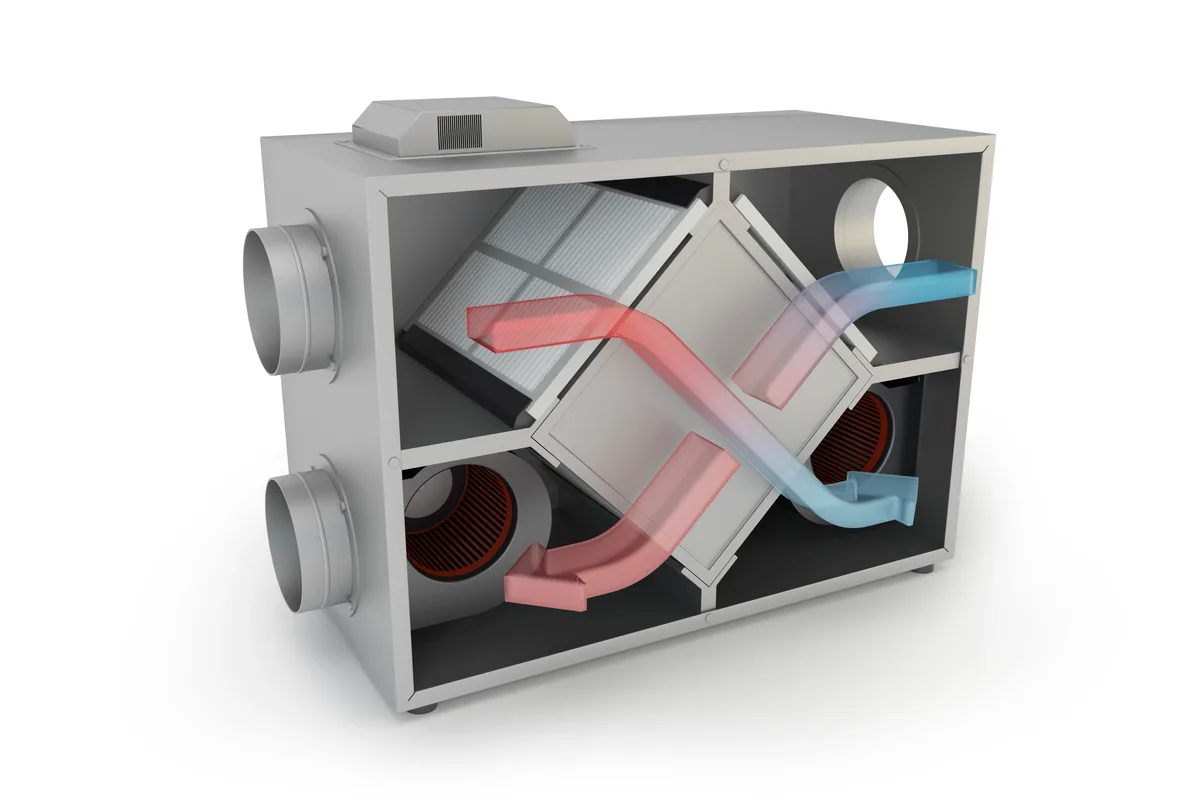
Do I need an HRV in Ontario? It comes down to how tight your house is. A heat recovery ventilator brings in fresh outdoor air and exhausts stale indoor air while recovering most of the heat between the two streams, and that job only matters once a house is sealed well enough that air is not leaking through the walls anyway. A 1955 Aldershot bungalow with original windows ventilates itself; a 2019 house in Alton Village or Waterdown would be stuffy and damp within a week without one.
New builds: you already have one
Ontario's Building Code has required mechanical ventilation in new houses for decades, and since the 2017 update to the SB-12 energy-efficiency standard an HRV has been the usual way builders meet it. If you bought a new home in Alton Village, the Orchard, Waterdown, Binbrook or Joshua Creek, look for a wall-mounted box near the furnace with two insulated ducts running to an outside wall. Many owners have never turned it on, or shut it off because it seemed to cost money — both are mistakes.
- Run it: a low continuous setting, boosted from the bathroom timers when someone showers.
- Clean the filters every two to three months and wash the core at least once a year — a clogged core moves almost no air.
- Clear the two outdoor hoods of leaves, lint and snow; the intake hood in particular ices up in lake-effect weather.
- Check the drain line under the unit; a dry trap or a kink leaves water sitting in the cabinet.
Older houses: the answer changes after a retrofit
Air sealing, a spray-foamed basement, new triple-pane windows and attic upgrades all reduce the accidental ventilation that pre-war brick homes in Westdale, Kerr Village and Old Oakville have always relied on. The first winter after that work, the symptoms show up: condensation running down the glass, a bathroom that never dries, cooking smells that linger until morning, and a general staleness by evening. That is the point at which an HRV moves from nice-to-have to necessary.
- Window condensation every cold morning even with the humidifier off.
- Bathroom fans that cannot clear steam, or no bathroom fans at all.
- A house that smells of last night's dinner at breakfast.
- Radon or CO2 readings that climb overnight with the doors closed.
- Anyone in the house with asthma or allergies living in a tightly sealed home.
If you have not done that work, and the house still feels drafty in a January wind off Lake Ontario, spend on air sealing first and revisit ventilation afterward.
HRV or ERV in Burlington and Oakville
An HRV transfers heat only; an ERV transfers heat and some moisture. In a typical Ontario winter the HRV is the conventional choice because it also helps dry the house out. Along the lakeshore, where summers are humid and homes run air conditioning for months, an ERV keeps some of that outdoor humidity out and eases the AC's dehumidifying load. An ERV is also the better fit for a tight house that runs too dry in January, because it holds some indoor moisture in. Our HRV vs. ERV comparison walks through which side of that line your house falls on.
Either type is installed one of two ways: fully ducted, with its own supply and exhaust grilles, or simplified, tied into the furnace return so the furnace blower distributes the fresh air. The simplified version is cheaper and common in production housing, but it only ventilates while the furnace fan runs. Cost depends heavily on that choice — see what an HRV costs installed for the ranges.
Related questions, answered briefly
- Does an HRV cost a lot to run? The fan is small; a modern ECM-motor unit running continuously adds little to a Burlington Hydro or Oakville Hydro bill, and the recovered heat offsets most of the ventilation loss.
- Will an HRV dry the house too much? In a deep cold snap it can push humidity low; run it on a lower setting or add a humidistat control in January.
- Does an HRV frost up in winter? Yes — the core frosts below roughly -5°C and the unit runs a defrost cycle. That is normal; a unit that stays iced has a stuck damper or a dead defrost motor.
- Can I add an HRV to a house with a boiler and no ducts? Yes, but it must be fully ducted, which is more work than tying into a furnace return.
ZK Mechanical installs and services HRVs and ERVs as part of indoor air quality work across Burlington, Oakville and Hamilton. If you are unsure whether your house needs one, ask us; we will look at the envelope before we quote a box.