
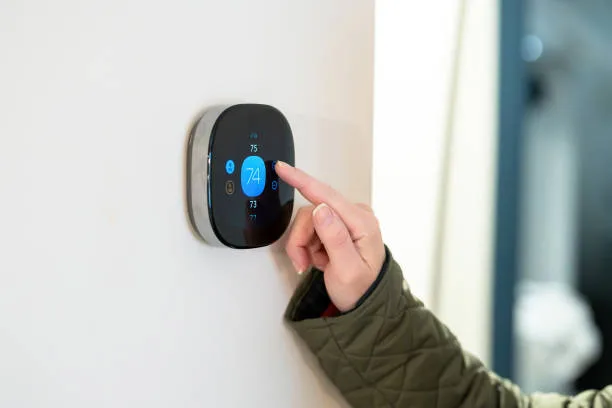
Ecobee vs Nest comes down to sensors and wiring for most Ontario homes. Ecobee ships wireless room sensors that let the thermostat average several rooms and follow occupancy, and it includes an adapter that solves the missing-common-wire problem in older houses. Nest is simpler to live with, looks better on a hallway wall and suits a household already running Google devices. Both control a furnace and air conditioner well; ecobee gives you more control over a heat pump.
Two Different Design Philosophies
Ecobee is a Toronto company and its products read that way: lots of exposed settings, thresholds you can adjust yourself, and an installer-oriented streak that shows up in menus most homeowners never open. Nest came out of Silicon Valley and hides almost everything, learning a schedule from your behaviour instead of asking you to build one.
Neither approach is wrong. It matters because the two failure modes are different. An ecobee that nobody configured runs on defaults that are merely acceptable. A Nest that nobody configured invents a schedule from a few weeks of habits, which is fine in a house with a routine and frustrating in one without.
Room Sensors: The Difference You Actually Feel
This is the strongest practical argument for ecobee in a typical two-storey. A thermostat in a downstairs hallway reads the hallway, not the bedroom above the garage that runs cold every night. Ecobee's wireless sensors report temperature and occupancy, and you tell the thermostat which rooms to include at which times — bedrooms overnight, main floor during the day.
Nest supports its own wireless temperature sensors and can prioritize one at a time, but they read temperature only, without occupancy. If uneven temperatures between floors are your actual complaint, sensors help but they do not replace airflow work — the underlying causes are covered in our answer on why one room is always cold.
The C-Wire Question in Older Burlington and Hamilton Houses
A Wi-Fi thermostat needs constant power, which comes from a common wire. Plenty of 1950s and 1960s bungalows in Aldershot, Kerr Village and around Westdale were wired with a four-conductor thermostat cable and no common, because a mercury-bulb thermostat did not need one.
- Ecobee includes a power extender adapter that installs at the furnace and creates a common from the existing four wires. It is the reason ecobee installs cleanly in older houses more often than not.
- Nest can run without a common by drawing small amounts of power through the heating or cooling wire. It usually works, and when it does not the symptoms are maddening — random restarts, a furnace that cycles briefly with no call for heat, or a thermostat that goes offline nightly.
- Two-wire hydronic systems — the cast-iron radiator houses in Old Oakville and central Hamilton — defeat both. There is no fourth conductor for the adapter to work with, so the fix is pulling a new cable or adding a separate transformer and relay.
- If a thermostat is being installed with new equipment, a fresh cable costs almost nothing at that moment and removes the entire question.
Scheduling Around Ontario Electricity Plans
Free quotes, written pricing.
Ontario residential customers choose between time-of-use, tiered and ultra-low overnight pricing, and the shape of each plan is different enough to change how you should schedule cooling. Under time-of-use, summer on-peak hours land in the afternoon, which is exactly when a house is heating up. Under ultra-low overnight, the cheap window runs late at night and the weekday evening peak is expensive.
Ecobee's schedule editor lets you place several comfort periods per day with different setpoints, which maps neatly onto peak windows. Nest can be told a schedule, but its learning behaviour will keep adjusting around you unless you turn that off. Whichever you buy, check your current plan with Burlington Hydro, Oakville Hydro or Alectra Utilities before building the schedule — the rate windows are the thing you are scheduling against.
Apps, Ecosystems and the Long Term
Nest devices are managed through the Google Home app, and Google has been consolidating its home products there. Ecobee runs its own app and has supported Apple Home directly for years, which still matters in an iPhone household. Newer devices on both sides support Matter, the cross-platform standard, which softens the ecosystem question compared with a few years ago.
The ecobee premium model adds a speaker with Alexa built in and an indoor air quality sensor. Treat that sensor as a trend indicator rather than an instrument — it will tell you the air got worse after you cooked, not what the contaminant was. Real air quality problems get solved at the filter and the ventilation, not at the thermostat.
Heat Pumps: Not a Tie
If you have or are considering a heat pump, ecobee is the stronger of the two because it exposes compressor and auxiliary heat lockouts by outdoor temperature, and backup heat is where heat pump savings get thrown away. Nest offers a simpler balance setting that works but gives you less say. Our guide to smart thermostats for heat pumps covers the wiring and settings in detail, including why ductless systems need the manufacturer's own control instead.
Verdict: Who Should Choose Which
Ecobee is the better default for Ontario houses, mainly for the sensors and the common-wire adapter. Nest earns its place in Google households and in homes where the thermostat sits somewhere visible and design matters. There is no efficiency gap between them large enough to justify replacing a working thermostat of either brand.
- Choose ecobee if you have a heat pump or dual-fuel system, if bedrooms run at different temperatures than the hallway, if your house has no common wire, or if you want to set schedules precisely against time-of-use or ultra-low overnight rates.
- Choose Nest if the household already runs Google Home, if you want the simplest possible wall device, or if the thermostat is in a prominent spot and appearance is part of the decision.
- Choose neither if your system is a ductless mini-split or a communicating heat pump — use the manufacturer's controller.
- Skip the upgrade entirely if you have a working programmable thermostat and no Wi-Fi at the equipment; the savings will not repay a service call.
Both lines include ENERGY STAR certified models, and a qualifying smart thermostat earns a rebate whose amount depends on the channel — which models count and how to claim is set out on our smart thermostat rebate page. If you would rather have it installed, configured and left working, see our smart thermostat installation service or book a visit.
Frequently asked questions
Is ecobee better than Nest in Canada?
For most Ontario houses, yes, for two practical reasons rather than any efficiency claim. Ecobee includes room sensors that let the thermostat respond to bedrooms instead of a hallway, and it ships a power extender adapter that solves the missing common wire in older homes. Nest remains a good choice in Google households and on straightforward furnace and air conditioner systems.
Can I install a smart thermostat without a C-wire?
Sometimes. Ecobee includes an adapter that creates a common wire at the furnace from an existing four-conductor cable, and Nest can borrow small amounts of power from the heating or cooling wire. Neither trick works on a two-wire hydronic system, which is common in older radiator-heated homes — those need a new cable or a separate transformer and relay.
Do smart thermostats really lower heating bills in Ontario?
They lower bills when they change behaviour: fewer hours heating an empty house, schedules that line up with your electricity plan's expensive windows, and sensible recovery times. The savings come from the schedule, not the hardware, which is why a well-set basic programmable thermostat can match a poorly configured smart one. On a heat pump the bigger lever is limiting backup heat.
Which thermostat works with a heat pump and a gas furnace together?
Both brands can run a dual-fuel system, but ecobee and Honeywell Home's professional models give you more direct control over the switchover temperature and lockouts. Whichever you use, the switchover point should be set from your own gas and electricity costs rather than left at a default, and only one appliance should be heating at a time.