
Home gym HVAC is a moisture and fresh-air problem first and a cooling problem second: a person training hard gives off roughly four times the heat of someone sitting on a couch, and more than half of it leaves the body as sweat. Give the room its own cooling, hold relative humidity at or below 50%, and bring in outdoor air instead of relying on a floor fan. In a basement that means an added supply and return or a ductless unit, plus a dehumidifier or ERV; in a garage it means a separate system, because house ductwork is not allowed to open into a garage.
Why a Gym's Load Is People and Moisture, Not Square Footage
An air conditioner removes two kinds of heat: sensible heat, which you read on a thermometer, and latent heat, which is the energy held in water vapour. A spare bedroom is nearly all sensible load. A gym in use is the reverse, because evaporated sweat goes straight into the air and stays there until something condenses it out.
That is why a room can read 21°C and still feel heavy halfway through a workout. A system sized by floor area cools the air quickly, reaches setpoint, shuts off and leaves the moisture behind. Add a treadmill motor, a television and a second person, and the gap between what the thermostat says and what the room feels like gets wider.
- Mirrors or basement windows fog during a session
- The room still smells an hour after you finish
- Rust blooms on bars, plates and the feet of the rack
- Rubber flooring stays tacky, or mats are damp underneath
- You get a dull headache or the air feels stuffy with the door closed, which points to carbon dioxide building up
Any two of those mean the room needs moisture removal and outdoor air, not a bigger fan.
Basement Gym: Added Supply and Return, or a Ductless Unit
Most finished basements have one or two supply registers in the ceiling and no return at all. Adding a return grille to the gym matters more than adding another supply, because without a path back to the furnace the humid air has nowhere to go. A properly sized supply and return pair is the least expensive fix when the ceiling is still open; our guide to HVAC for finished basements covers the duct details.
The limit of that approach is the thermostat. It lives on the main floor, so the gym only gets cooling when the rest of the house asks for it. A 6 a.m. workout in October, when the main floor is satisfied, gets no conditioning at all.
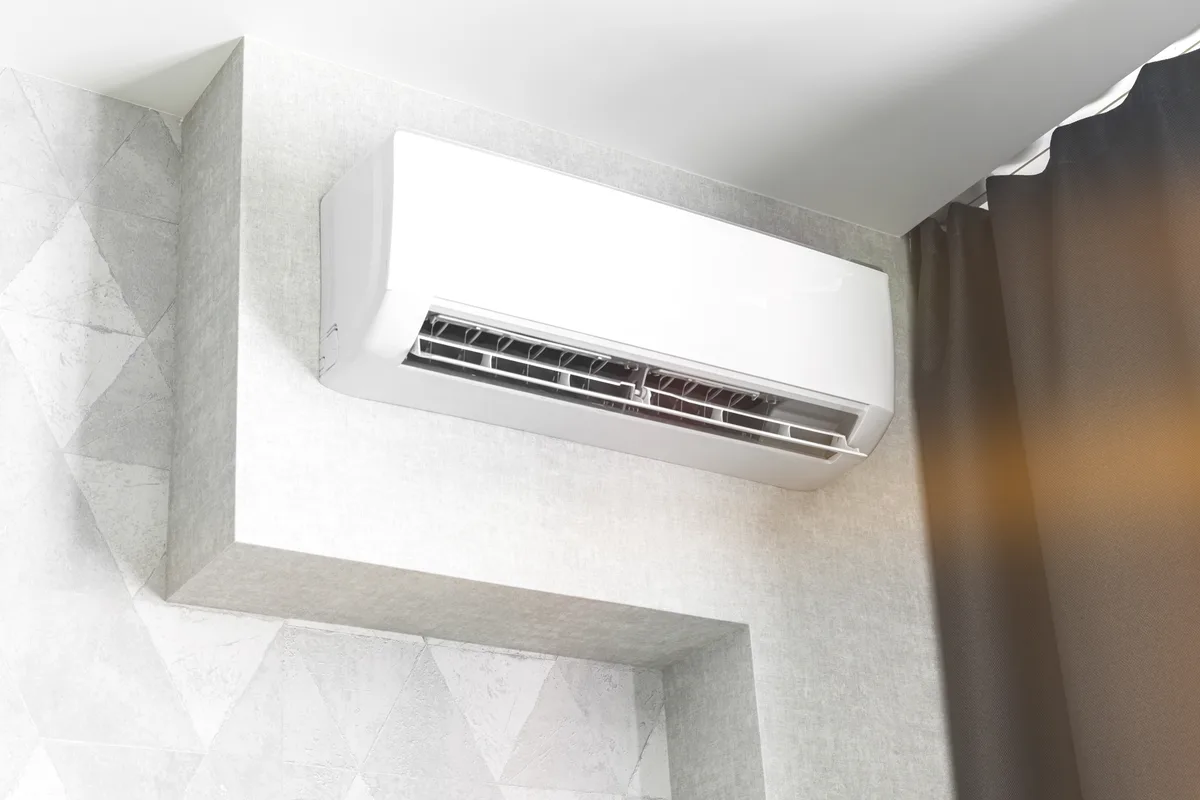
A ductless unit solves that with its own thermostat, a dry mode and a schedule that follows your training. Decision rule: one person training under an hour a day can live with added ducts and a dehumidifier. Two people, daily cardio equipment or hot sessions call for a dedicated ductless unit.
Dehumidifier or ERV: Which One a Basement Gym Needs
They do different jobs, and a hard-used gym often needs both. A dehumidifier removes moisture that is already in the room. An ERV exhausts stale air and brings in outdoor air, recovering most of the heat and some of the moisture on the way through.
The catch is summer near Lake Ontario. On a humid July day in Burlington, Oakville or Stoney Creek, outdoor air carries more moisture than the basement air it replaces, so ventilating alone can make the room wetter. The dehumidifier is the primary tool from June to September, and the ERV handles carbon dioxide and odour all year.
- Set the dehumidifier to 45–50% relative humidity and let it drain to a floor drain or condensate pump, not a bucket.
- A ducted whole-home dehumidifier tied into the return runs $1,500–$3,000 installed and treats the whole basement.
- Run the ERV on a timer or a wall switch during and after each session.
- An HRV dries the room in winter but adds moisture load in summer; the HRV vs ERV comparison explains which core suits a damp basement.
Free quotes, written pricing.
Garage Gym: Why House Ductwork Cannot Serve It
Ontario's Building Code does not allow the duct system serving a house to be interconnected with an attached garage. The wall and ceiling between them are built as a barrier against exhaust fumes, gasoline vapour and fire, and a supply or return opening defeats it. A contractor offering to cut a register into the garage wall is offering something that fails a home inspection and can pull carbon monoxide into the bedrooms.
So a garage gym gets a separate system with no connection to the furnace. There are three workable choices.
- Ductless heat pump: heats, cools and dehumidifies from one wall-mounted unit, with a cold-climate model for an unheated garage. A single zone runs $4,000–$7,000 installed.
- Gas unit heater: heat only, installed to CSA B149.1 by a TSSA-licensed gas technician. The code and the rating plate set the mounting height, clearances to combustibles, venting to the outdoors and gas-line sizing. Choose a sealed-combustion model so the burner is not drawing chalk dust and room air.
- Electric heater: simple to install under an ESA permit, with the highest running cost of the three. Like the gas heater, it does nothing for summer heat or humidity.
Insulate first. An uninsulated overhead door and bare block walls will swallow any heater, and a sealed, insulated garage then needs a way to exhaust stale air. Our garage heater installation page covers the gas option in detail.
Sizing and Placement Details That Matter in a Gym
Capacity is calculated with the people load added, then matched to an inverter unit with a low minimum output so it can run long and slow. Long run time is what removes moisture. A unit that is too big will cool the room in ten minutes and never dry it.
- Aim the airflow across the room, not at the rack or the treadmill. Cold air on a sweating back is why people turn the unit off.
- Keep the indoor unit away from the chalk bowl and clean its filter monthly; chalk and rubber dust load a filter faster than household dust.
- Put the treadmill on its own circuit. The heat pump needs a dedicated circuit as well, installed under an ESA permit.
- In a low basement, check head clearance: a wall unit needs space above it to draw air in.
What a Home Gym System Costs
- Single-zone ductless heat pump for a basement or garage gym: $4,000–$7,000 installed
- Cold-climate upgrade for a garage: roughly $500–$1,500 more
- Ducted dehumidifier on the furnace return: $1,500–$3,000 installed
- Added supply and return runs: written quote, driven by whether the ceiling is open or finished
- Gas unit heater: written quote, driven by the length of the gas line and the vent route
Verdict: The Right Setup for Each Kind of Gym
- Light use in a basement with an open ceiling: add a supply and a return, and run a dehumidifier at 45–50%.
- Daily or two-person use in a basement: a dedicated ductless unit, plus an ERV if the room has a door that closes.
- Attached garage used year-round: insulate, then a cold-climate ductless heat pump.
- Attached garage used mostly in winter: a sealed-combustion gas unit heater, with a dehumidifier for the shoulder seasons.
None of this is urgent in the way a dead furnace is, but damp equipment rusts and wet drywall grows mould, so do not leave a foggy gym for another summer. When you call, we measure the room, ask how many people train and for how long, and price the options in writing. Start with our ductless mini-split service or request a quote.
Frequently asked questions
What temperature and humidity should a home gym be kept at?
Most people train comfortably between 18°C and 20°C, a few degrees cooler than the rest of the house, with relative humidity between 40% and 50%. Humidity matters more than the temperature number: at 60% the same 19°C room feels close and equipment starts to rust. A separate thermostat or ductless remote lets the gym run cooler without chilling the bedrooms.
Can I use a portable air conditioner in a garage gym?
It will take the edge off, but a single-hose portable unit exhausts room air outdoors and pulls hot, humid replacement air in through every gap, so it fights itself. It also needs its hose routed through a wall or window, not into the house. For a gym used a few times a week it is a stopgap; for regular use a ductless unit dries the room far better.
Is a ceiling fan or floor fan enough for a basement gym?
A fan moves air across your skin, which helps sweat evaporate, but that moisture stays in the room. In a closed basement the humidity climbs with every session and the fan does nothing to lower it or to bring in oxygen-rich outdoor air. Use fans for comfort alongside a dehumidifier and some form of ventilation, not in place of them.
Do I need a carbon monoxide alarm in a garage gym with a gas heater?
Yes. Ontario already requires carbon monoxide alarms in homes with a fuel-burning appliance or an attached garage, and a room where you are breathing hard beside a gas appliance deserves its own. Mount one in the gym, keep the heater's vent clear of snow, and never train with a vehicle idling in the garage, even with the door open.