
Quick answer
A forced-air house gets dusty when the return side of the system pulls in dust faster than the filter can catch it. The usual culprits are leaky return ducts in the basement, a gap around the filter, a low-grade filter, and dry winter air that keeps dust airborne. Sealing the returns and upgrading the filter fixes most cases; duct cleaning alone rarely does.
If you are asking why is my house so dusty, the answer is almost never that the house is dirty. In a home with a furnace and ductwork, the blower moves the entire volume of air in the house several times an hour, and everything on the return side of that loop — the grilles, the joist cavities, the filter rack — decides how much dust rides along. Find the leak or the gap, and the dusting schedule goes back to normal.
The return ducts are usually the source
Supply ducts push air out; return ducts pull air in, and any opening on the return side inhales whatever is nearby. In 1950s and 1960s bungalows in Aldershot and Roseland, the returns are often panned joist bays — sheet metal nailed under the floor joists — so the system breathes through every crack in the framing, insulation dust included. Duct joints in 1970s–90s subdivisions like Tyandaga and Millcroft were rarely sealed at all, which is why the basement ceiling near the furnace collects grey fuzz. The signs that point to the returns:
- Dust puffs from registers for a few seconds when the blower starts
- A grey line of dust on the ceiling or carpet along a joist bay or duct run
- The basement feels drafty near the furnace while the fan runs
- The filter loads on one side, or one corner stays clean because air is bypassing it
The fix is sealing, not cleaning: mastic on the return trunk seams, foil tape (not cloth duct tape) on the boots, and a proper filter rack cover. That is the part of duct sealing that pays for itself in fewer dust cloths.
Check the filter slot before you blame the filter
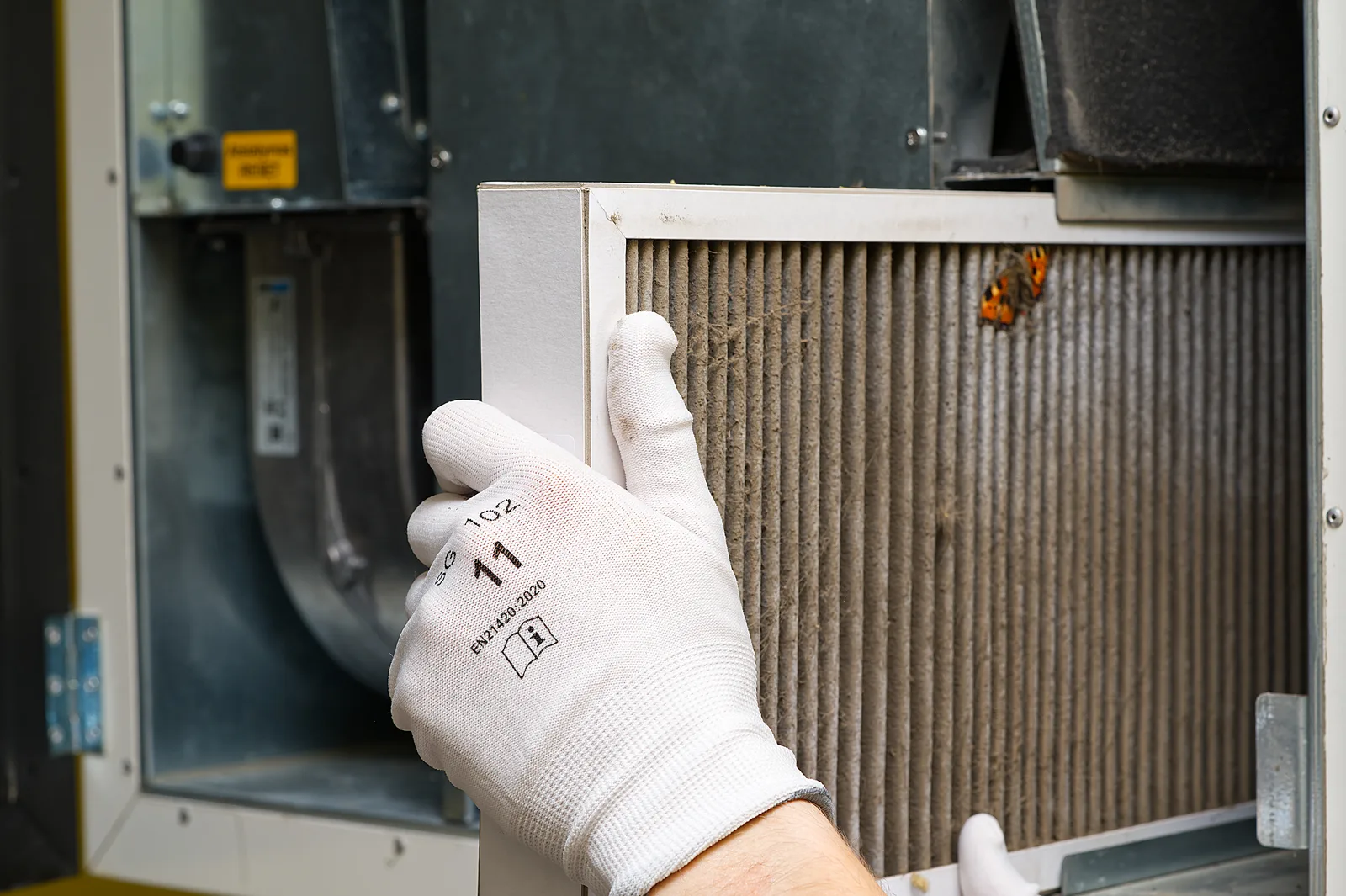
A filter can only catch dust that passes through it. If the slot is a size larger than the filter, or the cover is missing, a good share of the air goes around the media and straight into the blower. Standard 1-inch fibreglass filters catch little household dust anyway — they exist to protect the blower, not your lungs.
- Look for a gap: with the blower running, hold a tissue near the edge of the filter door. If it pulls in, air is bypassing.
- Move to a pleated MERV 8 filter in a 1-inch slot, or MERV 11 if the furnace has a generous return. Our MERV ratings guide explains the trade-offs.
- Change it every 60–90 days in heating season; a loaded filter forces air around itself. See how often to change a furnace filter.
- If you want MERV 13 filtration, ask about a 4-inch media cabinet — it filters better with less restriction than a dense 1-inch pleat.
Dry winter air makes dust worse
Between December and February, a Burlington house without a humidifier often drops below 30% relative humidity, because the outdoor air the furnace warms holds little moisture to begin with. Dry air holds a static charge, so dust clings to screens, baseboards and blinds instead of settling where a vacuum can reach it, and pet hair drifts for hours. Bringing humidity up to 30–40% with a whole-home humidifier makes an obvious difference to the dusting cycle, and it is the same fix that stops the static shocks; see whether you need a humidifier in winter.
When duct cleaning is the right call — and when it is not
If the dust started after drywall work, a basement finish or a flooring tear-out, the ducts themselves are loaded and a one-time duct cleaning is the right answer; drywall dust is fine enough to pass a builder-grade filter and keeps shedding for months. If the house has always been dusty, or dust comes back within weeks of a cleaning, the ducts are not the reservoir — the leaks and filter bypass are refilling them. Cleaning without sealing is paying to empty a bucket with a hole in it.
One more source homeowners overlook: an unfinished basement or crawl space with a bare concrete or dirt floor. Concrete sheds fine dust as it ages, and a return leak in that space is a direct pipeline upstairs. Sealing the leak and painting or sealing the slab usually ends it.
Related questions, answered briefly
- Does a dusty house mean my ducts are dirty? Not necessarily — it usually means the return side is leaking or the filter is being bypassed, which is why dust returns quickly after a cleaning.
- Can an air purifier fix a dusty house? A whole-home media filter or purifier removes what passes through it, but it cannot keep up with an unsealed return pulling dust out of a joist bay. Seal first, filter second.
- Why is one room dustier than the others? Check that room's return path: a return grille that connects to a leaky joist bay, or a supply run that passes through an unfinished space with an open joint.
- Will a humidifier reduce dust? It shortens how long dust stays airborne and stops static from holding it to surfaces, so it helps, but it does not remove the source.
ZK Mechanical seals and cleans ductwork across Burlington, Oakville and Hamilton, and we start with a static-pressure test and a look at the returns rather than a sales pitch for cleaning. If your house is dusty no matter how often you vacuum, book a duct assessment in Burlington or contact us and describe what you are seeing.