
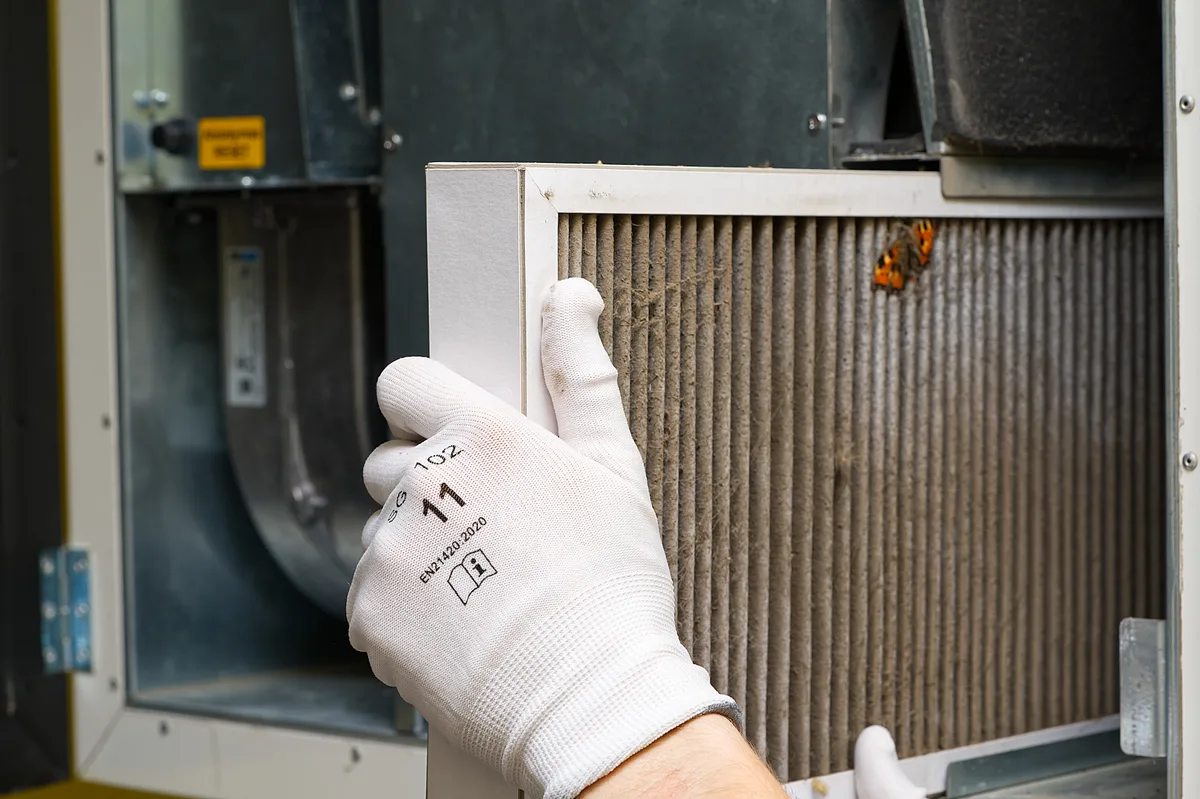
Media filter vs electronic air cleaner: which is better? For most Ontario homes the media filter is, because a 4- to 5-inch pleated filter rated MERV 11 to 13 keeps its efficiency for 6 to 12 months with no attention, while an electronic air cleaner only performs when its cells are washed about once a month. Keep a working electronic unit if you will wash it on schedule and nobody in the house reacts to ozone. Convert it to a media filter when the power supply fails, the cells are damaged, or the washing has stopped happening.
How a Media Cabinet Cleans the Air
A media cabinet is a sheet-metal box on the return duct beside the furnace that holds one deep pleated filter, 4 to 5 inches thick, rated anywhere from MERV 11 to MERV 16. The depth is the point: the pleats give it several times the surface area of a 1-inch filter, so it can trap finer dust without choking the blower. There are no wires, no power and nothing to wash. You slide the old filter out and a new one in every 6 to 12 months, sooner with pets, renovation dust or a furnace fan that runs all day.
How an Electronic Air Cleaner Works and Where It Fails
An electronic air cleaner, properly an electrostatic precipitator, charges particles instead of straining them. Air passes a mesh pre-filter, then a row of fine ionizing wires held at several thousand volts, then a stack of aluminum collector plates that pull the charged dust out of the airstream. A clean unit catches very fine particles, smoke included, with almost no resistance to airflow.
The weakness is that efficiency falls as the plates load up. Once they are coated, charged dust has nowhere to stick and passes through to the ducts. These are the failures we see on units from the 1990s and 2000s.
- Dirty cells: collection drops off within weeks, and the black dust that should be on the plates ends up on supply registers and walls instead.
- Arcing: the snapping or zapping sound means dirt, a bent plate or a damp cell is letting the high voltage jump the gap. Each arc makes a little ozone.
- Broken ionizing wire: a snapped wire shorts the cell or leaves a section uncharged. Wires are replaceable, but they are fine and easy to break again when washing.
- Dead power supply: the high-voltage pack fails with age, the indicator light goes out, and the cabinet becomes a coarse mesh screen. On an older model the part can be hard to find.
Washing is the whole maintenance plan. Pull the cells and pre-filters about once a month, soak them or run them through the dishwasher if the manual allows it, and let them dry completely before they go back in, because a cell reinstalled damp will arc. If yours has stopped working and you want it fixed, that is an electronic air cleaner repair call.
Do Electronic Air Cleaners Produce Ozone?
Yes, in small amounts. The corona around the ionizing wires makes some ozone in normal operation and more when the cells are dirty and arcing. A well-maintained unit keeps the amount small, but ozone is a lung irritant, and Health Canada's advice is to keep indoor ozone as low as possible and to avoid devices that generate it on purpose. For a household with asthma, a newborn or anyone who notices the sharp smell these units give off, that settles the question in favour of a media filter, which produces none.
Pressure Drop: The Number That Has to Suit Your Furnace Blower
A better filter only helps if the blower can still move enough air through it. Furnace nameplates list a maximum external static pressure, commonly 0.5 inches of water column, and that budget has to cover the filter, the cooling coil and all the ductwork. A 4- to 5-inch MERV 11 or 13 filter in a correctly sized cabinet uses a modest share of it. A MERV 16 filter, or any deep filter on a return duct that was undersized to begin with, can push the system past its rating.
When that happens a PSC blower moves less air, so the furnace runs hot and trips its limit switch in winter and the cooling coil ices up in summer. An ECM blower speeds up to compensate, using more electricity and making more noise. We measure static pressure with a manometer before and after a filter change, and if the reading is high the fix is a bigger cabinet, a second return or a lower MERV rating. The answer page on whether a furnace filter can be too restrictive explains the symptoms, and MERV ratings explained covers what each number catches.
Free quotes, written pricing.
This is the one place an electronic air cleaner has a real edge. Its open plates add very little resistance, so on 1950s–60s bungalow ductwork with a single small return it can clean finer particles than those ducts would tolerate through a dense pleated filter.
Converting an Old Electronic Air Cleaner to a Media Filter
Many conversions need no duct changes at all. Electronic cabinets were built in a handful of standard sizes, 16x25 and 20x25 being the common ones, and retrofit media filters are made to slide onto the same rails once the cells and pre-filters come out. The power supply is switched off and disconnected so nothing in the cabinet stays live. We measure the cabinet and check the model before promising a drop-in fit, because a few older designs need an adapter frame.
The exception is a cabinet that is rusted, leaking air or the wrong size for the furnace now connected to it. Then a new furnace filter cabinet is the better job: the old box is cut out, a media cabinet sized to the return goes in, and the seams are sealed so air cannot bypass the filter.
What Each One Costs to Own
Neither option has a single published price, because the cost is driven by the cabinet size, how much sheet metal has to change and whether power is nearby. What you can compare is where the money goes over ten years.
- Media filter: one replacement filter every 6 to 12 months and no electricity. A retrofit into an existing electronic cabinet is the cheapest route because the sheet metal stays.
- Electronic air cleaner: no filters to buy, a small electrical draw, and your time at the sink every month. The cost arrives when the power supply or a cell fails on a unit old enough that parts are scarce.
- New media cabinet on a furnace that has only a 1-inch filter slot: sheet-metal labour to cut it into the return, plus the cabinet and the first filter.
- A visit to diagnose a dead or arcing electronic unit: the standard $90–$150 diagnostic, credited toward the repair if you go ahead.
We give the installed price in writing after seeing the return duct, and we will tell you if the existing cabinet can be reused.
Verdict: Media Filter for Most Homes, Electronic Only for the Disciplined
The media filter wins for most households because it works the same on day 200 as on day one and asks for one or two filter changes a year. An electronic air cleaner that is washed monthly is a good air cleaner; one that is washed twice a year is a noisy box doing less than a basic pleated filter.
- Choose a media filter if you want low maintenance, if anyone at home has asthma or allergies, or if your electronic unit needs a part.
- Keep the electronic air cleaner if it works, you wash it monthly without fail, nobody notices the ozone smell, and your ducts cannot spare the static pressure a deep pleated filter needs.
- Convert when you hear arcing that washing does not stop, the indicator light is out, or the cells are bent or missing wires.
- Add something else if the goal is odours, germs or humidity: a filter of either type only removes particles.
ZK Mechanical measures static pressure, checks the cabinet and quotes the conversion or a new cabinet in writing across Burlington, Oakville, Hamilton and Mississauga. Start with air purifier and filtration installation, or send us the model number and a photo of the cabinet.
Frequently asked questions
Can I leave the electronic air cleaner switched off and use it as a filter?
Not well. With the power off, only the mesh pre-filter catches anything, and it stops lint and hair, not fine dust. Everything smaller goes through to the cooling coil and the blower, where it builds up and costs you airflow. If you are not going to power and wash the unit, pull the cells and fit a retrofit media filter in the same cabinet.
What MERV rating should I buy for a media cabinet?
MERV 11 suits most houses and catches fine dust, pollen and pet dander. Step up to MERV 13 for allergies or smoke if a static pressure test shows the blower has room for it. Treat MERV 16 as a special case: it captures the finest particles but restricts airflow the most, and it belongs only on a system that has been measured with it installed.
Why does my electronic air cleaner keep snapping after I washed it?
Usually the cells went back in damp. Give them a full day to dry and try again. If the snapping continues on dry cells, look for a bent collector plate, a broken ionizing wire or a cracked insulator, any of which lets the voltage jump. Switch the unit off until it is checked, because every arc produces ozone and the noise will not fix itself.
Does a media filter help with wildfire smoke?
A MERV 13 media filter captures a good share of fine smoke particles on each pass, provided the furnace fan is running to move air through it. During a smoke event, set the thermostat fan to ON, keep windows closed, and expect the filter to load faster than usual. Check it when the smoke clears and replace it early if it has turned grey.