
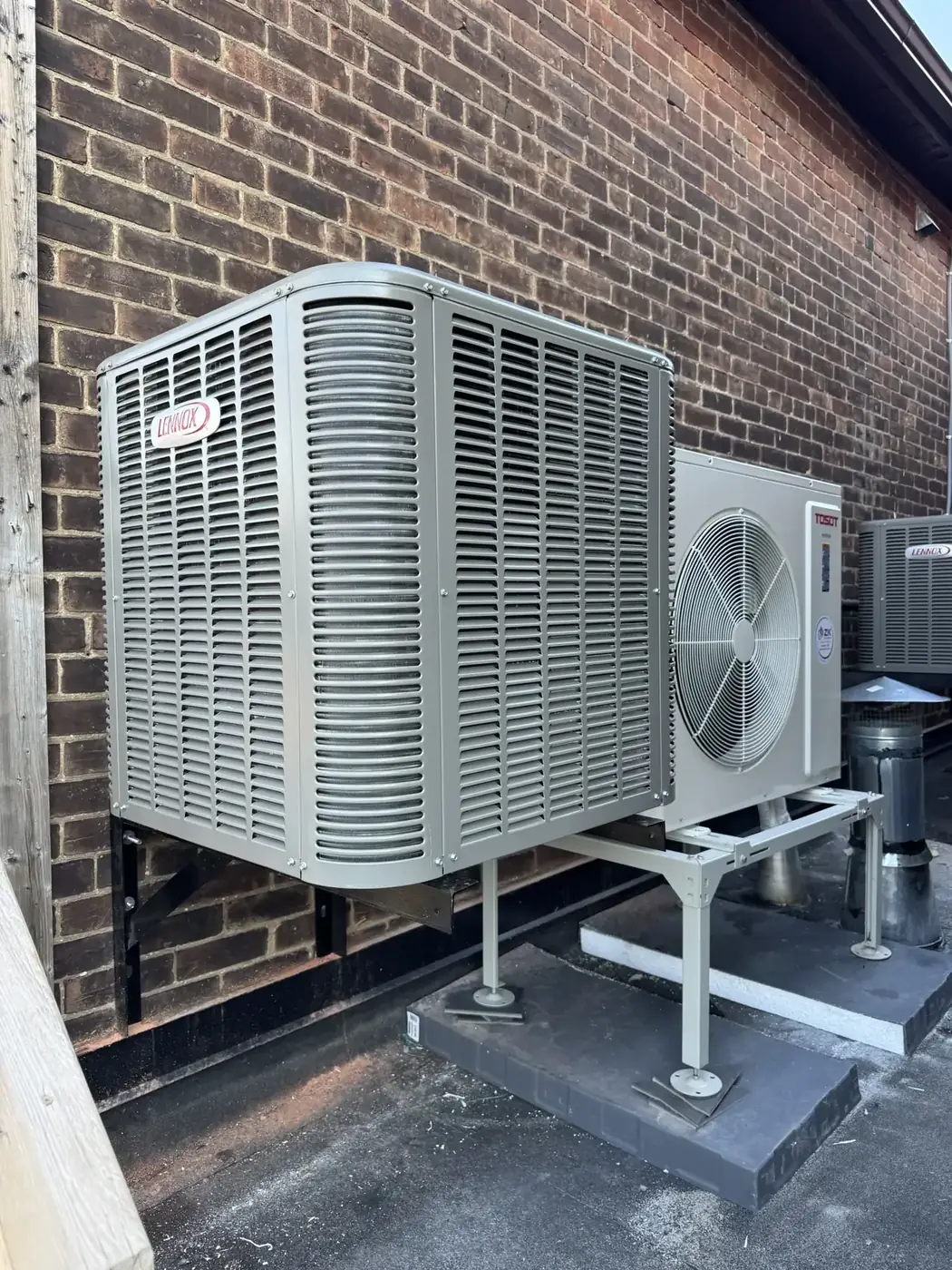
To winterize your air conditioner in Ontario you need to do far less than the internet suggests: clear the leaves out of the base, shut off power at the outdoor disconnect, put a lid on the top only, and keep falling ice and sliding roof snow off it. A condenser is built to sit outdoors and it survived every winter before you owned the house. The two things that genuinely damage units over a Halton winter are moisture trapped under a full cover and ice dropping onto the fan grille from the eaves.
One exception first, and it is not a small one. If you heat with a heat pump rather than a straight air conditioner, do none of this. That outdoor unit is your heating system from October through April and it needs to stay powered, clear and draining all winter.
Never Wrap the Whole Unit
Full covers cause the failures they are sold to prevent. Sealing a condenser inside a fitted vinyl or plastic bag traps humidity against the coil and the electrical compartment, so the cabinet spends five months damp instead of dry, and corrosion at the contactor and along the fin edges accelerates rather than slows.
Worse, a wrapped condenser is a warm, dry, sheltered box in a cold yard. Mice move in, nest in the fan shroud and chew the low-voltage wiring and the compressor leads. Every spring we open at least one unit whose only fault is rodent-chewed wire underneath a cover the homeowner bought to protect it.
If you want to cover it, cover the top only. A piece of exterior plywood cut slightly larger than the cabinet and weighted with a paver works perfectly, as does a purpose-made breathable top cover with open sides. That keeps leaves, twigs and dripping ice out while letting the cabinet breathe.
What Actually Damages a Condenser Over an Ontario Winter
- Ice released from a two-storey eave. A slug of ice off a gutter splits the top grille and bends a fan blade, and after that the unit still runs but out of balance.
- Snow sliding off a steep asphalt or metal roof onto a unit tucked against the wall, which is common on the newer builds in Alton Village and the Orchard where condensers sit under a bump-out.
- Meltwater from a downspout discharging beside the unit, freezing and lifting the pad out of level.
- Drifted snow packed over the cabinet during a lake-effect squall off Lake Ontario, then refreezing into a solid block.
- Somebody running the air conditioner on a mild January day, which is exactly why the disconnect gets switched off.
- Mice, nesting under a full cover and chewing wire all winter.
The Fall Shutdown, in Order
- Late October, once the maples are down: pull the leaves and seed pods out of the base and off the coil, and rinse the fins while the outdoor tap is still on.
- Cut the perennials back and trim the hedge away from the sides. Anything you leave standing becomes a snow trap by January.
- Shut the outdoor disconnect — the small grey box on the wall beside the unit — or the AC breaker in the panel. This is the step that prevents a warm-spell run.
- Add a downspout extension so roof melt discharges well clear of the pad instead of icing up beside it.
- Fit a plywood lid or a breathable top cover and weight it down. Leave all four sides open.
- Note the date somewhere. In spring you restore power at least a full day before using the system, and the rest of the sequence is in our spring AC startup checklist.
Why Killing Power Is Really About the Compressor
Because a compressor started cold slugs liquid. On a 10°C afternoon in February somebody flips the thermostat over to cool just to check, the compressor starts with refrigerant sitting in cold oil, and the damage happens in the first few seconds and does not undo itself. Cutting power at the disconnect makes that impossible for anyone in the household.
Free quotes, written pricing.
The trade-off is that the crankcase heater is off too, which is exactly why the spring rule is to re-energize the disconnect a full day before the first cooling call rather than five minutes before.
Heat Pumps Get the Opposite Instructions
Leave it powered, leave it clear, and keep it up out of the snow line. A heat pump runs through the whole heating season, so it needs electricity, unobstructed airflow on all four sides and room underneath for defrost meltwater to drain away. Shovel a path around it after a storm, brush the top clear, and never chip ice off the coil with a tool — the fins and the copper are thinner than they look.
If it periodically steams and pauses, that is the defrost cycle doing its job rather than a fault. What the defrost cycle looks like explains the plume, the noise and the few minutes of cool indoor air that come with it.
Elevated stands matter here. On the Hamilton Mountain, up in Waterdown and anywhere the snow piles deep against a north wall, we set heat pumps and condensers on risers so the coil clears the drift line and defrost water cannot freeze into a slab beneath the unit. A stand tall enough to clear the expected drift is the fix, and it costs little to do at install time.
While You Are Out There, Check the Furnace Vent
Walk the perimeter and find the white PVC pipes. High-efficiency furnaces and tankless water heaters vent through plastic pipe on an exterior wall, usually a metre or so above grade, and a drift or a plow bank across them shuts the appliance down on a pressure switch — often at three in the morning, in the coldest week of the year.
Clear both pipes after every significant snowfall, and keep them in mind when deciding where the shovelled snow goes. If it has already happened to you, what to do when a furnace vent is blocked by snow covers the safe reset.
What You Do Not Need to Do
- You do not need to drain the refrigerant. It is a sealed system and the refrigerant belongs inside it year round.
- You do not need to cover the indoor coil. It lives inside the furnace plenum where nothing can reach it.
- You do not need a special winter service visit. The air conditioner's real inspection belongs in spring, with gauges, when the system can actually be run.
- You do not need to remove the condenser and store it in the garage, whatever a neighbour tells you at the end of the driveway.
- You do not need to run the fan periodically over winter. There is nothing to circulate and nothing to keep loose.
If your condenser came through last winter with a bent grille, a pad that has lifted or wiring the mice found interesting, that is a spring service call rather than an emergency, and it is cheap next to the alternative of discovering it during a heat wave. Reach out and we will look at it when we are next in your neighbourhood, or read what our cooling service covers.
Frequently asked questions
Should I cover my air conditioner in winter?
Cover the top, never the whole unit. A full wrap traps moisture against the coil and electrical compartment and invites rodents to nest inside. A weighted piece of plywood or a breathable top cover keeps leaves and falling ice out while the cabinet stays ventilated and dry.
Do I need to turn off the power to my air conditioner in winter?
For a straight air conditioner, yes — switching off the outdoor disconnect prevents anyone from running it on a mild winter day, which can damage the compressor. Just remember to restore power at least 24 hours before the first cooling run in spring so the crankcase heater can do its work. Never cut power to a heat pump.
Can snow damage an outdoor AC unit?
Snow sitting on a condenser is largely harmless. What causes damage is ice falling from an eave onto the top grille, snow sliding off a roof onto the cabinet, and meltwater freezing under the pad and tipping it out of level. Deal with the sources — downspout extensions, a top cover, and knowing where roof snow lands.
Should I cover a heat pump in winter?
No. A heat pump needs free airflow across the coil and clear drainage underneath it while it is heating your house, and covering it will cause the failures you are trying to prevent. Keep snow shovelled away from all four sides, keep the top clear, and leave the power on.
When should I winterize my AC in Ontario?
Late October is the natural window here — after the leaves have come down and before the first hard freeze, while the outdoor tap still works for a final coil rinse. Doing it the same weekend you book the fall furnace tune-up means the whole system is dealt with in one pass.