
Quick answer
A furnace humidifier leaking water has one of three causes: a blocked drain or scaled water panel overflowing the tray, a solenoid valve stuck open and feeding water with the furnace off, or a leak on the supply side at the saddle valve or feed tube. Close the humidifier's water valve first. A new water panel is about $20–$40 and fixes most overflow leaks.
If your furnace humidifier is leaking water, close its supply valve before you do anything else. It is the small valve on the quarter-inch copper or plastic tube that runs from a cold water pipe to the humidifier. With the water off, the leak stops and you have time to work out which of three places it came from: the drain side, the solenoid valve or the supply line.
Overflowing tray: a clogged drain line or a scaled water panel
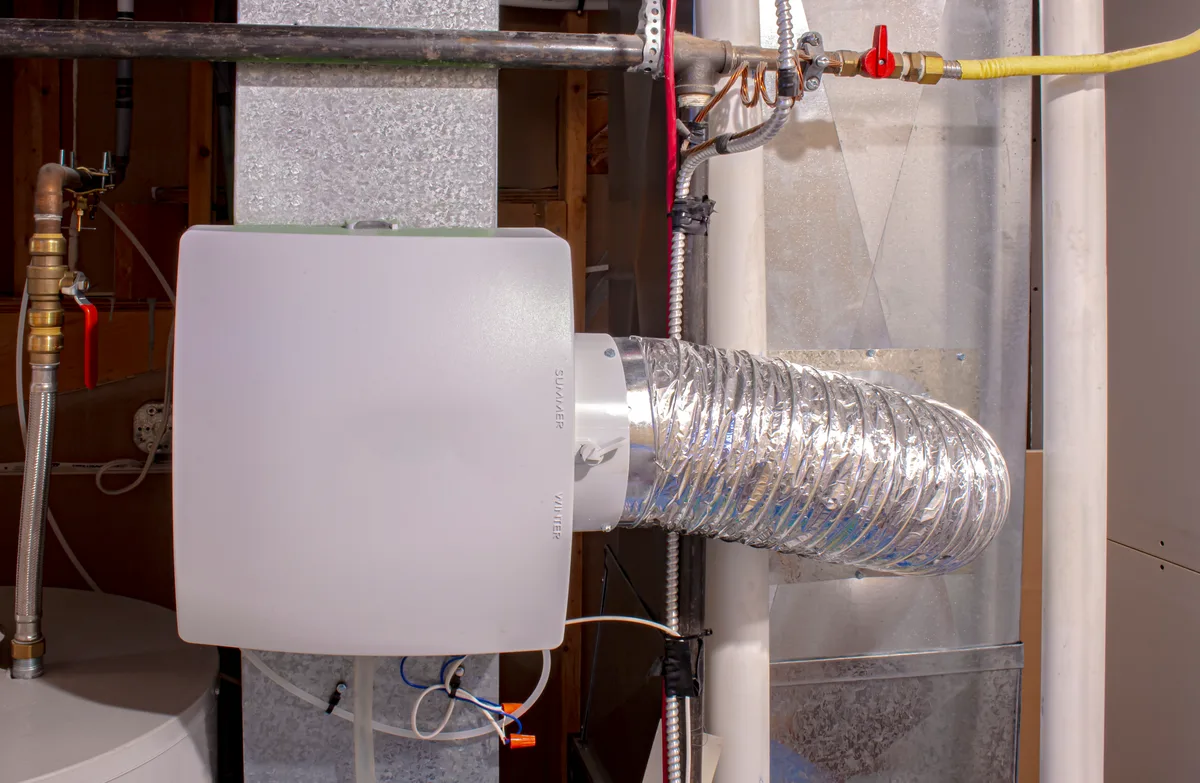
Most leaks from a bypass or fan-powered humidifier are drain-side overflows. These units trickle water across a water panel (the evaporator pad), and whatever does not evaporate runs out the bottom through a drain tube to the floor drain or condensate pump. Halton and Hamilton water is hard, and the minerals left behind collect in three spots: the distribution tray on top of the panel, the panel itself, and the drain spud and tube at the bottom.
When the distribution tray scales up, water runs off one edge instead of spreading across the panel and drips down inside the housing. When the drain tube plugs with scale or slime, the bottom of the housing fills and spills out the front cover or the back, against the duct. A panel that is a season or two overdue is stiff and white with mineral, and water sheets off its face instead of soaking in. A unit mounted out of level does the same thing with a clean panel.
Water running with the furnace off: a solenoid valve stuck open
If water is trickling down the drain tube while the furnace sits idle, the solenoid valve is not closing. The solenoid is the brass or plastic valve where the feed tube enters the humidifier. It should open only when the humidistat calls for moisture and the furnace is running. A grain of scale or solder on the valve seat holds it open, and it then runs water around the clock, summer included.
You can confirm it in a minute. Turn the humidistat to its lowest setting or Off, wait for the furnace to stop, and watch the drain tube. Water still flowing means the valve needs cleaning or replacing. Old drum-style humidifiers fail differently: a float valve sticks, the pan overfills and water runs over the rim.
Leaks on the supply side: saddle valve, feed tube and water pressure
- Saddle valve. The self-piercing clamp valve that taps the water pipe seals with a small rubber gasket and a needle. The gasket hardens, the stem packing weeps, and the valve often leaks more after it has been turned for the first time in years. The lasting fix is a proper quarter-turn shut-off in its place.
- Feed tube. Quarter-inch plastic tubing goes brittle beside a hot plenum and cracks at the compression nut. Copper tube kinks and pinholes where it has been bent or has rubbed against sheet metal.
- Water pressure. High house pressure forces water past compression fittings and can keep a marginal solenoid from seating.
- Missing orifice. A small restrictor in the feed line meters the flow. If it was left out after a service, the panel gets more water than the tray and drain can carry.
Why a humidifier leak into the furnace cabinet cannot wait
A humidifier hangs on the supply plenum or the return drop, directly above or beside the furnace. Water that gets past the housing runs down the duct wall and into the cabinet. On the return side it lands in the blower compartment, where the control board and its low-voltage connections sit. On the supply side it runs down onto the heat exchanger and the top of the cabinet, and rusts steel that is meant to stay dry.
Look for rust streaks on the cabinet below the humidifier, white mineral trails on the duct, and water in the bottom of the blower compartment. If the board has been wet, switch the furnace off at its power switch and leave it off until it has been checked: a wet board can short and take the transformer or fuse with it. Water at the base of the furnace has other sources too, and why a furnace leaks water sorts the humidifier from the condensate drain.
What to check yourself, when to call, and what the repair costs
- Close the supply valve and dry the area so you can see where new water appears.
- Pull the cover and look at the water panel. Crusted, stiff or collapsed means replace it. The panel is changed every heating season, in the fall before the first cold week, and twice a season on very hard water.
- Pull the drain tube off the bottom spud and flush it at a sink. Check that it slopes downhill the whole way with no sag holding water.
- Lift out the distribution tray and clear its holes with a toothpick.
- Turn the water back on, set the humidistat high with the furnace running, and watch for five minutes.
Call a technician instead of carrying on if:
- Water has reached the control board or is sitting inside the blower compartment.
- The supply valve will not close, or the saddle valve leaks where it clamps the pipe.
- Water keeps running through the drain tube with the humidistat off.
- Water panel: about $20–$40 for the part.
- Diagnostic visit: $90–$150, credited to the repair when you proceed.
- Solenoid valve, feed tube or supply valve replacement: most humidifier repairs land in the $150–$450 band.
- Replacement when the housing is cracked or scaled beyond cleaning: $500–$900 installed for a bypass unit, $700–$1,200 for a fan-powered one.
A humidifier that has leaked for years is often cheaper to replace than to rebuild, and a new one comes with a proper supply valve and drain. ZK Mechanical does both humidifier repair and humidifier installation from the Burlington shop. For a unit that has stopped adding moisture instead of leaking, see why a furnace humidifier is not working. Send photos or request a visit, and browse the other air quality and ducts answers.