
Quick answer
Yes, run your AC during wildfire smoke. A central air conditioner recirculates the air already in the house and does not pull smoke in from outside. Keep windows shut, set the thermostat fan to ON so air passes the filter continuously, use a MERV 13 filter if your system can handle it, and turn the HRV or ERV down or off when the AQHI is 7 or higher.
You should run your AC during wildfire smoke, and the reason is how a central system moves air. The outdoor unit never exchanges air with the house: it only carries heat out through two copper refrigerant lines. The indoor blower pulls air from your rooms through the return grilles, across the filter and the cooling coil, and sends the same air back. A closed-up house with the AC running stays cooler and cleaner than one with the windows open.
How to set the system when the AQHI reaches 7
Environment Canada's Air Quality Health Index runs from 1 to 10+, and 7 and above is the high-risk band where special air quality statements for smoke are issued. Treat 7 as the trigger for the settings below. They follow Health Canada's wildfire smoke advice: recirculate, filter, and limit outdoor air.
- Close windows and doors, including basement windows and the door to an attached garage.
- Set the thermostat fan to ON instead of AUTO. The filter only cleans air while the blower runs, and in AUTO it runs just when the compressor does.
- Fit a MERV 13 filter if the system can take it. MERV 13 is the lowest rating tested to capture at least half of the finest particle size range, where smoke sits; a MERV 8 is not rated for that range at all.
- Run kitchen, bath and dryer exhaust only as long as you need them. Every litre of air they push out is replaced by smoky air leaking in.
- Add a portable HEPA cleaner in the bedroom, sized to the room, and keep that door closed.
Turn the HRV, ERV or fresh-air intake down or off
An HRV or ERV does the one thing you do not want in smoke: it brings outdoor air in on purpose. Its small filters are built to stop bugs and lint and do little against smoke particles. During a special air quality statement, set the wall control to recirculation if the unit has that mode, to its lowest speed, or off, and turn it back up once the AQHI drops.
Many 2000s and newer houses have a second path: a fresh-air duct tied from an outside hood into the return duct near the furnace, sometimes with a motorized damper. If yours has a manual damper, close it for the smoke event and tag it so it is reopened afterwards. Do not block the combustion air or intake pipes that serve the furnace or water heater. Those are not ventilation; the burners need them to run safely.
Window and portable units behave differently from central air. A window unit recirculates as long as its fresh-air lever is closed. A single-hose portable air conditioner blows room air outdoors through its hose, and that air is replaced by smoky outdoor air pulled in through every gap in the house, so it is the worst choice on a smoke day. Ductless mini-splits recirculate like central air but have only a coarse screen filter.
Check the filter more often in smoke, and watch for restriction
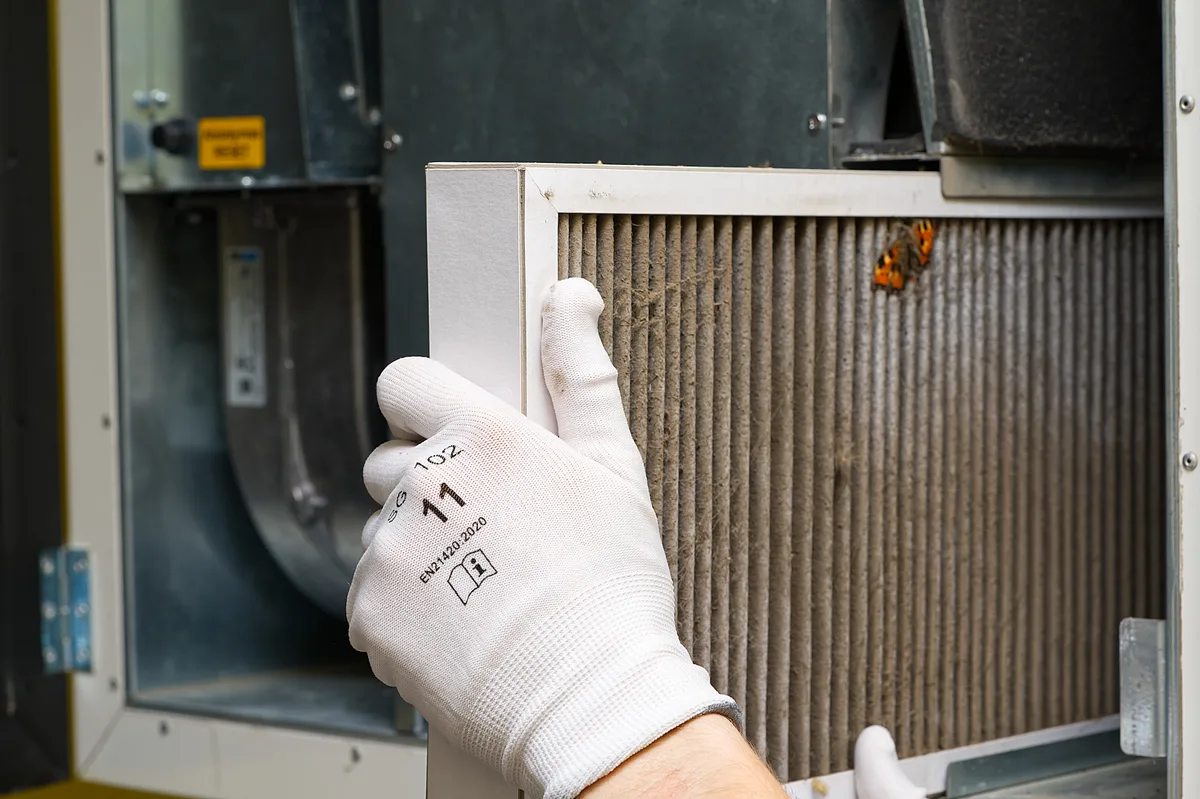
A filter that normally lasts three months can load up in two or three weeks of heavy smoke with the fan running continuously. Look at it weekly: grey-brown and smelling of campfire means it has done its job and is ready to change. Keep a spare on hand, because stores sell out once the statements start.
The catch with MERV 13 is thickness. In a standard 1-inch slot, a MERV 13 filter is restrictive enough to cut airflow on many furnaces, and low airflow in cooling season is what freezes an evaporator coil. If the vents feel weaker or the copper line at the furnace frosts, drop to MERV 11 and change it more often. Our answer on whether a furnace filter can be too restrictive explains how to tell.
Fan ON has one side effect in humid weather: between cooling cycles the blower re-evaporates some water off the wet coil, so the house can feel a little damper. In smoke, cleaner air is worth that trade. Go back to AUTO when the air clears.
Upgrades that handle PM2.5: media cabinets and HEPA bypass
If smoke season has become a regular event for your household, the permanent fix is more filter area. Three upgrades deliver it.
- Media filter cabinet. A 4- or 5-inch deep pleated filter in a sheet-metal cabinet on the return gives MERV 11 to 13 filtration at a lower pressure drop than a 1-inch filter of the same rating, and it is changed once or twice a year. See filter cabinet installation.
- HEPA bypass unit. A separate cabinet with its own fan pulls a share of the return air through a true HEPA filter and feeds it back. It filters finer than any furnace filter without loading the main blower; details are on the air purifier installation page.
- Sealed return ducts. Leaky returns in a basement or garage wall pull unfiltered air in around the filter. Sealing them makes any filter work better.
There is no flat price for these: the cost depends on the furnace's return layout, how much sheet metal has to change and whether an outlet is nearby. A static pressure reading comes first so the filter suits the blower, then the quote is put in writing.
Southern Ontario had days in June 2023 when smoke from Quebec and northern Ontario fires pushed the AQHI into the high-risk range. If someone in the house has asthma, a heart condition or is pregnant, it is worth improving the filtration before the next event. ZK Mechanical's indoor air quality service covers filtration, HEPA and ventilation settings. Contact us for an assessment, or read more in the air quality and ducts answers hub.