
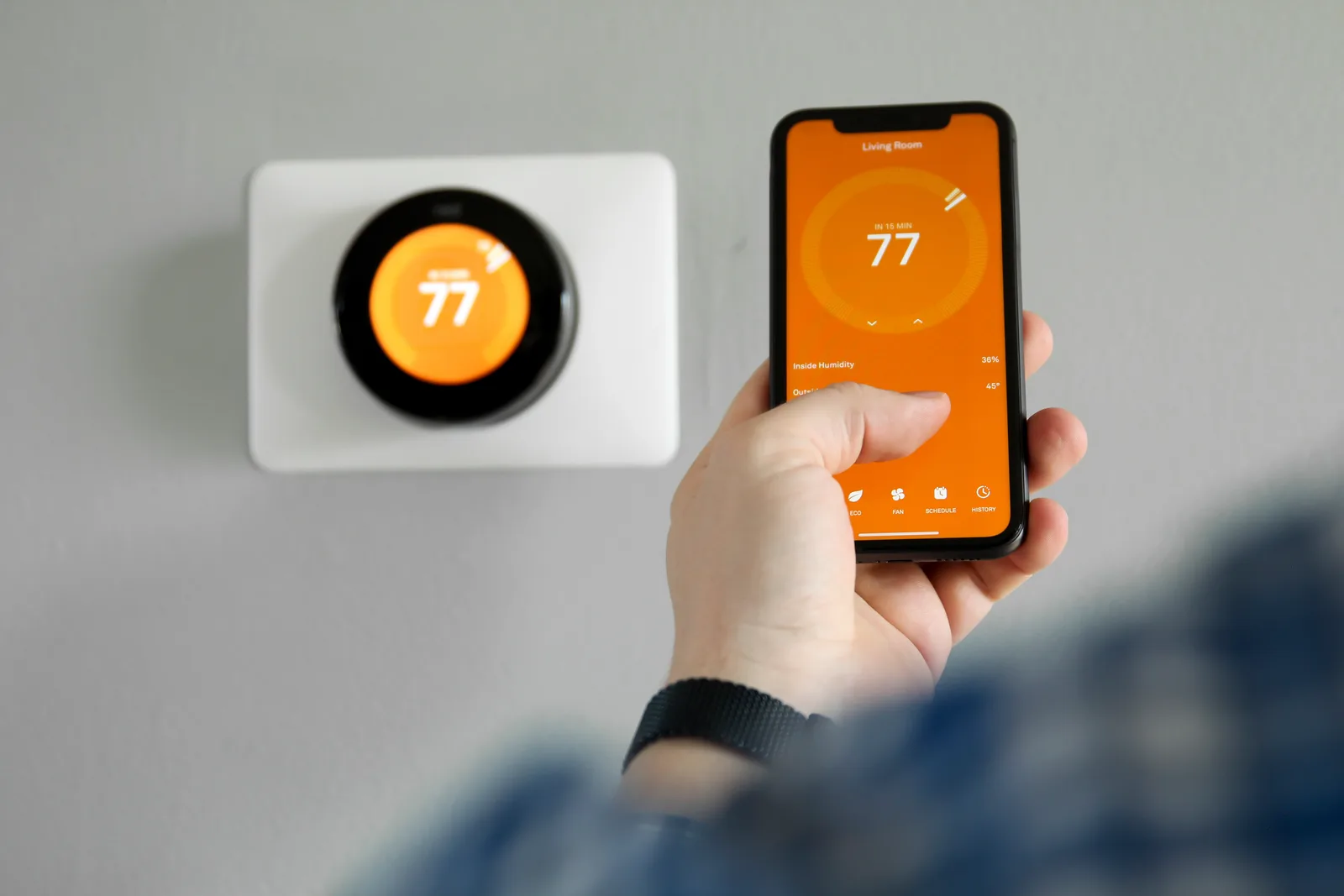
The problem
A smart thermostat is only as good as its configuration, and most are installed on the assumption that the defaults will do. Two things go wrong. Older four-wire thermostat cable has no common wire, so the thermostat steals power through the control circuit, browns out, and drops off Wi-Fi or reboots in a way that looks like a network fault. And the equipment profile is left generic, so a two-stage furnace or a heat pump is driven as a single-stage gas unit: the second stage never runs, or the heat pump hands off to electric backup at the first call for heat.
What we did
Power is sorted first with a proper 24-volt common wire or the manufacturer's adapter at the furnace board, so the thermostat has steady power and stops power-stealing. The equipment profile is then set to what is installed — W1 and W2 or Y1 and Y2 staging for a two-stage system, and for a heat pump the reversing-valve setting (O or B), the compressor lockout temperature and the auxiliary-heat lockout. Those last two settings decide whether the system saves money or quietly runs on expensive backup heat all winter.
- Smart Wi-Fi thermostat
- C-wire or adapter as required
- Equipment staging configuration
The result
A thermostat that stays on the network and drives the equipment the way the manufacturer intended, with the staging and lockouts written into the setup rather than left at defaults. Where a program is running, a qualifying smart thermostat can attract a rebate under the Home Renovation Savings Program, at an amount that depends on the channel.
Is this your situation?
This kind of work is worth a conversation if any of these sound familiar:
- The thermostat drops off the network and it looks like a Wi-Fi fault.
- You have a heat pump and suspect it is running on expensive backup heat too often.
- A two-stage or modulating furnace never seems to use its lower stage.
- The wiring at the thermostat has no common wire.
Questions about this kind of job
What is a C-wire and why does the thermostat keep dropping offline without one?
The C or common wire completes the 24-volt circuit from the furnace transformer so the thermostat has continuous power. Without it a Wi-Fi thermostat pulls power through the heating or cooling control wires, which only works between calls and can chatter the furnace relay. When its battery runs down the thermostat reboots or loses the network, which looks like a router problem but is a wiring one.
What are the aux heat and compressor lockout settings on a heat pump?
The auxiliary-heat lockout is the outdoor temperature above which the thermostat is not allowed to call electric backup; the compressor lockout is the temperature below which the heat pump is not allowed to run. Set them wrong and the system runs on strip heat at 5 °C, or tries to run the compressor when the furnace should carry the house. They are set from the equipment's capacity table and fuel prices.
Why does a two-stage furnace need the thermostat to know it is two-stage?
A two-stage furnace has two burner rates and needs a W1 and a W2 signal, or a thermostat that manages staging by run time, to use its low stage most of the time and the high stage only on cold days. Wired and configured as single-stage, every call goes straight to high fire, so the furnace runs louder, cycles more often and loses most of the comfort benefit it was bought for.
Can a smart thermostat be installed on any furnace or boiler?
Most 24-volt forced-air systems, yes, once power and staging are handled. Line-voltage baseboard heaters, some boilers with millivolt controls, and communicating systems that use a proprietary controller are the exceptions; those need either a different thermostat or the manufacturer's own control. The wiring at both the thermostat and the equipment board is checked before one is chosen.