
The problem
Boilers are quiet, they are tucked away, and they get forgotten in a way furnaces do not. The failure mode is gradual: system pressure creeping down from 12 psi and nobody topping it up, an expansion tank that lost its air charge years ago and lets the relief valve weep on every heat-up, air trapped in the top-floor radiators, or combustion drifting off where it should be. By the time a room stops heating, the underlying fault has usually been developing for a season or more.
What we did
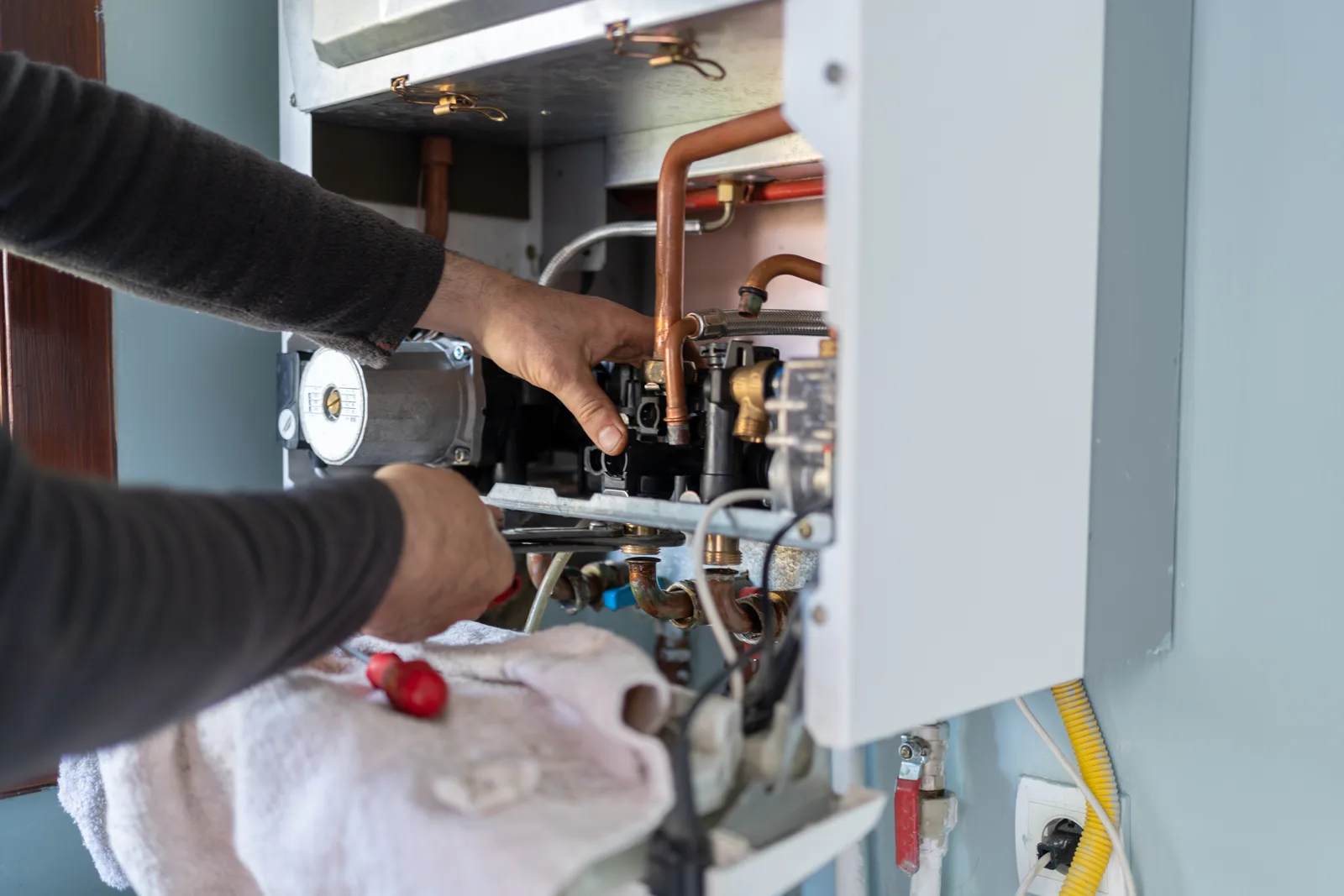
Service means opening it up and measuring, which is what the photo shows. Combustion is checked with an analyser for oxygen and carbon monoxide in the flue rather than judged by the colour of the flame; the cold fill pressure and the expansion tank's pre-charge are verified against each other; the circulator, air separator and automatic vents are confirmed to be moving water and shedding air; and the high limit, low-water cutoff and pressure-relief valve are exercised. Any loop or radiator that has not been getting flow shows up during that process instead of being reported by the homeowner in February.
- Residential gas boiler
- Circulator and expansion tank
- Combustion and control components
The result
A heating system that keeps its whole distribution working rather than losing rooms one at a time, with combustion set where the manufacturer wants it and a written record of the flue readings and pressures. Boilers that get this attention routinely outlast the ones that only get looked at when something stops.
Is this your situation?
This kind of work is worth a conversation if any of these sound familiar:
- You heat with a boiler and it has not been properly serviced in years.
- System pressure keeps dropping and needs topping up.
- Some rooms have stopped heating while others are fine.
- You want combustion measured rather than judged by the look of the flame.
Questions about this kind of job
What pressure should a residential boiler show when it is cold?
Most two-storey houses run 12 to 15 psi cold, enough to push water to the highest radiator with a little to spare, and the expansion tank's air charge is set to match that fill pressure. Pressure that keeps falling means a leak or a failed automatic feeder; pressure that climbs toward the 30 psi relief setting on every heat-up means the expansion tank has lost its charge.
Why is combustion measured with an analyser instead of by looking at the flame?
A blue flame can still be producing carbon monoxide and running off its design air-fuel ratio. An analyser in the flue reads oxygen, carbon monoxide and flue temperature and shows whether the burner is set where the manufacturer specifies. Modulating condensing boilers can only be adjusted with those readings, and the numbers are recorded so drift can be seen at the next service.
What does the expansion tank do and how does it fail?
Water expands when heated, and the expansion tank gives it somewhere to go: a rubber diaphragm separates the system water from a cushion of air. When the diaphragm fails or the air charge leaks out, the tank fills with water, pressure spikes on every cycle and the relief valve drips. Checking the charge with a tire gauge is a routine part of service.
How often should a boiler be serviced?
Once a year before the heating season, and manufacturers of condensing boilers often make annual service a warranty condition. The visit covers combustion readings, pressure and expansion tank, cleaning the condensate trap on a condensing model, checking the circulator and safety controls, and bleeding air from the distribution. Skipping a year rarely causes a failure; skipping several is how the gradual faults accumulate.