
The problem
Duct cleaning has a reputation problem, earned by the $99 flyer that turns into several hundred dollars of per-vent charges once someone is in the house, and by portable shop-vacuum outfits that clean the first metre inside each register and leave the trunk untouched. It also gets sold as an energy-saving measure, which it is not. There are real reasons to do it — after a renovation that sent drywall dust through the system, when you inherit a house with unknown history, or when there is visible debris at the registers — and plenty of times the honest answer is that a filter changed on schedule will do more.
What we did
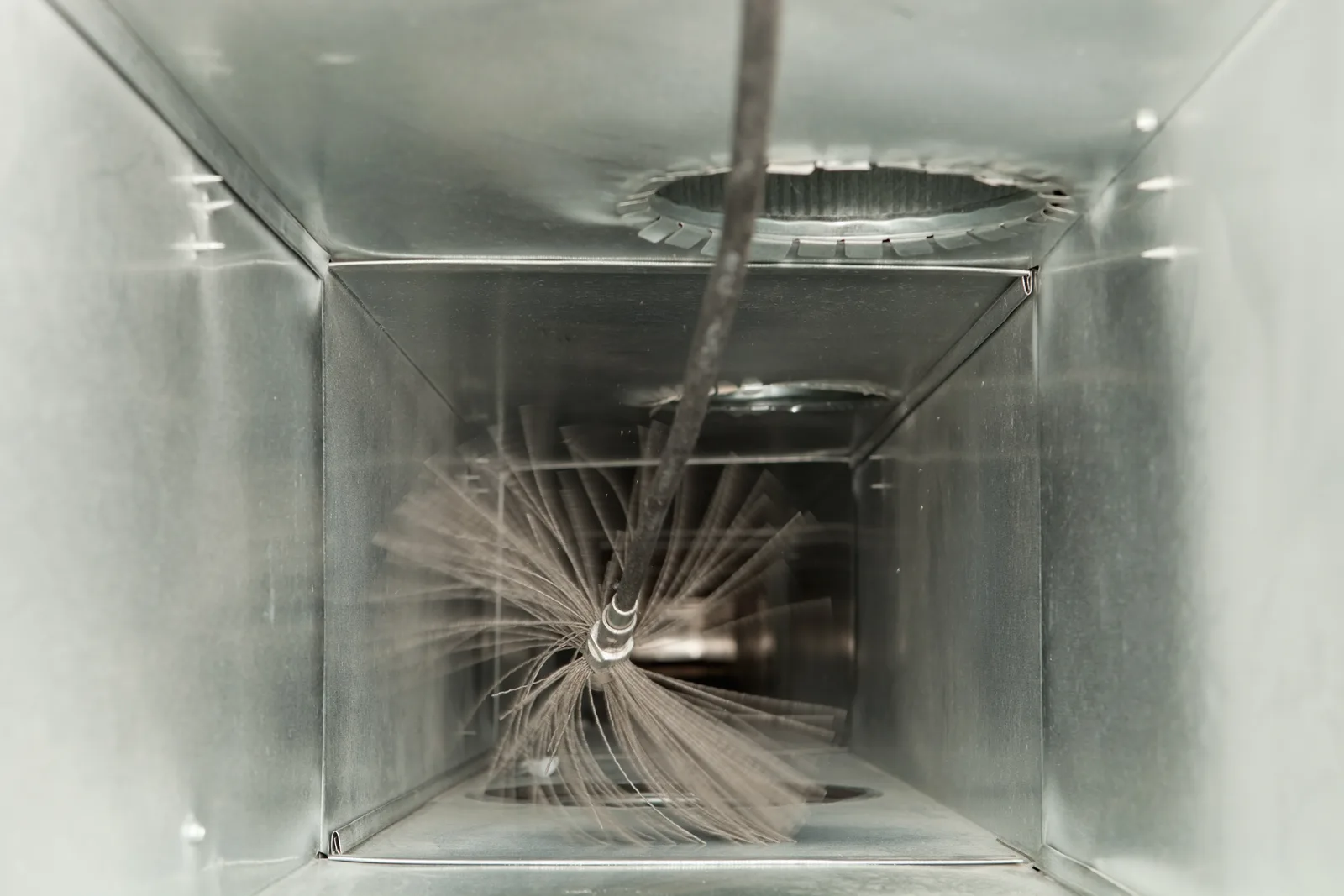
The work shown is a rotary brush agitating the duct wall while a truck-mounted vacuum holds the whole system under negative pressure through an access cut into the trunk, so what comes loose leaves the building instead of relocating to another branch. Supply and return trunks are both accessed, since cleaning only what is reachable from the registers leaves the majority of the system untouched. Access holes are sealed with plugs when the work is done, and the blower compartment is cleaned so the fan is not blowing the same dust back in.
- Rotary brush system
- Truck-mounted vacuum
- Register and trunk access
The result
Ductwork that is clear, on a whole-system price rather than a headline followed by add-ons. Typical homes fall in the $300–$700 range, and if a visit would not benefit the house, that is what the homeowner is told.
Is this your situation?
This kind of work is worth a conversation if any of these sound familiar:
- You have just finished a renovation and drywall dust went through the system.
- You have moved into a house whose ductwork history is unknown.
- There is visible debris at the registers or airflow has noticeably dropped.
- You have been quoted a headline price and want to know what it actually covers.
Questions about this kind of job
Does duct cleaning lower heating and cooling bills?
No, and any company that sells it that way should be treated with caution. Ductwork with a normal layer of dust moves air almost exactly as well as clean ductwork. What changes efficiency is a clogged filter, a dirty blower wheel or a matted evaporator coil, and those are cleaned as part of a tune-up, not a duct cleaning.
How does the negative-pressure method differ from a portable vacuum?
A truck-mounted vacuum is connected to the main trunk, pulling the entire system toward one collection point, while the brush or compressed-air whip works each branch from the register end. A portable unit at each register only reaches what the hose can touch and pushes the rest into the trunk. The volume of air a truck unit pulls is what carries debris out of the house.
When is duct cleaning actually worth doing?
After a renovation that put drywall or sanding dust through the system, on moving into a house whose history is unknown, after a rodent or mould problem in the ducts, or when debris is visible at the registers. On a house with a good filter changed on schedule and no history of the above, the ducts stay clean on their own for years.
Should the ducts be sanitized or fogged after cleaning?
Usually not. There is little evidence that fogging or biocide treatments inside ductwork do any good, and they can leave residues in the air stream. If mould was found, the source of the moisture is the problem to fix, and any treatment should be limited to the affected section. A clean system with a dry, properly sized return needs no chemical treatment.