
The problem
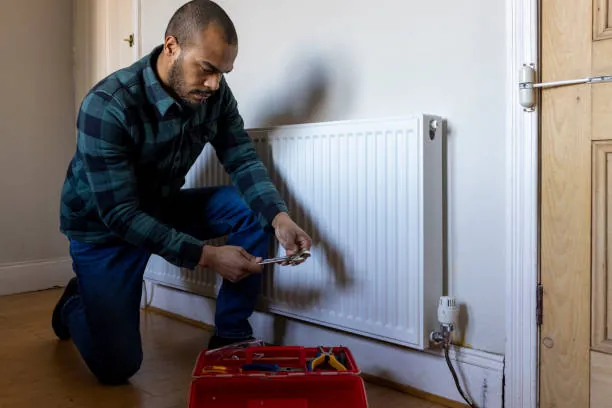
In a radiator house the complaint is almost never the whole building — it is one room, usually the furthest from the boiler or the highest in the house. People assume the boiler is undersized and start pricing a replacement, when the cause is air sitting in the top of a radiator, a lockshield valve closed too far by somebody decades ago, sludge settled in the bottom of a cast-iron emitter, or flow that has never been balanced across the loops. The radiator in the photo sits under a window, where a cold top half is easy to notice and easy to misread.
What we did
Working the emitter side first means bleeding trapped air from each radiator, confirming each one reaches temperature across its full height, and balancing flow at the lockshields so the far end of the system gets its share instead of the near end taking everything. A radiator hot at the bottom and cold at the top is holding air; one hot at the top and cold at the bottom is holding sludge and needs flushing. Where thermostatic radiator valves are fitted, the pins are checked for seizing after a summer in one position, which is a common and cheap fault.
- Cast-iron or panel radiators
- Bleed valves and lockshields
- Thermostatic radiator valves where fitted
The result
Rooms that heat evenly on the boiler that is already there. This is the work worth doing before anyone quotes replacement equipment, because a system that was never balanced will disappoint just as much with a new boiler attached to it.
Is this your situation?
This kind of work is worth a conversation if any of these sound familiar:
- One room, usually the furthest or highest, never gets warm.
- Radiators are hot at the bottom and cold across the top.
- Someone has suggested replacing the boiler because of a single cold room.
- Thermostatic valves have been left in one position for years.
Questions about this kind of job
Why is the radiator hot at the bottom and cold at the top?
Air has collected at the top of the radiator, where water cannot circulate, so only the lower part heats. Opening the bleed valve with a key until water instead of air comes out fixes it, and the boiler pressure is topped up afterward. If the same radiator needs bleeding every few weeks, air is getting into the system somewhere and the cause needs finding.
What does balancing radiators mean?
Each radiator has a lockshield valve on its return that sets how much water flows through it. Radiators near the boiler get too much flow and the far ones get too little, so the near ones are throttled until each radiator shows a similar temperature drop from inlet to outlet, often around 10 to 12 °C. It is done once, with a thermometer, and rarely needs revisiting.
Why does a thermostatic radiator valve stop working?
The valve pin under the head sits in one position all summer and can seize there, usually closed, so the radiator stays cold when heating starts. Removing the head and freeing the pin with gentle taps usually restores it. Leaving the valves fully open over the summer, or working each head through its range once a season, keeps them free.
Does one cold radiator mean the boiler is too small?
Almost never. An undersized boiler shows up as the whole house falling behind on the coldest days, not as one room that never warms. A single cold radiator points to air, a closed or seized valve, sludge or an unbalanced loop. Those are fixed on the emitter side for a fraction of what a replacement boiler costs, and they would still be there after one.