
Quick answer
An AC that bangs when it starts up usually has a compressor that is hard-starting on a weak capacitor or worn windings, or one that has broken its mounting grommets or an internal spring. If the bang is indoors, it is ductwork flexing or the filter door slamming as the blower starts. A brief clatter at shut-off is often a scroll compressor and is normal.
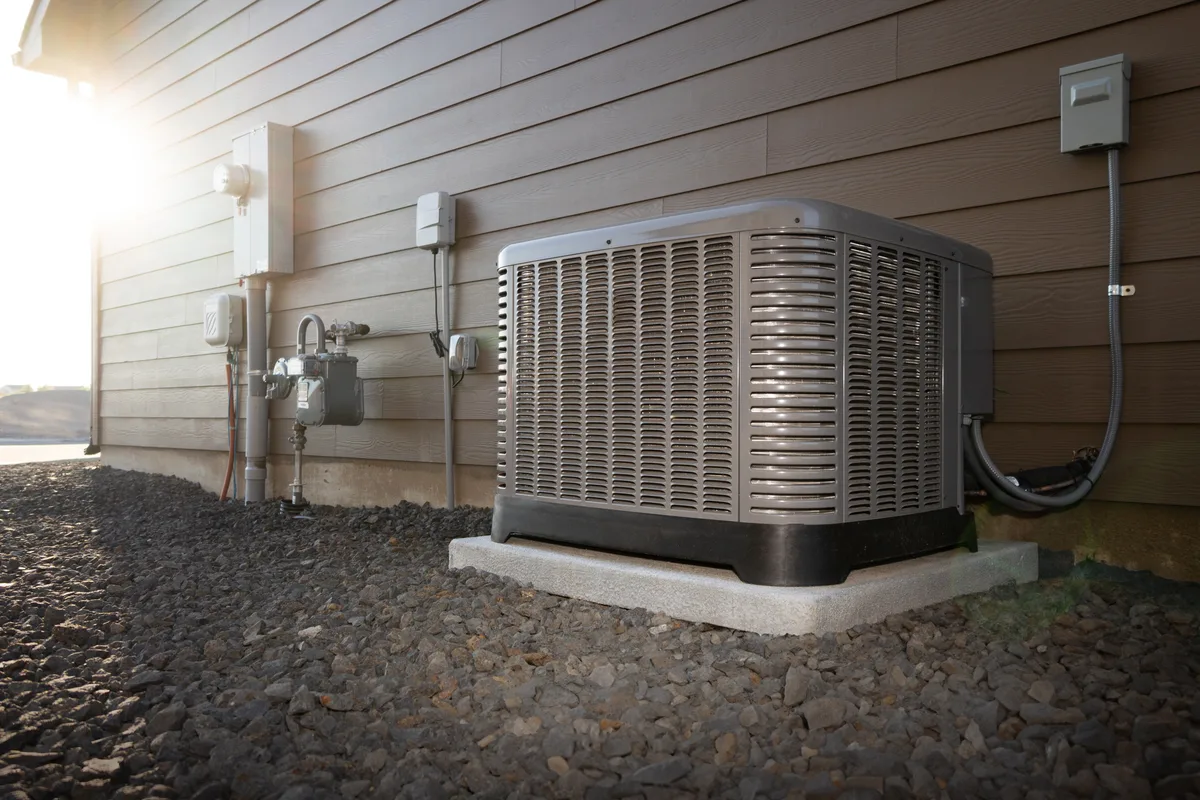
When your AC bangs when it starts up, first find out whether the bang is outdoors or indoors, because the outdoor causes involve the compressor and the indoor ones involve sheet metal. Have someone lower the thermostat while you stand beside the outdoor unit, then repeat it standing at the furnace. Note whether the noise also happens at shut-off.
How to tell an indoor bang from an outdoor one
- Outdoor, at start: a clunk or thud from the condenser the instant it starts, often with the house lights dipping. Compressor hard-start or broken mounts.
- Outdoor, at shut-off: a one- or two-second clatter or whirr as the unit stops. Usually a scroll compressor spinning backwards briefly.
- Indoor, a second or two after the blower starts: a boom or pop from the return duct or furnace area, often repeated in reverse when the blower stops. Ductwork oil-canning.
- Indoor, a sharp metallic slap at the furnace: a loose filter door, or the filter itself being sucked against its rack.
Compressor hard-starting, and when a hard-start kit is a fix or a warning
A compressor that struggles to start jolts in its mounts and sends a thud through the cabinet and the copper lines. The cheap cause is a weak run capacitor, which leaves the motor short of starting torque; replacing it runs $150–$350. The expensive cause is the compressor itself: worn windings and bearings that need more current every year to break loose. Lights that dim hard at each start go with both, and why lights dim when the AC turns on covers the electrical side.
A hard-start kit is a start capacitor and relay that give the compressor an extra kick for the first fraction of a second. It is a proper fix when the compressor is healthy and the conditions are hard: a long refrigerant line set, an expansion valve that does not let pressures equalize between cycles, or low voltage at the house. Some manufacturers specify one for exactly those installations.
It is a warning when a compressor that started fine for years now needs one. If the run capacitor tests good, the voltage is normal, and a unit past 12 years old still will not start cleanly without a kit, the kit is buying time, not curing anything. At that point the money question is repair against replacement, and AC repair versus replacement sets out how to weigh it.
Broken mounting grommets, an internal spring, or a scroll running backwards at shut-off
The compressor sits on rubber grommets bolted to the base of the unit. When they harden, split or lose a bolt, the compressor shifts on every start and stop and knocks against the base or drags the copper tubing against the cabinet. New grommets and hardware are a small repair, and worth doing promptly, because tubing that rubs eventually wears through and leaks refrigerant.
Older reciprocating compressors also hang on springs inside the sealed shell. A broken internal spring lets the mechanism slam the shell at start-up and shut-down with a heavy, hollow bang. It cannot be repaired from outside; the fix is a new compressor, and on an older unit that usually means pricing a new condenser instead.
A noise at shut-off, not start-up, is often normal. When a scroll compressor stops, high-pressure gas can push the scrolls backwards for a second or two before the pressures settle, producing a brief rattle or whirr. It sounds alarming and does no harm. If it has become louder or longer than it used to be, mention it at the next service; otherwise leave it alone.
Indoor bangs: ductwork oil-canning and the filter door
A boom from the basement as the blower starts is flat sheet metal snapping inward under suction, the way the bottom of an oil can pops. The return drop beside the furnace is the usual spot, and a dirty or very restrictive filter makes it worse by raising the suction. It often appears right after a furnace replacement, when a stronger blower meets the original return duct. Push on the suspect panel with the blower off; if you can make the sound by hand, you have found it.
- Change the filter, and try a less restrictive one if the bang began with a high-MERV filter.
- Make sure return grilles are not blocked by furniture.
- Check that the filter door is latched and the filter is the right size for the rack.
- Have the panel braced or cross-broken, a small duct repair job.
Call for service when the bang comes with any of these
- The breaker trips, or the lights dim sharply on each start.
- The outdoor unit hums for several seconds before it starts, or fails to start.
- The bang is getting louder week over week.
- Copper lines are visibly shaking or touching the cabinet.
Until it is looked at, an outdoor bang with a failed start is a reason to switch the system off; an indoor duct pop is a nuisance you can live with. A diagnostic visit is $90–$150 and comes off the repair, and it includes measuring the compressor's starting current against its rating, so the verdict is a reading and not a guess.
ZK Mechanical diagnoses start-up noises as part of AC repair in Burlington, Oakville, Milton, Hamilton, Mississauga and Etobicoke. Call (647) 801-1252 or describe the noise online; a short phone video of the start-up helps. Other sounds are sorted in the cooling answers.