
Quick answer
A frozen AC takes 1 to 3 hours to thaw with cooling switched off and the fan set to ON, and up to 24 hours when the indoor coil is encased in a solid block of ice. Do not chip the ice or use a heat gun. Change the filter before restarting; if it refreezes by the next day, it needs service.
How long it takes a frozen AC to thaw depends on how much ice there is and whether air is moving across it. Light frost on the copper line and the face of the coil clears in 1 to 3 hours with the fan running. A coil that has been freezing for a day or two, iced out to the cabinet walls, can take up to 24 hours. The clock only starts once the compressor is off.
How to thaw a frozen AC in 1 to 3 hours
- Set the thermostat to Off for cooling, so the compressor stops making ice.
- Set the fan to ON. The blower pushes room-temperature air through the coil and melts it from the inside out.
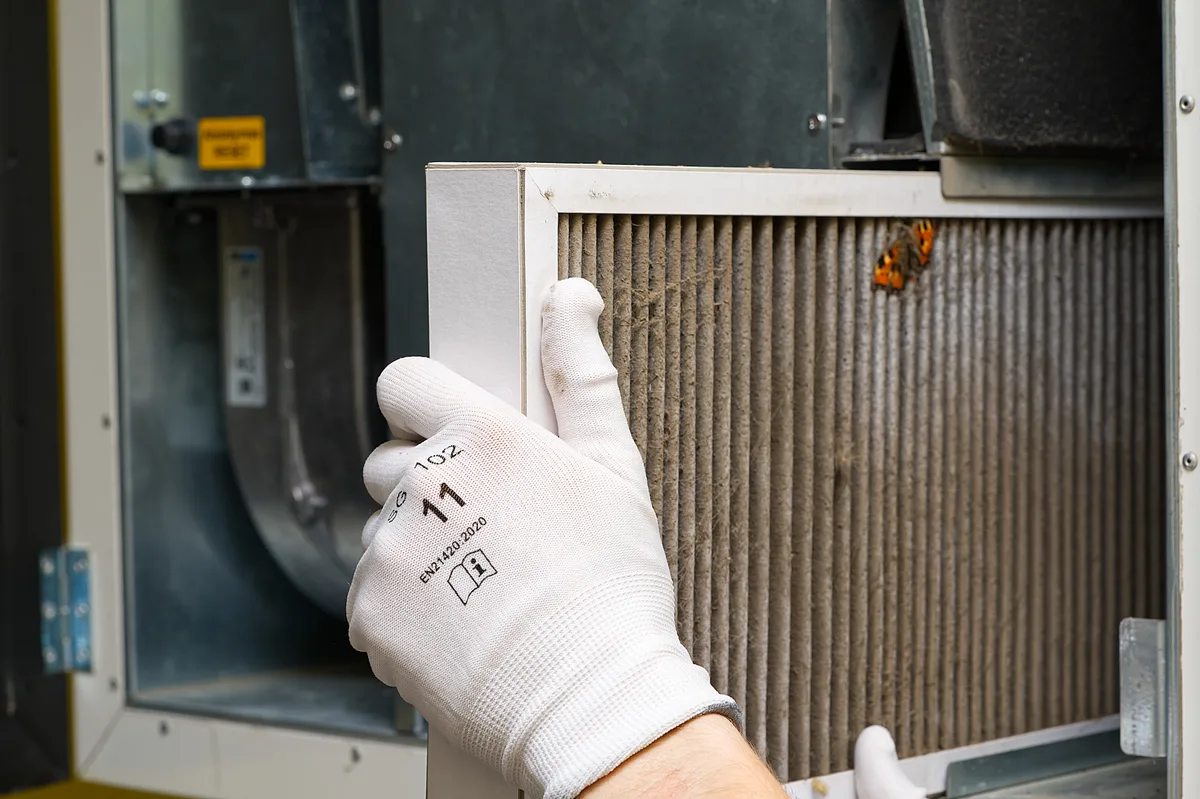
- Pull the filter. If it is grey and matted, leave it out for the thaw and have a new one ready.
- Open every supply register and move furniture and rugs away from the return grilles.
- Check progress at the larger insulated copper line where it enters the coil case. When it is dry and at room temperature and airflow at the registers is back to full strength, the coil is clear.
Leaving the fan off also works; it takes longer, often overnight. Choose that if water is dripping inside the furnace cabinet, because the blower and control board sit directly underneath the coil.
Why you never chip ice or use a heat gun on a frozen coil
The evaporator coil is thin copper or aluminum tubing threaded through paper-thin aluminum fins. A screwdriver or ice pick punctures a tube easily, and a punctured coil means a refrigerant leak and, usually, a new coil. A heat gun or hair dryer is no better: it can warp the plastic drain pan under the coil and overheat the brazed joints while ice a few centimetres away has not moved. Room air and time are the only safe tools.
Where the meltwater goes, and why the furnace board is at risk
A heavily frozen coil holds several litres of water. The drain pan and its 3/4-inch drain are built for a steady trickle of condensate, not a block of ice melting at once, and ice that has grown past the edge of the pan drips outside it. On the common basement layout, an upflow furnace with the coil in a case on top, anything that misses the pan runs down inside the furnace onto the blower and the control board.
- Put towels or a shallow tray around the base of the furnace and check them every half hour.
- Confirm water is arriving at the floor drain or condensate pump. If it is not, the line is blocked; see how to unclog an AC drain line.
- If water is coming out at the furnace door seams, turn the furnace power switch off and let the coil thaw without the fan.
- Do not restore power until the cabinet is dry. A soaked furnace control board is a $500–$1,200 replacement.
Do not restart until airflow is fixed; refreezing within a day needs a technician
Ice forms when the coil surface drops below 0 °C, and the most common reason is too little air crossing it. Before switching cooling back on, fit a new filter, keep the registers open and make sure you can feel air at the farthest register. Then run it and watch the larger copper line for the first hour. Avoid running the AC on cool nights as well, for the reasons in how cold is too cold to run the AC.
A coil that ices again by the next day with a clean filter has a fault that thawing will not fix. The two usual ones are low refrigerant and a blower that is not moving enough air.
- Low refrigerant from a leak drops the coil pressure, and with it the coil temperature, below freezing. Finding and sealing the leak and recharging runs $300–$800+, and refrigerant work in Ontario requires an ODP card.
- Blower faults: a failed blower capacitor, a motor running slow or a blower wheel caked with dust. A blower motor is $300–$700.
- A dirty evaporator coil: years of dust on the underside block air the same way a clogged filter does.
- A collapsed or disconnected return duct, or too many closed registers.
The longer list of causes is in why an AC freezes up.
Can a frozen AC wait, or is it urgent?
A frozen AC is safe to leave switched off; it is not safe to keep running. Running the compressor against a block of ice sends liquid refrigerant back to it, and that is how a filter problem becomes a compressor problem. During a heat wave with someone vulnerable in the house, treat it as urgent and start the thaw while you wait.
A diagnostic visit is $90–$150, folded into the repair if you proceed, and a technician can only test a system that has thawed. Start the thaw, then call ZK Mechanical at (647) 801-1252 or book a visit for AC repair in Burlington, Oakville, Milton, Hamilton or Stoney Creek. More questions like this one are answered in the cooling answers hub.