
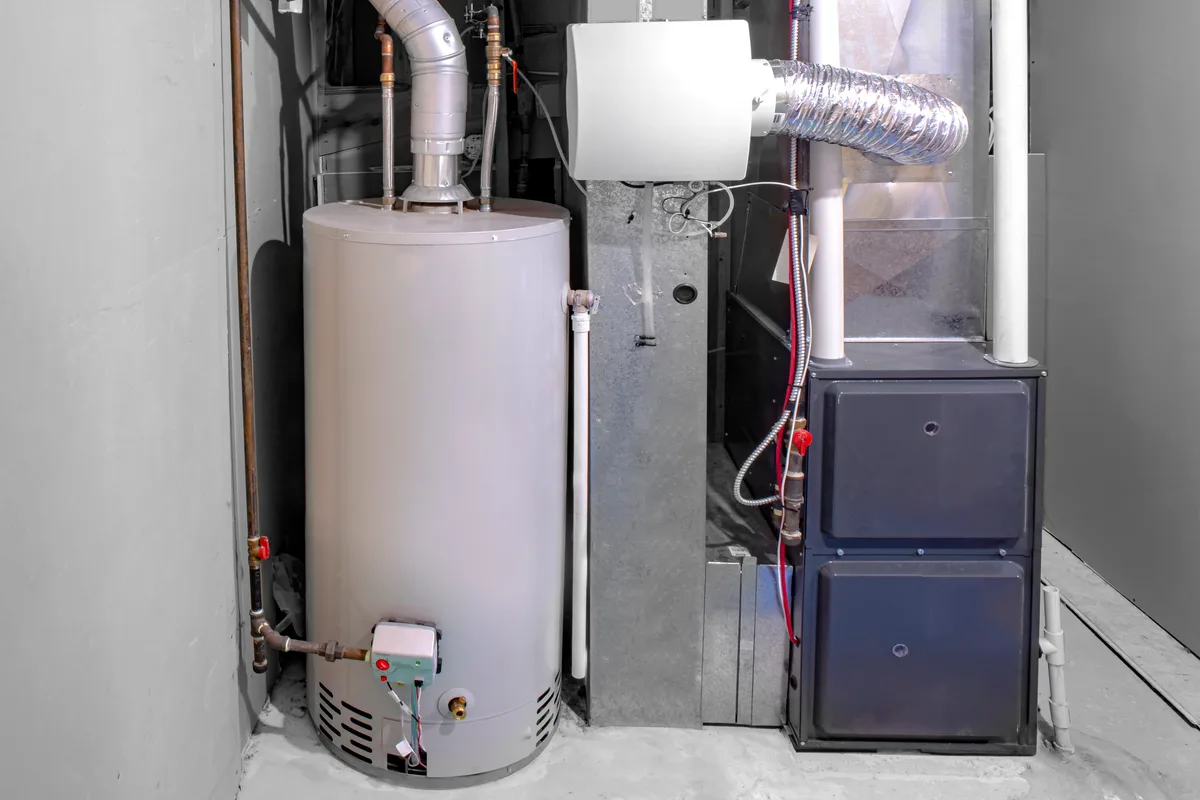
Power vent vs conventional vent water heater is a choice your chimney makes for you. A conventional (atmospheric) tank needs a vertical chimney or B-vent that still drafts on its own; a power-vent tank needs a 120 V receptacle and a route to an outside wall for ULC S636 plastic pipe. If the furnace now vents through the sidewall and the water heater is alone in an old masonry chimney, go power vent or line the chimney. If the B-vent or liner is sound and correctly sized, a conventional tank costs less, runs silently and keeps working in a power outage.
How Each Type Gets Exhaust Out of the House
A conventional tank vents by natural draft. Exhaust leaves the burner hot, rises through the flue in the middle of the tank, passes an open draft hood on top and climbs a metal B-vent or a chimney because it is lighter than the air around it. There is no fan and, with a standing pilot or a self-powered gas valve, no electrical connection. The draft hood is open to the room, which is the weakness covered further down.
A power-vent tank has a blower on top. It mixes the exhaust with room air to cool it, then pushes it through 2- or 3-inch plastic pipe to a termination on an outside wall. A pressure switch has to prove the blower is moving air before the control lets the burner light, and an electronic igniter replaces the pilot. All of that needs household power.
The Orphaned Water Heater: When the Furnace Leaves the Chimney
The most common reason to switch is a furnace replacement. A mid-efficiency furnace and a conventional water heater share one chimney, and the furnace supplies most of the heat that keeps it drafting. Replace that furnace with a high-efficiency model vented in plastic through the sidewall and the water heater is left alone, or orphaned, in a flue sized for two appliances.
A flue that is too big stays cold. The water heater's exhaust cools before it reaches the top, the water vapour in it condenses on the masonry, and the acidic moisture eats mortar and clay tile from the inside. Draft weakens at the same time, so exhaust spills at the draft hood. The gas code's vent-sizing tables apply to the water heater alone once the furnace is gone, and a masonry chimney on an outside wall rarely passes for one 40,000 BTU tank.
There are two fixes: a metal liner sized to the water heater, or a power-vent tank and a capped chimney. Our guide to chimney liners at furnace replacement compares them. This is the usual story in 1950s–60s bungalows and in 1970s–90s subdivisions across Burlington, Hamilton and Mississauga when the original furnace finally goes.
Backdraft and Spillage in Tight or Depressurized Homes
An atmospheric tank relies on a few pascals of natural draft, and anything that pulls air out of the house can overpower it. A large range hood, a clothes dryer, bathroom fans and a wood fireplace all exhaust indoor air; in a house tightened with new windows and spray foam, the easiest path for replacement air can be down the water heater's vent. Exhaust then spills into the basement at the draft hood, and it can carry carbon monoxide.
- Melted or deformed plastic rings where the water pipes enter the top of the tank
- Rust streaks, soot or scorch marks around the draft hood
- Condensation on the cold pipes and basement windows whenever the burner runs
- A carbon monoxide alarm that sounds when the dryer and range hood run together
- A stale exhaust smell near the tank
Any of those signs is a reason to stop using the appliance and call; the answer page on how to tell if a water heater is backdrafting explains what to check safely. At install we test for it under worst-case conditions: windows and exterior doors closed, dryer, range hood and bathroom fans running, furnace blower on. The water heater is fired and a smoke source is held at the draft hood, and the draft has to establish in the first few minutes and hold. A tank that fails gets make-up air, a liner or a different vent type, not a pass.
Free quotes, written pricing.
What a Power-Vent Tank Needs, and What It Asks of You
- A 120 V receptacle within reach of the factory cord. Extension cords are not acceptable, and a new receptacle means an electrician and an ESA notification.
- ULC S636 certified vent pipe in the diameter the manual specifies, within its maximum length and elbow count, sloped and supported so it cannot sag and hold water.
- A sidewall termination that meets CSA B149.1 clearances: at least 12 inches from an opening window or door for a tank this size, above the snow line, and away from the gas meter regulator and any air intake.
- Tolerance for fan noise. The blower hums whenever the burner runs and for a short purge before and after, and next to a basement bedroom or home office people notice it.
- Acceptance that it will not fire when the power is out. You have whatever hot water is in the tank, then none until the power returns.
A power-vent tank also has more parts that can fail: the blower, the pressure switch, the igniter and the control board. Each is replaceable, and none exists on a conventional tank. In exchange you get a sealed, fan-forced vent that cannot backdraft the way a draft hood can, and a slightly higher efficiency rating because less heat escapes up a chimney between burner cycles. The efficiency gain is small and is not a reason to switch by itself.
What Each Costs Installed in Ontario
- Conventional gas tank into a sound, correctly sized vent: the lower half of the $1,200–$2,500 installed band for a tank swap
- Power-vent tank replacing a power-vent tank on existing venting: toward the top of that band, because the tank itself costs more
- First-time switch from conventional to power vent: the tank plus a new S636 vent run, a wall penetration, a receptacle and capping the old flue connection, priced on site
- Conventional tank that needs a chimney liner to stay: the tank plus the liner, priced after the chimney is measured
- Renting instead of buying: $25–$45 a month, which over a tank's life adds up to several times the purchase price
We put the vent work on its own line of the quote so the two options can be compared honestly. General price bands are on the pricing page.
Which Ontario Houses Have Which
- Pre-war brick houses and 1950s–60s bungalows: a masonry chimney, originally shared with the furnace, and a conventional tank that is often orphaned by now.
- 1970s–90s subdivisions: a metal B-vent through the roof shared by a mid-efficiency furnace and a conventional tank. The B-vent may still be usable for the water heater alone if it is resized.
- 2000s+ new builds: no chimney at all. The water heater has been power vent or direct vent since the house was built, and the replacement has to match.
- Townhouses and semis: limited outside wall, so the termination location, and its distance from windows and the neighbour, decides whether a power vent is even possible where the tank sits.
Verdict: Let the Vent Decide
- Stay conventional if the B-vent or lined chimney is sound, sized for the water heater alone, passes a spillage test with the exhaust fans running, and you value silence and hot water during an outage.
- Go power vent if the water heater is orphaned in a masonry chimney, if it fails a spillage test, if the house has been air-sealed or has a large range hood, or if the tank is moving somewhere with no vertical vent.
- Consider direct vent if the tank sits on an outside wall and you want sealed combustion without a fan; see power vent vs direct vent water heaters.
- Do not vent a new conventional tank into an unlined outside chimney just because the old one did.
ZK Mechanical's TSSA-licensed technicians inspect the vent, run the spillage test and quote both options where both are possible, across Burlington, Oakville, Milton, Hamilton and Mississauga. See power-vent water heater installation, or book a visit and tell us whether your furnace has been replaced since the tank went in.
Frequently asked questions
Can I replace a power-vent water heater with a conventional one to save money?
Only if the house has a code-compliant vertical vent for it, and most houses built with a power-vent tank have no chimney or B-vent at all. Adding one through the floors and roof costs far more than the difference between the two tanks. In a house that still has a sound, correctly sized vertical vent, switching back is possible and we will price it.
How loud is a power-vent water heater?
About as loud as a bathroom exhaust fan, and only while the burner runs plus a short purge at each end of the cycle. Solid pipe supports and a rubber coupling at the blower outlet keep the hum from carrying into the framing. A blower that has started to whine, rattle or grind is telling you a bearing is failing, and it is cheaper to replace before it seizes.
Will a power-vent water heater run on a generator?
Usually, if it is connected properly. The blower and control draw little power, so a modest generator can carry them through a transfer switch or a correctly wired inlet. The control checks polarity and grounding and will lock out on a poor connection, so a makeshift hookup often fails. Check the manual for the manufacturer's position before relying on it.
Do I need a chimney liner if only the water heater uses the chimney?
For a masonry chimney, almost always. A flue sized for a furnace and a water heater together is too large and too cold for the water heater alone, so exhaust condenses and draft weakens. A metal liner sized to the tank restores the draft and keeps acidic moisture off the brick. The alternative is a power-vent tank and a capped chimney.