
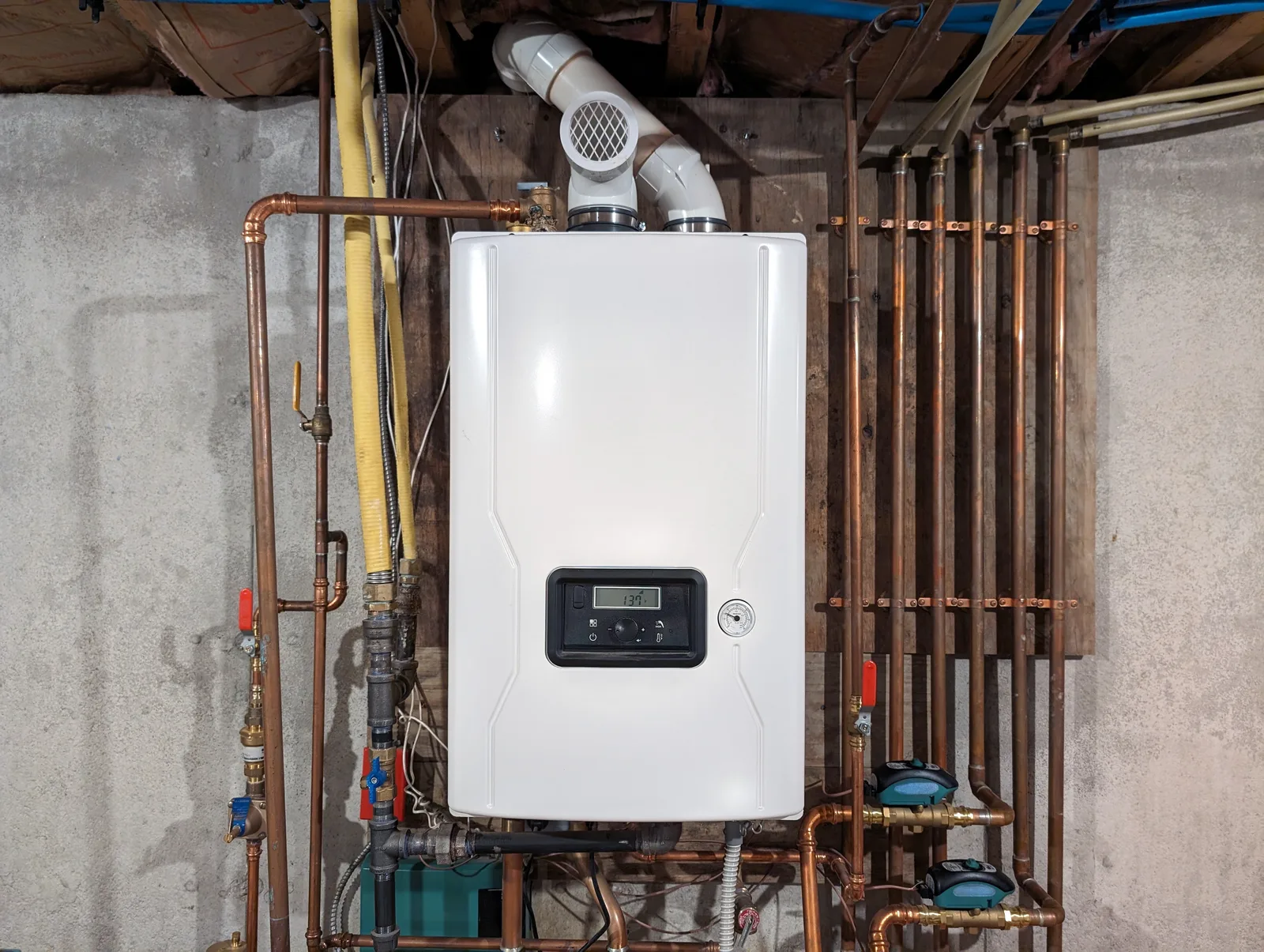
Navien NPE-A2 vs NPE-S2: which tankless to buy comes down to whether you want hot water recirculation. The A2 has a recirculation pump and a small buffer tank built in; the S2 has neither and costs less. Buy the A2 if the furthest bathroom waits a long time for hot water or the house already has a return line, and buy the S2 if the heater sits close to the fixtures it serves. Both are condensing units with stainless steel heat exchangers, sold in 180, 210 and 240 sizes.
What the A2 Has That the S2 Does Not
The difference is the ComfortFlow package: a circulator pump and an insulated buffer tank inside the A2 cabinet, with controls to run them. Everything that makes hot water is shared. Navien lists the same gas inputs for both series: 150,000 BTU/h for the 180, 180,000 for the 210 and 199,900 for the 240.
- Heat exchangers: both use two stainless steel heat exchangers, a primary and a condensing secondary.
- Efficiency: Navien rates the NPE-240A2 at 0.95 UEF and the NPE-240S2 at 0.96. The pump and buffer tank cost the A2 about a point.
- Turndown: both 240 models modulate from 199,900 down to 13,300 BTU/h, so a single low-flow tap can still fire the burner.
- Venting: both are listed for 2 inch plastic vent up to 75 feet and 3 inch up to 150 feet.
- Sizes: the S2 also comes as a 150 with a 120,000 BTU/h input. There is no A2 in that size.
The buffer tank does a second job that owners notice more than the pump. It smooths out the slug of cold water a tankless can send down the pipe between two short draws, the so-called cold-water sandwich. An S2 with no recirculation will do that now and then; an A2 in internal recirculation mode mostly will not.
Recirculation Options: Dedicated Return Line or Crossover Valve
The A2 pump can run in three ways, and they give very different results at the tap.
- Internal mode: the pump circulates only through the buffer tank inside the unit. The heater itself stays hot, which removes the start-up delay, but the water sitting in the pipes still has to be pushed out. Wait time at a far bathroom barely changes.
- External mode with a dedicated return line: a third pipe runs from the furthest fixture back to the heater, forming a loop. Hot water is at every tap on the loop almost at once and the cold line is untouched. This is the right answer in a house that has the return line already or has open ceilings during a renovation.
- External mode with a crossover valve: Navien's NaviCirc valve goes under the sink at the furthest fixture and uses the cold line as the return path. No new pipe is run. The trade is that the cold tap near the valve runs warm for a moment, and fixtures on branches away from the valve gain less.
In a finished two-storey house the crossover valve is what most people end up with, because opening walls for a return line is a renovation in its own right. Our recirculation pump installation page covers the plumbing side.
What Recirculation Does to Wait Time and Gas Use
Recirculation trades a little gas for a lot less waiting. A loop full of hot water loses heat through the pipe walls, the heater fires in short bursts to top it up, and the faster the loop cools the more often that happens. On an uninsulated loop left running around the clock, the standby loss can eat much of the efficiency you bought the tankless for.
Control is what keeps that in check. Depending on how it is set up, the A2 can run the pump on a schedule, on a learned pattern of when the household draws hot water, or from a push button near the fixture. Set it to the hours you are home and awake, and insulate whatever return pipe you can reach.
Recirculation also touches the warranty. Navien's published residential terms of 15 years on the heat exchanger, 5 on parts and 1 on labour apply to standard use and controlled recirculation. Check the registration card for the terms on your model before the pump is set to run without a control.
Sizing the 180, 210 or 240 by Winter Flow Rate
Size the heater by the litres per minute it can deliver in February, not by how many bathrooms the house has. Navien publishes 5.2 US gallons a minute, 19.7 L/min, for the 240 at a 75 °F (about 42 °C) rise, which is what it takes to bring 5 °C winter water up to a 47 °C setpoint. The 11.2 gallons a minute on the brochure is at a 35 °F rise, a figure that describes summer in a much warmer place.
Free quotes, written pricing.
- NPE-180 (150,000 BTU/h): roughly 15 L/min at that winter rise. Two showers at once, with nothing else running.
- NPE-210 (180,000 BTU/h): roughly 18 L/min. Two showers and a kitchen tap, or three showers with low-flow heads.
- NPE-240 (199,900 BTU/h): 19.7 L/min. Three showers at once, at its limit, which covers most four-bedroom houses.
The 180 and 210 figures are scaled from the 240 by gas input, so treat them as estimates and read the model's own flow chart. A shower mixed to 40 °C takes a little over 6 L/min of hot water in winter. Bathroom count only tells you how many showers could run together; the number that do is what you size for, and our answer on what size tankless you need works through the count.
Which Houses Need the A2 and Which Are Fine With the S2
Pipe length between the heater and the furthest tap decides it. In a 2000s+ two-storey with the mechanical room in one basement corner and the ensuite over the garage at the other end, the run can hold several litres of cold water, and a tankless adds its own few seconds of ignition delay on top. That house wants the A2 and some form of external recirculation.
A townhouse or a 1950s–60s bungalow with the heater near the middle of the plumbing is different. The runs are short, the wait is close to what the old tank gave, and the pump would spend its life solving a problem the house does not have. The S2 is the sensible buy there.
The S2 also suits a house that already has a separate recirculation pump on a return line. Navien lists the S2 as compatible with external recirculation, so the existing pump can stay. Adding a pump and controls to an S2 later usually costs more than the difference between the two units.
What an NPE-A2 or NPE-S2 Costs Installed
A 199,000 BTU-class Navien replacing an existing tank typically lands at $4,200–$5,000 installed, inside a wider tankless band of $3,500–$6,500. The S2 sits lower in that range because the unit itself costs less. A crossover valve adds a part and some time under a sink; a new return line is priced by how much drywall is in the way.
- Typical tank-to-tankless conversion with a 240-size unit: $4,200–$5,000 installed
- Full range for tankless installs, including gas-line and venting work: $3,500–$6,500
- Gas line upsizing where the existing run cannot carry the load: +$400–$1,200
- Annual descale flush on local hard water: $150–$300
Navien allows half-inch gas pipe on runs up to 24 feet, but the whole house load still has to be calculated under the CSA B149.1 gas code, and the meter has to be able to supply it. The tankless cost guide breaks down each line of a quote.
Verdict: A2 for Long Pipe Runs, S2 Where the Runs Are Short
Buy the A2 if you are unsure. The extra cost is small against the installed price, the buffer tank improves how the heater behaves on short draws, and the pump is there the day you decide the wait at the ensuite is too long.
- Choose the NPE-A2 for a detached two-storey, any house with an existing return line, and any household that has complained about waiting for hot water.
- Choose the NPE-S2 for a townhouse, a bungalow with a central mechanical room, a secondary suite with its own heater, or a house with a working external recirculation pump.
- Choose the 240 size unless the house has one bathroom; the 210 and 180 save little and give up winter flow.
- Comparing brands instead of models? Read Navien vs Rinnai first.
We service Navien heaters and install both series, and the quote states which model, which recirculation mode and which vent route you are getting. Details of the installation are on our tankless water heater page, and you can request a written quote with the distance from your heater to the furthest bathroom.
Frequently asked questions
Can recirculation be added to an NPE-S2 later?
Yes. Navien lists the S2 as compatible with external recirculation, so a separate pump can be installed on a return line or with a crossover valve. You pay for the pump, its controls and the labour, and you still have no buffer tank inside the heater. If you expect to want recirculation within a few years, the A2 is normally the cheaper route.
Is there an NPE-150A2?
No. Navien's A2 series is sold as the 180, 210 and 240. The 150 size, with a 120,000 BTU/h input, exists only as the NPE-150S2. It suits a one-bathroom home or a small secondary suite, and it will struggle to run two showers together on Ontario winter inlet water, so check the flow chart before choosing it.
Does the NPE-240 need a bigger gas line than my old tank?
Often, yes. A 240 can burn 199,900 BTU/h against about 40,000 for a typical tank. Navien permits half-inch pipe on short runs, but a licensed gas fitter must size the whole system under CSA B149.1, including the furnace, range and dryer on the same meter. Where the run has to be upsized, expect it as a separate line on the quote.
Will the A2's recirculation pump raise my gas bill?
Somewhat, and how much depends on the control. A loop kept hot all day loses heat through the pipe and makes the burner fire in short bursts. Run on a schedule or from a push button, the added gas is small. Insulating the hot and return lines and limiting the pump to waking hours keeps most of the tankless saving intact.