
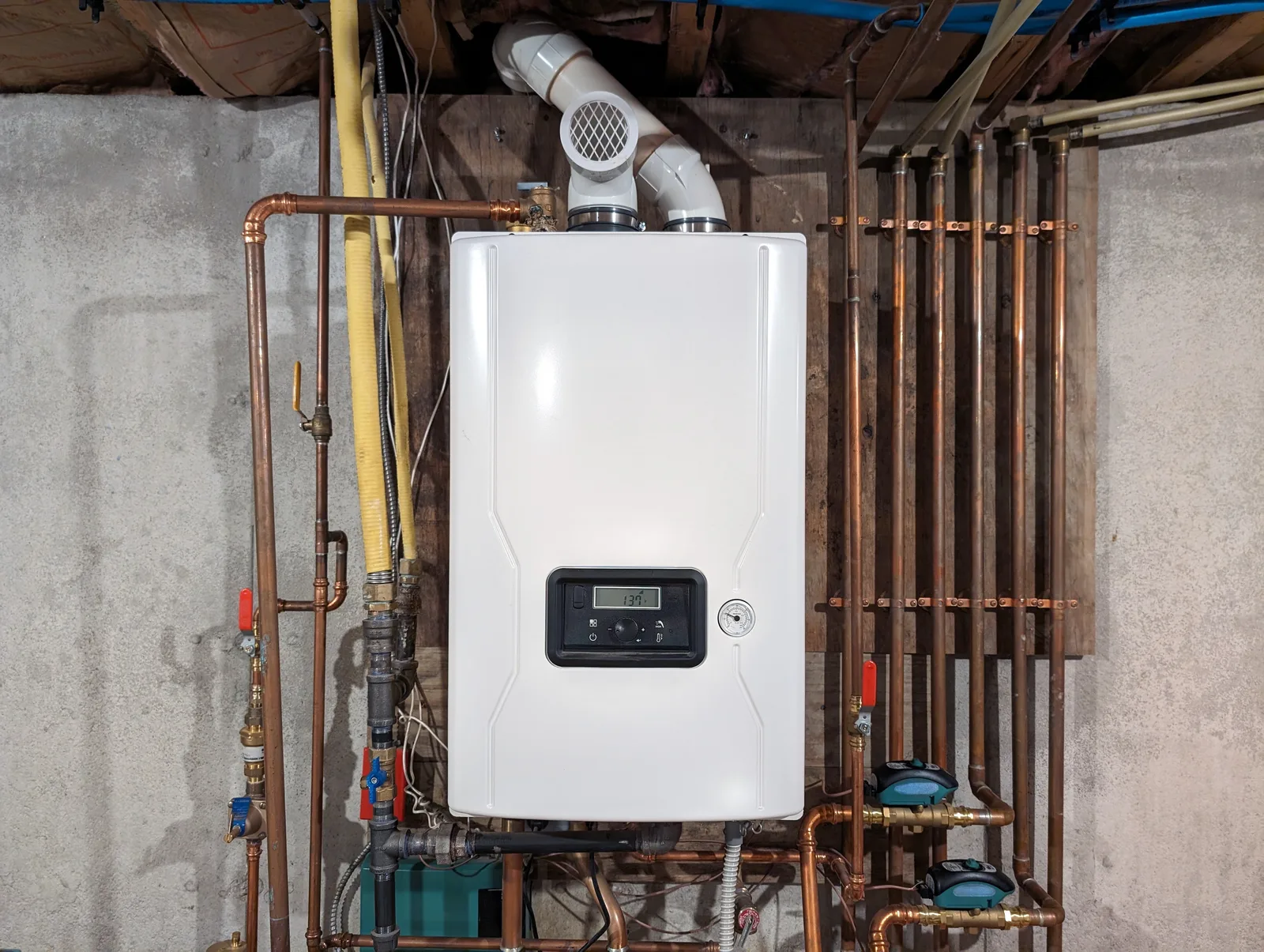
Navien vs Rinnai tankless water heaters is the choice most homeowners land on once they decide to give up the tank, because those two brands cover the majority of the residential units we install and service. Both build condensing heaters that top out near 199,000 BTU, both will run a busy family house, and both need an annual flush on our water. The differences that matter are the heat exchanger material, whether a recirculation pump lives inside the cabinet, and how each behaves when the incoming water is near freezing in February.
Heat Exchangers: Stainless Steel vs Copper
Navien builds its condensing units around dual stainless steel heat exchangers. Rinnai has stayed with a heavy-wall copper primary heat exchanger, backed by a stainless secondary, in its condensing SENSEI line. Both approaches work, and they have been working in Ontario basements for years; they age and repair differently.
- Copper moves heat faster, which is part of why Rinnai units feel quick to deliver and hold temperature steadily through changes in flow.
- Stainless tolerates scale and the acidic condensate a condensing unit produces, which is the argument Navien makes for it on harder water.
- Either one scales up if it is never flushed. Neglect, not metal, is what ends most tankless heat exchangers around here.
Water across Burlington, Oakville and Hamilton comes largely from Lake Ontario and is not the hardest in the province, but it is hard enough to lay scale inside a heat exchanger, and parts of Halton on groundwater are harder again. That is a maintenance question rather than a brand question — see hard water and tankless heaters in Hamilton and Halton for what it does and how often to flush.
Recirculation: The Built-In Pump Question
This is the clearest functional split between the two brands as most people actually buy them. Navien's NPE-A models include a recirculation pump and a small buffer tank inside the cabinet, so hot water can be pre-circulated on a schedule or at the press of a button without adding external hardware. The NPE-S models leave the pump out and cost less.
Rinnai offers recirculation on specific models in its condensing line as well, and either brand can be set up with an external pump working through a dedicated return line or a crossover valve under the farthest sink. So the question to put to a contractor is not which brand recirculates — it is which model in this quote does, and does my house have a return line.
It matters far more in some houses than others. A long 2000s+ two-storey in Alton Village or Joshua Creek, where the ensuite sits at the opposite end of the second floor from the mechanical room, can run a lot of cold water before it gets hot. A compact Aldershot bungalow with the bathroom almost directly above the heater does not need a pump at all.
Winter Flow Rates: What 199,000 BTU Buys in February
Tankless capacity is not a number of showers; it is a temperature rise at a flow rate, and our winters are the hard case. In August the incoming water is warm and a flagship unit will serve several fixtures at once. In February the supply arrives only a few degrees above freezing, and reaching a normal 49 °C tap setting means lifting it by more than 40 °C.
At that rise, a 199,000 BTU condensing unit from either brand delivers somewhere around 4.5 to 5 gallons per minute. That comfortably covers two showers at once, or a shower and a kitchen tap. It does not cover two showers plus a filling tub, which is where larger households in Millcroft or Ancaster get caught out. Size the unit on winter numbers, not on the summer figure printed on the box, and remember that this is the one specification where both brands behave the same way.
Gas Line and Venting: Where the Quote Actually Moves
Free quotes, written pricing.
The heater is only part of the job, and the items below are about your house rather than the badge on the cabinet.
- Gas supply. A tankless heater draws far more gas at once than the tank it replaces. If the existing run was sized for the old tank, upsizing the pipe or pulling a dedicated line adds $400–$1,200. Both brands have the same appetite.
- Venting. Condensing units from either brand vent in plastic pipe through a side wall, with a concentric option where only one penetration is practical. Termination clearances from windows, doors and the gas meter are the real constraint on narrow lots in Kerr Village or Westdale.
- Condensate. A condensing heater produces acidic condensate that needs a drain and, in many installs, a neutralizer before it enters older cast-iron plumbing.
- Electrical. Both need a 120-volt receptacle nearby, and neither produces hot water in a power cut without a generator — worth thinking about on rural Flamborough properties that lose power in an ice storm.
Those four items, not the manufacturer, are why two tankless quotes for the same house can differ by more than a thousand dollars. Our GTA tankless cost guide lists what belongs in a complete written quote.
Descaling, Error Codes and Parts
Both manufacturers expect an annual flush, and both announce trouble through an error code on the front panel. Ask for isolation valves at the time of installation, because without them a descale means cutting pipe, and a contractor who skips them has left you a bill for later.
Codes are the fastest way to know what you are facing before anyone opens the cabinet. Our Navien error code guide and Rinnai error code guide list the ones that come up most on service calls. An annual descale runs $150–$300, and it is the single maintenance item that decides whether a tankless heater reaches its 15–20 year lifespan or dies early with a scaled exchanger.
What Each Costs Installed
Price is not a meaningful differentiator between these two at matched output and features. The recirculation pump and the condition of your gas line move the total far more. The most common conversion we do — a mid-tier 199,000 BTU unit from either brand replacing an existing tank — lands at $4,200–$5,000 installed. The wider band for tankless work is $3,500–$6,500, and gas-line upsizing adds $400–$1,200 on top when it is needed.
For comparison, a straight tank-for-tank replacement is $1,200–$2,500 installed, and the running-cost gap between a tank and a tankless is around $80–$200 a year. That is the honest frame: you are buying endless hot water, floor space and lifespan, not a fast payback.
Verdict: Who Should Choose Which
There is no wrong answer between these two brands, which is why the decision usually comes down to one feature and one contractor.
- Take Navien if you want recirculation built into the cabinet with no external pump, if the stainless heat exchanger argument appeals on harder water, or if the installer you trust stocks Navien parts.
- Take Rinnai if you want the copper heat exchanger and its fast recovery, if you are replacing or matching an existing Rinnai, or if your contractor's parts channel leans that way.
- Take neither yet if the gas line, the venting route and your household's actual hot-water pattern have not been assessed. A tank remains the better buy for a small household, a short-term hold, or a house where the gas upgrade would eat the savings.
We install and service both, and we will say plainly when a tank makes more sense for your house than a conversion does. See our tankless water heater service for what a full install includes, or book a quote and we will price the heater, the gas line and the venting separately so nothing hides in a lump sum.
Frequently asked questions
Does Navien or Rinnai last longer?
In the field we see similar lifespans, roughly 15 to 20 years, and maintenance separates them far more than the badge does. A unit flushed annually with isolation valves in place outlives an identical unit that was never touched, regardless of whether its heat exchanger is stainless or copper. Ask about the descale schedule before you ask about the brand.
Do I need the model with the built-in recirculation pump?
Only if hot water takes a long time to arrive at your farthest fixture. In a long two-storey with the ensuite far from the mechanical room, recirculation is the feature that makes the system feel better than the tank it replaced. In a compact bungalow or a townhouse it adds cost and standby energy use for little benefit.
Will a tankless unit keep up with two showers in winter?
Yes for a flagship 199,000 BTU unit from either brand. At February inlet temperatures such a unit delivers roughly 4.5 to 5 gallons per minute at a normal tap temperature, which covers two showers or a shower plus a sink. Two showers and a filling tub at the same time will outrun it, so size against your worst-case simultaneous demand.
How often does a tankless heater need descaling here?
Once a year is the standard interval on our water, and homes on Halton groundwater or with a lot of hot-water use may want it sooner. The flush circulates a descaling solution through the heat exchanger for about an hour and costs $150–$300. Skipping it is the most common reason a tankless unit underperforms or throws flow and temperature faults.