
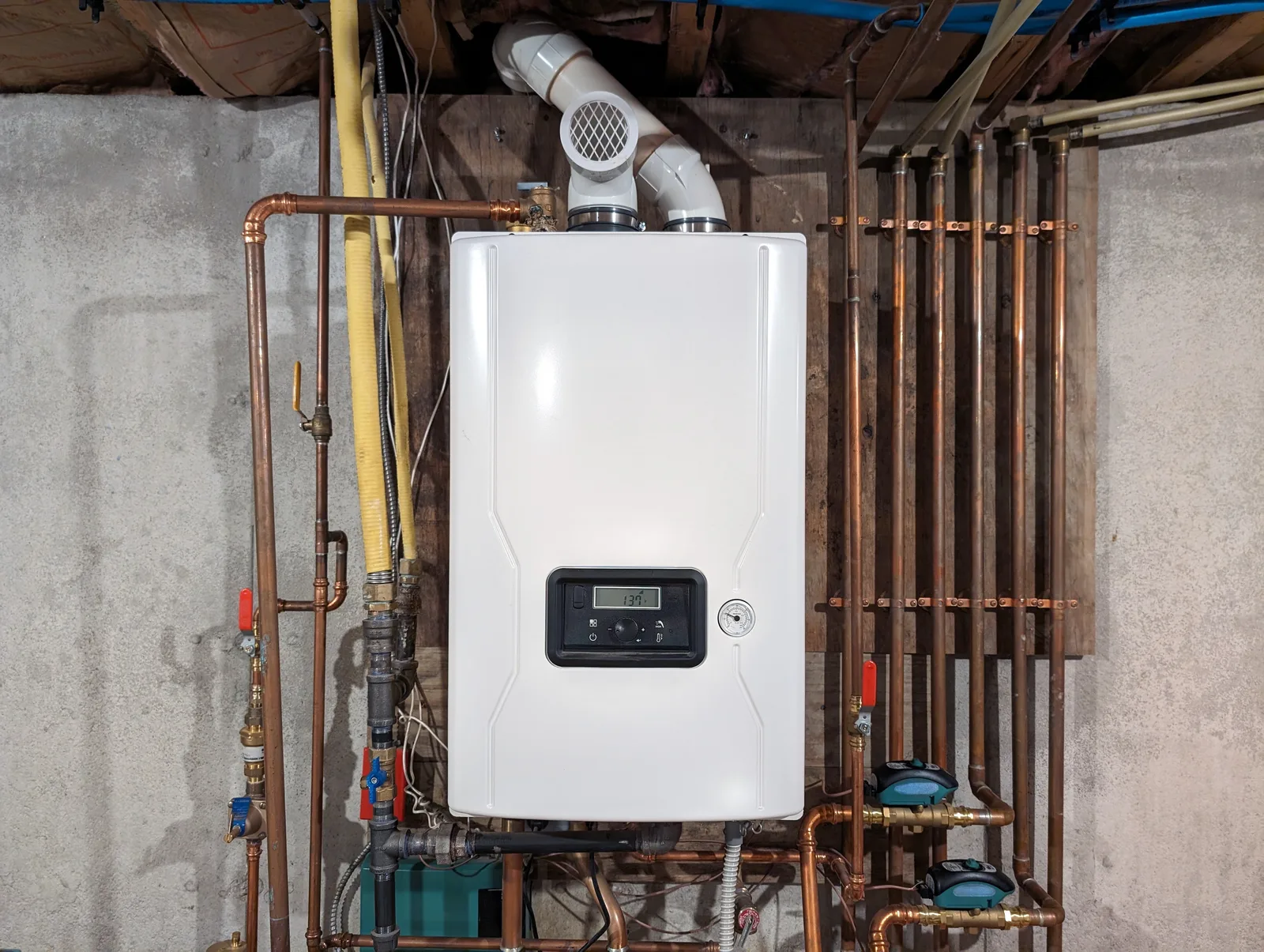
The best tankless water heaters for Ontario homes are condensing gas units in the 160,000 to 199,000 BTU class, and the three lines we install and service most here are Navien, Rinnai and Bosch. Which one belongs in your basement has less to do with the badge on the front than with three things: how much hot water the unit still delivers when the city water coming in is near 5°C, whether it has recirculation built in, and whether your existing gas line and vent path can serve it. Here is how we choose between them for houses in Burlington, Oakville and Hamilton — and who should stay with a tank.
The Flow Rating on the Box Is a Summer Number
Every tankless unit is rated in gallons per minute at a stated temperature rise, and the headline figure on the carton usually assumes a small rise. Ontario does not give you a small rise in January. Municipal water arriving at a Halton or Hamilton basement in late winter sits close to 5°C, and a normal tap setpoint is about 49°C, so the unit has to lift the water roughly 44°C.
Do the arithmetic and a 199,000 BTU condensing unit delivers somewhere around 4.5 to 5 gallons per minute at that winter rise — not the 10 or 11 on the front of the box. A 160,000 BTU unit lands nearer 3.5 to 4. A modern shower head uses roughly 1.5 to 2 gallons per minute, which is why the sizing conversation is really a conversation about how many fixtures run at once in the worst month of the year.
- 199,000 BTU condensing: two showers at once in February, or a shower plus a kitchen sink, with margin left over.
- 160,000 to 180,000 BTU: one shower plus a sink comfortably; two simultaneous showers will feel thin in deep winter.
- Summer performance is far better on any of them, because incoming water is much warmer and the required rise drops by half.
- Every unit also has a minimum activation flow — around half a gallon per minute — so a trickling bathroom tap may not fire the burner at all.
Condensing Only, and Here Is Why
A condensing tankless unit adds a secondary heat exchanger that pulls extra heat out of the exhaust before it leaves the building. That lands the efficiency in roughly the 0.93 to 0.96 UEF band and, more usefully, drops the flue temperature far enough that the unit vents in plastic pipe out a sidewall. Non-condensing models need stainless Category III venting, and in a retrofit that vent costs more than the unit saves.
Condensing brings one requirement with it: the exhaust produces acidic condensate that has to run to a drain, and most manufacturers want a neutralizer cartridge in that line. It is a small part and a small annual check, but it belongs on the quote. If a quote does not mention where the condensate goes, ask.
The Three Lines We Install
- Navien NPE-2 series — the A2 models carry a small buffer tank and a recirculation pump inside the cabinet. That is the tidiest answer to the cold-water sandwich and to a long pipe run out to an ensuite over a garage. The S2 models drop the pump and cost less.
- Rinnai SENSEI — straightforward controls, a large installed base across the GTA so parts and service are easy to come by, and a clean cabinet for a spot where the unit will be visible in a finished basement.
- Bosch Greentherm — less common locally, but a capable condensing unit worth pricing when lead times on the other two stretch out.
Free quotes, written pricing.
Honest framing: all three are built to the same pattern, and at the homeowner level the differences that matter are recirculation, the control interface and who can get a part for it on a Sunday evening. A brand nobody in Halton stocks parts for is a bad buy no matter how good the spec sheet reads. Our Navien vs Rinnai comparison goes deeper on those two specifically.
What Actually Decides the Model in a Halton or Hamilton House
- Gas supply. A 199,000 BTU unit asks for far more gas at once than the tank it replaces. If the line running to the old tank was sized for a 40,000 BTU appliance, the run has to be upsized, which adds $400–$1,200. Occasionally the meter itself is the limit, and Enbridge Gas has to change it — we arrange that before the install date, not on it.
- Vent path. Sidewall termination has to stay clear of windows, doors and the gas meter regulator vent, and it has to sit high enough to stay above winter snow. In a narrow Roseland or Kerr Village side yard that single constraint often decides which wall the unit hangs on.
- Water hardness. Halton and Hamilton both draw municipal water from Lake Ontario, and scale is the main thing that shortens a tankless heat exchanger's life — see our guide to hard water and tankless units.
- Power and freeze protection. The unit needs a 120V receptacle, and its built-in freeze protection only works while that receptacle is live. A unit on an exterior wall in an unheated space plus a winter outage is the one failure mode we see that a tank never has.
- Bathroom layout. If the furthest fixture is more than a long pipe run from the mechanical room, budget for recirculation from the start rather than adding it later.
What It Costs Installed
- Most common GTA conversion — a mid-tier 199,000 BTU gas unit replacing an existing tank: $4,200–$5,000 installed
- Full range across sizes, venting difficulty and gas work: $3,500–$6,500
- Gas line upsizing when the existing run is too small: $400–$1,200 on top
- Annual descale flush to keep the heat exchanger clean: $150–$300
- For comparison, a straight tank-for-tank swap runs $1,200–$2,500 installed
Our tankless cost guide for the GTA breaks those line items down further, including the extras that show up in older houses.
Verdict: Who Should Choose Which
For most two-bathroom detached homes in Burlington, Oakville or Hamilton, a 199,000 BTU condensing unit without recirculation is the correct answer and the cheapest one that works. Recirculation is worth paying for when the plumbing layout demands it, not as a default. And tankless is not automatically the right purchase — a one-bathroom house with a healthy tank is usually better off leaving well enough alone.
- Three or more bathrooms, an ensuite far from the mechanical room, or teenagers showering back to back: a 199,000 BTU condensing unit with built-in recirculation.
- Typical two-bathroom detached or semi: a 199,000 BTU condensing unit, no recirculation, standard sidewall vent.
- Small bungalow, townhouse or one-and-a-half baths: a 160,000 to 180,000 BTU class unit, which is easier on the gas line and cheaper to buy.
- One bathroom, a tank under eight years old, or a move planned inside five years: keep the tank and put the money elsewhere.
- No practical sidewall vent path — many stacked townhouses and condos: tankless is off the table regardless of budget.
Sizing is the part worth getting right before anything else, and our answer page on what size tankless water heater you need walks through the fixture count. When you are ready for a real number on your house, see our tankless water heater service or book a free written quote and we will check the gas line and vent path before quoting a model.
Frequently asked questions
What size tankless water heater does an Ontario home need?
Size by winter temperature rise, not by the flow number on the box. With incoming water near 5°C and a 49°C setpoint, a 199,000 BTU condensing unit delivers roughly 4.5 to 5 gallons per minute, which covers two simultaneous showers. A 160,000 BTU unit is a good fit for a one-and-a-half bathroom bungalow or townhouse where fixtures rarely run at the same time.
Do I need a bigger gas line for a tankless water heater?
Often, yes. A tankless unit fires at up to 199,000 BTU on demand, while the tank it replaces might have been 40,000 BTU, so a line sized for the old appliance can starve the new one. Upsizing the run typically adds $400–$1,200. In a few older houses the gas meter itself needs to be changed by Enbridge Gas, which is arranged before installation day.
Is a condensing tankless water heater worth the extra cost?
In a retrofit it usually costs less overall, not more. Condensing units vent in plastic pipe through a sidewall, while non-condensing units need stainless Category III venting that often costs more than the equipment difference. Condensing also runs in the 0.93 to 0.96 UEF range. The trade-off is an acidic condensate line that needs a drain and, on most brands, a neutralizer cartridge.
What is the cold-water sandwich and how do I avoid it?
It is the slug of cool water that reaches the tap when hot water is drawn, shut off, then drawn again a moment later — the unit has to re-fire and the water already in the pipe arrives first. Models with a small internal buffer tank and a recirculation pump largely eliminate it, and so does an external recirculation loop with a dedicated return line. It is most noticeable in houses where the fixtures sit far from the unit.