
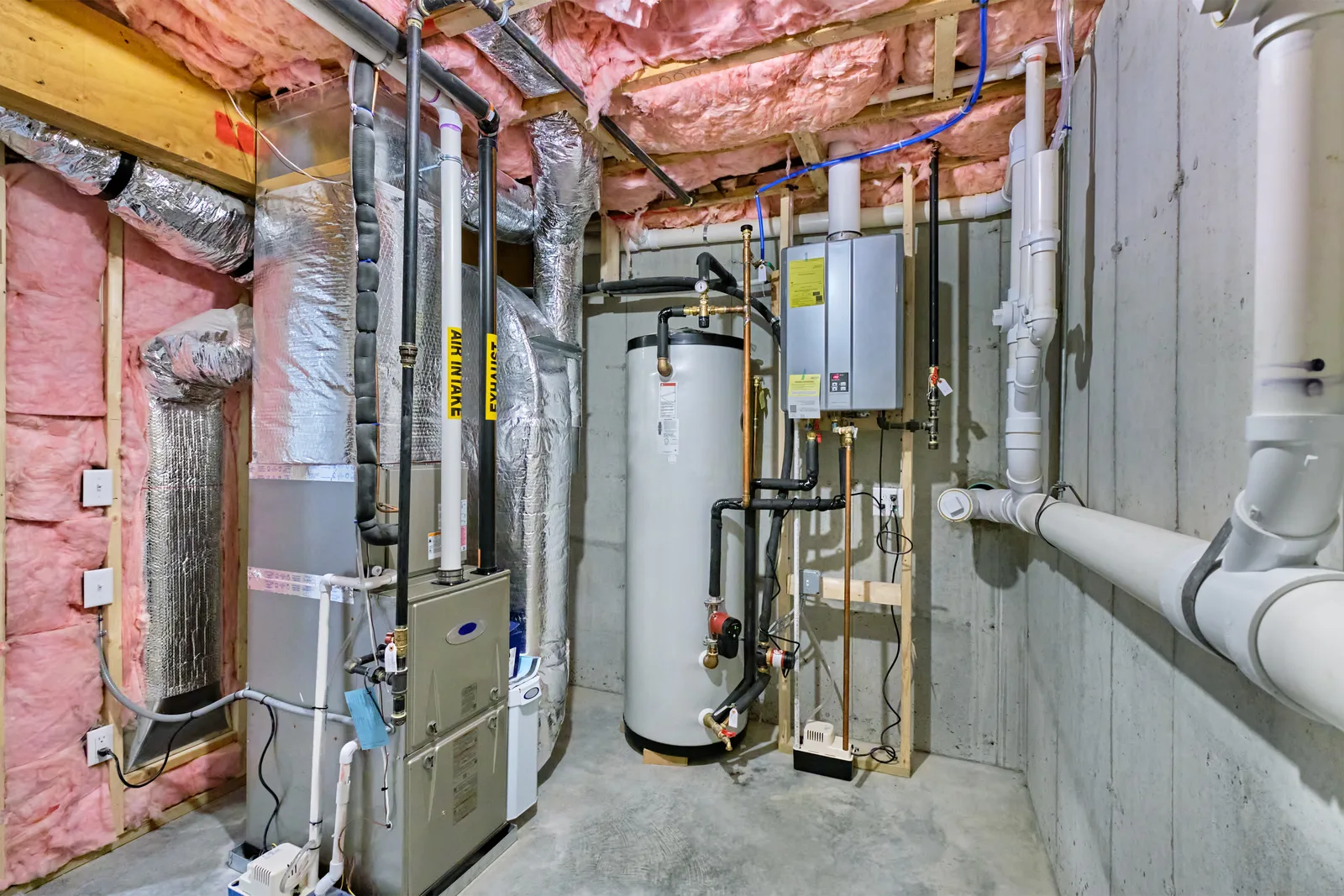
The best water heater for a family of 5 is one whose first-hour rating covers your busiest hour, which for five people is usually close to 290 litres, or about 77 US gallons, of hot water. Three options meet that: a 50 or 60 gallon power-vent gas tank with a high-input burner, a 75 gallon tank, or a 199,000 BTU tankless. A standard 50 gallon tank with a 40,000 BTU burner sits right at the edge, which is why it runs out on the fifth shower.
Count Your Peak Hour Before You Look at Tanks
Add up the hot water used in the single busiest hour of a normal day; for most families of five that is a weekday morning. The method is simple arithmetic, and the inputs are your own habits, not a chart of bedrooms.
- Showers: an 8-minute shower through a 7.6 L/min head uses about 61 L of mixed water. In winter roughly 80% of that comes from the hot side, so count 48 L per shower. Five showers is 240 L.
- Dishwasher: about 15 L of hot water if it runs in the same hour.
- Laundry: about 25 L for one warm load. A cold-wash household counts zero.
- Sinks: allow 10 L for shaving, hand washing and the kitchen tap.
- Total: about 290 L, or 77 US gallons.
Change the numbers to match your house. Two teenagers taking 15-minute showers add about 85 L between them. A family that showers at night and runs the dishwasher on a delay may peak at 200 L and need less heater than this page suggests.
Match the Peak Hour to the First-Hour Rating
First-hour rating is the litres or gallons a tank delivers in one hour starting full and hot, and it is the figure to hold against your peak. It combines the usable part of the stored volume, about 70% of the tank, with what the burner reheats during that hour. Tank size alone tells you the first half only.
You will find the rating on the manufacturer's specification sheet and on the energy label where the tank carries one; in Canada the EnerGuide label is voluntary on water heaters, so not every tank has it. Ask for the number in writing on the quote. For a peak of 77 gallons you want a first-hour rating of 85 or more, so the last person in line is not the margin.
Burner size moves the rating more than most people expect. A 40,000 BTU burner reheats roughly 155 L an hour through a 50 °C rise. A 65,000 BTU burner on the same size of tank reheats about 250 L an hour, and that extra 95 L is close to the usable volume of a whole 40 gallon tank.
The Shortlist: Three Ways to Serve Five People
- A 50 or 60 gallon power-vent tank with a high-input burner. Residential models with burners in the 60,000–65,000 BTU range publish first-hour ratings well above a standard 50, and the tank fits close to the footprint of the one you have. This is the least disruptive upgrade in a 2000s+ house that already vents through the side wall.
- A 75 gallon tank. It stores 284 L, about 200 L of it usable, with a burner around 75,000 BTU behind it. It is wider, taller and heavier, costs noticeably more than a 50, and needs its vent and gas supply checked against the larger input.
- A 199,000 BTU condensing tankless. It never empties, but it is limited by flow: about 19–20 L/min in an Ontario winter. That is three showers at once, not five.
What a 199,000 BTU Tankless Delivers at Ontario Inlet Temperatures
Free quotes, written pricing.
A tankless is rated by how many litres a minute it can heat through a given temperature rise, and the rise is largest in winter. Municipal water drawn from Lake Ontario reaches the house only a few degrees above freezing in February, so the heater has to add about 42–44 °C to reach a 47–49 °C setpoint. At that rise a 199,000 BTU condensing unit delivers about 19–20 L/min.
Each winter shower pulls about 6 L/min of hot water, so the unit carries three at once and little else. A fourth shower or a running dishwasher drops the temperature or the flow for everyone. In late summer, with warmer inlet water, the same heater manages four.
For a family of five the question is whether showers overlap or queue. If they queue, a tankless is the better fit because the fifth shower is as hot as the first. If three or more routinely overlap with laundry running, a large tank's stored volume handles the burst better. Our tank versus tankless comparison goes deeper on the trade.
Gas Line, Venting and Recirculation Decide What the House Can Take
The house often makes the choice before the family does. Check these three things on any quote.
- Gas line capacity. A 199,000 BTU tankless burns about five times the gas of a 40,000 BTU tank when it fires, and a 65,000–75,000 BTU tank is a step up too. The pipe from the meter was sized for the old load, so the fitter recalculates it; see whether a tankless needs a bigger gas line.
- Venting route. 1950s–60s bungalows usually vent an atmospheric tank into a chimney, and a larger burner may need a larger liner. 2000s+ houses have no chimney and use a power-vent water heater through the side wall, where vent length and termination clearances set the limit. A tankless needs its own ULC S636 plastic vent and a condensate drain.
- Recirculation. A big house with long pipe runs wastes water and time at the far bathroom whatever heats it. A tank can take a small pump on a return line; a tankless should be a model built for recirculation.
What Each Option Costs Installed
- Gas tank replacement: $1,200–$2,500 installed, depending on size and venting. A 75 gallon or high-input model sits at the top of that band or is quoted separately.
- Tankless conversion: $3,500–$6,500 installed, with a typical 199,000 BTU job at $4,200–$5,000
- Gas line upsizing where needed: +$400–$1,200
- Running cost: a tankless saves roughly $80–$200 a year over a standing tank
- Renting instead of buying: $25–$45 a month, which reaches $4,500–$8,000 over a 15-year span
Verdict: A High-Input 50 or 60 for Most, Tankless When Showers Queue
For most families of five on natural gas, a 50 or 60 gallon power-vent tank with a high-input burner is the right buy. It covers a 290 L peak hour with margin, costs far less than a tankless conversion, and rarely needs more than a gas-line check.
- Choose the high-input 50 or 60 gallon tank if your peak hour is under about 300 L and the current tank location and vent can be reused.
- Choose the 75 gallon tank if there is a soaker tub in regular use, a basement suite on the same heater, or three showers that overlap every morning.
- Choose the 199,000 BTU tankless if showers run one after another for an hour or more, you plan to stay 10+ years, and the gas line can be upsized.
- Skip the standard 40,000 BTU 50 gallon tank unless your own count comes in under 250 L.
We size by your count, not by a rule of thumb, and write the first-hour rating or winter flow rate on the quote. Our water heater service covers tank and tankless installs across Halton, Hamilton and the west GTA; send us your peak-hour numbers and a photo of the current heater to start. For the general method on smaller households, see what size tank water heater you need.
Frequently asked questions
Is a 50 gallon water heater enough for a family of 5?
Sometimes. A standard 50 gallon gas tank with a 40,000 BTU burner typically publishes a first-hour rating in the 80 to 90 gallon range, which covers a 77 gallon peak with little margin. It works if showers are short or spread across the day. With teenagers, a soaker tub or laundry in the morning rush, step up to a high-input burner or a larger tank.
Is an electric water heater a good choice for five people?
Only if it is sized generously. A standard 4,500 watt element reheats about 70 L an hour in winter, less than half of what a 40,000 BTU gas burner does, so stored volume has to carry the peak. That means a 60 to 80 gallon electric tank, or a heat-pump water heater with a large tank, and showers spread out where possible.
Would two smaller water heaters be better than one large one?
Rarely in a house with one mechanical room. Two tanks cost more to buy, vent and maintain, and double the standby loss. Two heaters make sense when a basement apartment needs its own supply, or when a distant bathroom wing is so far from the main heater that a second, smaller unit near it removes a long wait.
How do I find the first-hour rating of the tank I have now?
Look up the model number from the rating plate on the manufacturer's website; the specification sheet lists first-hour rating beside the burner input and tank volume. Some tanks also show it on an energy label on the jacket. Comparing that number with your own peak-hour count tells you whether the tank is too small or simply worn out.