
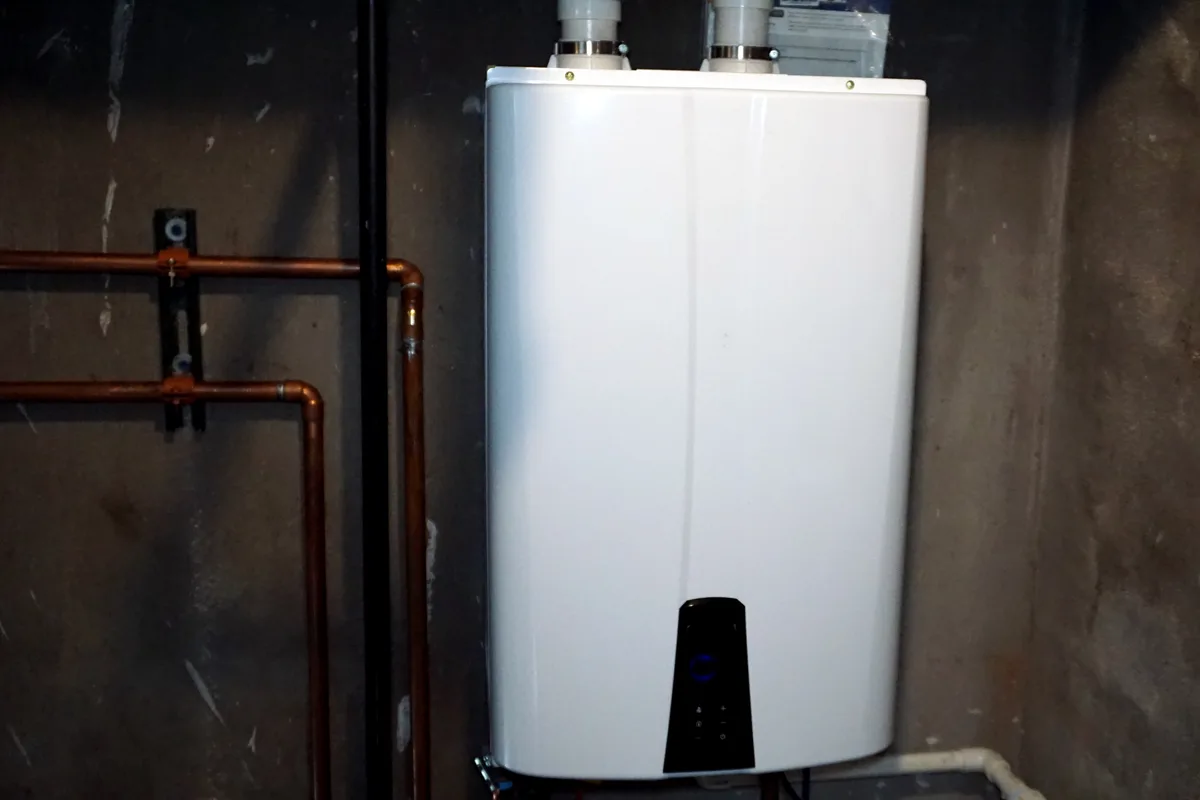
Condensing vs non-condensing tankless water heater is a shorter decision in Ontario than most online comparisons make it: a new gas tankless sold here is a condensing unit. Federal Energy Efficiency Regulations require household gas tankless heaters made since January 1, 2020 to reach a uniform energy factor of 0.86 or 0.87, depending on flow rate, and a non-condensing design tops out around 0.80–0.82. Condensing units run about 0.93–0.97 UEF, vent in plastic pipe and need a drain. The comparison still matters if you own an older non-condensing unit and are deciding whether to repair it, or if you are reading an American guide and wondering what you would give up.
How a Condensing Tankless Gets From 0.82 to 0.95 UEF
A condensing tankless adds a second heat exchanger that pulls heat out of the exhaust before it leaves the cabinet. In a non-condensing unit the burner heats one heat exchanger, usually copper, and the flue gas leaves hot, carrying roughly a fifth of the gas you paid for out through the vent. A condensing unit runs that exhaust across a second exchanger, usually stainless steel, where the incoming cold water cools it until the water vapour in the flue gas condenses and gives up its heat.
The ratings follow from that. Non-condensing models are rated about 0.80–0.82 UEF and condensing models about 0.93–0.97, so the condensing unit turns roughly 14 more cents of every gas dollar into hot water. UEF is measured on a standard draw pattern, which makes it the fair figure to compare across brands.
The saving is real but modest in dollars, because water heating is a smaller gas load than space heating. What matters more to the installed price is what that cooler exhaust lets the installer do with the vent.
Why Venting Cost Flips the Price Gap
The non-condensing unit is cheaper to build and dearer to vent, which is why installed prices end up closer than the box prices. Its exhaust is hot and under positive pressure, so it must leave through Category III stainless steel vent or the manufacturer's own concentric vent kit, sealed at every joint. That pipe is sold by the length at a price that makes a long run to an outside wall a real line on the quote.
A condensing unit's exhaust is cool enough for plastic. In Canada that plastic must be certified to ULC S636, the standard for gas vent systems in PVC, CPVC or polypropylene, and the installation follows the CSA B149.1 gas code and the heater's own manual. Ordinary plumbing drain pipe does not qualify, even though it looks the same from across the basement.
- Material: S636 plastic costs a fraction of stainless per metre, and fittings are stocked at every wholesaler.
- Length: many condensing models allow long runs in 2 or 3 inch pipe, which lets the heater hang where the old tank stood instead of against an outside wall.
- Intake: most condensing installs use two pipes, one bringing combustion air from outdoors, so the unit does not draw air from a tight basement.
- Termination: both types need clearances from windows, doors, gas meters and the lot line, and narrow side yards in 2000s+ subdivisions are where this gets tight.
- Slope: a condensing vent is pitched back toward the heater so condensate drains into the unit instead of dripping outside and freezing.
The Condensate Drain and Neutralizer a Condensing Unit Needs
Every condensing tankless makes water as it runs, and that water has to go somewhere. Condensate is mildly acidic, so we run it through a neutralizer, a cartridge of limestone-type media that raises the pH, before it reaches a floor drain, laundry standpipe or condensate pump. Without one, acidic condensate sits in cast iron and copper drain lines and slowly eats them.
Three things go wrong with condensate, and all three are cheap to prevent. The neutralizer media dissolves over time and needs topping up at the annual service. A drain line run through an unheated garage or crawlspace can freeze and shut the heater down on the coldest night. Where there is no floor drain nearby, a condensate pump has to lift the water to one, and a new pump installed is $250–$450.
A non-condensing unit needs none of this, which is its one real advantage in a spot with no drain. That advantage rarely survives the cost of the stainless vent.
Free quotes, written pricing.
ENERGY STAR and Rebates: What Each Type Qualifies For
Only condensing models can carry the ENERGY STAR mark. The current ENERGY STAR criteria for gas tankless water heaters ask for a UEF of 0.95 or higher, which rules out every non-condensing unit and some lower-rated condensing ones. If the label matters to you, check the exact model number, not the series name.
Rebates are simpler: there are none for either type right now. No current Ontario program pays a rebate for a gas tankless water heater, condensing or not, so any quote that leans on one deserves a second look. Our tankless water heater rebate page tracks what exists.
If You Own a Non-Condensing Tankless: Repair or Replace?
Repair it while the heat exchanger is sound and the fault is a serviceable part. Igniters, flame rods, flow sensors, fans and control boards can all be replaced, and a unit that has been descaled regularly can run 15–20 years. Replace it when the heat exchanger leaks, when parts for that model are no longer supplied, or when the repair costs more than half of a new unit and the heater is past 12 years old.
Scale decides which side of that line most local units land on. Hard water in Halton and Hamilton coats the heat exchanger, the unit runs hotter to push heat through the scale, and the copper fails early. An annual descale flush at $150–$300 is the cheapest insurance either type can have, and our guide to hard water and tankless heaters in Hamilton and Halton explains the signs.
What Changes When a Condensing Unit Replaces a Non-Condensing One
- The stainless vent comes out. A condensing unit is vented with the materials its manual lists, which normally means a new S636 plastic run and often a second pipe for intake air.
- A drain is added. The installer needs a route to a floor drain or standpipe, or a pump, plus the neutralizer.
- The wall penetrations change. Two smaller holes may replace one larger one, and the old opening is patched and sealed.
- The gas line is checked, not assumed. Input is usually similar, but the pipe is measured and the load calculated again under the gas code.
- The water side gets isolation and flush valves if the old unit never had them, so future descaling is a routine visit.
The published band for a tankless installation is $3,500–$6,500. Where a replacement lands in it depends on how much of the vent, drain and piping has to be redone, which is why the quote should list each of those as its own line.
Verdict: Condensing, With the Vent and Drain Priced in Writing
Buy condensing. In Ontario it is what a new gas tankless is, it uses about 15% less gas for the same hot water, and its plastic vent gives the installer more freedom over where the heater hangs. The non-condensing design only wins where it is already on the wall, working, and cheap to keep.
- Keep and maintain a non-condensing unit if it is under 12 years old, has been descaled, and has not thrown repeated ignition or flame-loss codes.
- Replace it with a condensing unit if the heat exchanger is leaking or scaled past recovery, or if a repair quote passes half the cost of a new heater.
- If you are converting from a tank, compare condensing models against each other; our tankless shortlist for Ontario homes does that.
- On any quote, look for four lines: vent material and length, condensate drain and neutralizer, gas line, and the descale valves.
ZK Mechanical installs and services condensing tankless heaters from Burlington, with TSSA-licensed gas technicians doing the venting and gas work. See our tankless water heater service for what an install includes, or ask for a written quote and send a photo of the current heater and its vent.
Frequently asked questions
Can a condensing tankless reuse the stainless steel vent from my old non-condensing unit?
Usually not. A heater may only be vented with the materials and sizes listed in its installation manual, and the old vent was sized and pitched for hot, dry exhaust, not cool, wet exhaust that must drain back to the unit. Most replacements get a new ULC S636 plastic vent, and the old stainless run is removed so nothing is left open in the wall.
Is it safe to keep running an older non-condensing tankless?
Yes, if it is venting properly and has been serviced. Age alone is not a hazard. Have a licensed gas technician check the vent joints for corrosion or staining, confirm combustion, and flush the heat exchanger. Stop using it and call if you see water inside the cabinet, scorch marks on the casing, or soot at the vent termination.
Does a condensing tankless last longer than a non-condensing one?
Not automatically. Life depends on water hardness, descaling and how hard the unit is worked more than on the design. Condensing models add a secondary heat exchanger, a condensate trap and a drain that need attention at each service. Maintained yearly on Halton or Hamilton water, either type can reach 15–20 years; neglected, either can fail far sooner.
Do condensing tankless water heaters work on propane?
Yes. Most condensing models are sold for natural gas and can be set up for propane with the manufacturer's conversion parts, or ordered as a propane version. That matters on rural lots in Caledon, Kilbride, Campbellville and Flamborough where gas mains do not reach. The conversion and the regulator setup are licensed gas work, and the unit is labelled for the fuel it now burns.