
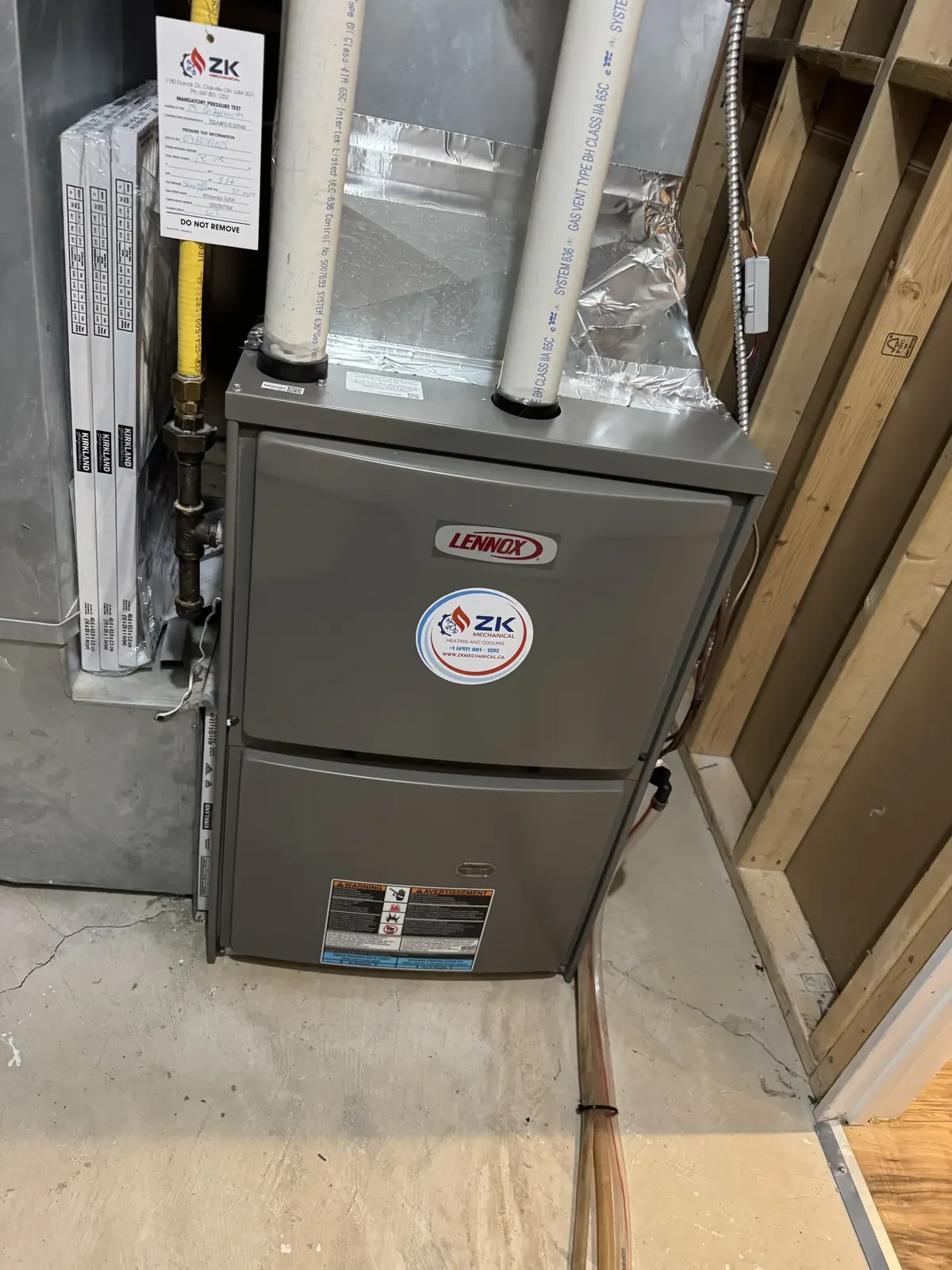
Heating homes on the Hamilton Mountain and along the escarpment is a different job from heating the lower city, and the reason is elevation rather than distance. The brow lifts the Mountain the better part of a hundred metres above the harbour and out of the shelter Lake Ontario gives the streets below, so it runs colder, holds snow longer and takes far more wind. In practice that shows up in exactly three places: the heat loss calculation, the vent terminations, and how much backup heat you need.
Why the Mountain Runs Colder Than the Lower City
Three effects stack on top of each other. Air cools as you gain height, so the brow starts a step behind the harbour before anything else happens. The lower city and the North End sit close to a large body of water that gives up its heat slowly through early winter, and the Mountain is both further from it and above it. Finally, south of Rymal Road the land opens into what was Glanbrook farmland, where subdivisions have young trees and nothing to break the wind.
- A storm that falls as cold rain in the North End can be laying down snow on Concession Street at the same hour.
- Wind drives that snow into drifts against the side of the house, which is where a high-efficiency furnace exhausts.
- Open lots south of Rymal lose heat to wind washing through attic insulation, the attic hatch and the rim joist far faster than a sheltered lower-city street does.
- Ice and wind on exposed brow streets bring down power lines, and a gas furnace does nothing without electricity.
What Changes in the Heating Design — and What Does Not
The exposure factor and the infiltration load change; the equipment certification does not. A heat loss calculation accounts for how sheltered a house is, so the same floor plan on an open corner lot in Summit Park carries a higher load than it would tucked into a row on Locke Street. That is a real adjustment and a good installer makes it.
What is not real is altitude de-rating. Under the CSA B149.1 gas code, appliances only need high-altitude equipping above about 1,370 metres (4,500 feet), and the escarpment is a rise of roughly a hundred metres. If a quote adds capacity or a special orifice because you live "up on the Mountain", ask for the manufacturer's page that says so — there will not be one. Size the equipment to the measured heat loss instead.
Drifting Snow and Sidewall Vents: The Failure We See Most
The most common February no-heat call above the brow is not a broken furnace at all — it is a buried vent. A condensing furnace breathes through a pair of plastic pipes that terminate low on an exterior wall, and the gas code requires those terminals to sit above the snow that is reasonably expected to accumulate. On an exposed Mountain lot, a single overnight blow can put more snow against that wall than the installer planned for. The pressure switch senses the blockage and shuts the burner down, which is the system protecting you, not failing you.
- Learn where your terminals are before winter and clear a good arm's length around them after every storm, including the intake, not just the exhaust.
- Do not aim the snowblower at that wall, and tell the plow contractor not to windrow snow along it.
- If it has happened twice, the fix is to raise or relocate the terminals rather than to keep shovelling — that is a permitted alteration and it is worth doing properly.
- The water heater and dryer vents on the same wall deserve the same look.
- A furnace locked out this way flashes a fault code at the sight glass. Note the blink pattern before you cut the power, because resetting the switch erases the one piece of evidence a technician wants.
Free quotes, written pricing.
Mountain Housing Eras and What Each One Needs
- Just above the brow — Concession Street, Inch Park, and the older blocks off Upper James and Upper Gage: 1950s and 1960s bungalows and side-splits, usually still on the trunk ductwork the original furnace was built around, with a single hallway return.
- Late 1960s and 1970s Westcliffe, Rolston, Gilkson and Buchanan: back-splits with a half-level that never balances. Transfer grilles and a properly sized return do more here than a larger burner.
- 1970s to 1990s Templemead, Huntington and Riverdale: full two-storeys with ducts in interior walls. A two-stage furnace running longer, gentler cycles usually settles the upstairs-downstairs argument.
- 2000s and newer Summit Park, Heritage Green and Binbrook: tight envelopes with builder-grade single-stage equipment that is often a size too large, and HRVs that were never balanced after handover. Our guide to builder-grade HVAC upgrades covers the same equipment tier in Halton.
- Rural Glanbrook and the pockets beyond the gas main: propane, with its own tank and regulator clearances — see propane furnaces in rural Flamborough for how those installs differ.
Brow and Escarpment-Face Homes: Wind, Glass and Power
Houses along Mountain Brow Boulevard, Scenic Drive and the streets overlooking Sam Lawrence Park take wind straight off the face with nothing in front of them, and they were usually built or renovated to take advantage of the view. Large north-facing glazing over the city is wonderful and it is also where most of the heat goes. On these homes the heat loss is dominated by glass and air leakage, not by wall area.
The order of work matters. Sealing the rim joist, the attic hatch and the old chimney chase, then getting the attic to a current insulation level, shrinks the load enough that a smaller, better-modulating furnace fits. Buying a bigger burner to overcome a leaky envelope just means shorter, noisier cycles. And because outages are more frequent on these streets, it is worth deciding in advance how the house will cope — our note on keeping pipes from freezing when the furnace fails is the short version.
Gas, Dual-Fuel or All-Electric Up Here
For a Mountain home already on the Enbridge Gas main, dual fuel is the honest recommendation more often than not: a cold-climate heat pump does the bulk of the season, the gas furnace covers the coldest mornings, and you are never relying on electric backup during a wind event. Alectra Utilities distributes the electricity in Hamilton, and a heat pump with electric backup needs both a dedicated circuit and enough panel to carry it — many Mountain homes from the 1960s are still on a full 100-amp panel. Read how heat pumps perform in Hamilton winters before committing to all-electric, and insist the panel is load-calculated as part of the quote rather than discovered on install day.
What We Check on a Mountain Heating Call
- Vent terminal height, clearance and orientation relative to the prevailing wind and the snow line.
- Static pressure across the furnace, which tells us whether the duct system can actually deliver what the equipment produces.
- Combustion analysis, and on older equipment the condition of the heat exchanger.
- Attic hatch, rim joist and chimney chase sealing — the three leaks that cost the most on an exposed lot.
- Thermostat setback behaviour, because a deep overnight setback on an exposed house means a hard morning recovery.
- Whether the backup heat and the electrical service actually match the equipment installed.
We work the Mountain from our shop on North Service Road in Burlington, and the Lincoln Alexander Parkway puts most addresses above the brow inside a half-hour run. If your house is cold in the wind, or the furnace keeps locking out after a storm, book a look at heating service on the Hamilton Mountain or talk to us about it directly.
Frequently asked questions
Is the Hamilton Mountain really colder than the lower city?
In practice, yes. The brow sits close to a hundred metres above the harbour, further from the moderating effect of Lake Ontario and more exposed to wind, so it holds snow longer and feels colder on the same day. It is enough of a difference to matter in a heat loss calculation.
Does my furnace need to be de-rated because I live on the Mountain?
No. The CSA B149.1 gas code only calls for high-altitude equipping above roughly 1,370 metres (4,500 feet), and the escarpment is a rise of about a hundred metres. Size the furnace to the home's measured heat loss, not to its elevation — if a quote adds capacity because you live above the brow, ask for the manufacturer page that requires it.
Why does my furnace stop working after a snowstorm?
Most often the exhaust or intake terminal on the exterior wall has drifted over. The pressure switch detects the blockage and locks the burner out to keep combustion gases from backing up. Clear a wide space around both pipes; if it recurs, the terminals should be raised or moved.
Do heat pumps work on the Mountain in winter?
Cold-climate models do, and most of the systems we install above the brow keep the gas furnace as backup so the coldest mornings and any wind-related outage risk are covered. Panel capacity is the usual limiting factor on 1960s and 1970s Mountain homes.
Do you service Binbrook, Stoney Creek Mountain and rural Glanbrook?
Yes. Those addresses are all City of Hamilton and we reach them by the Linc and the Red Hill. Homes beyond the gas main run on propane, which changes the fuel storage and clearance requirements but not the furnace itself.