
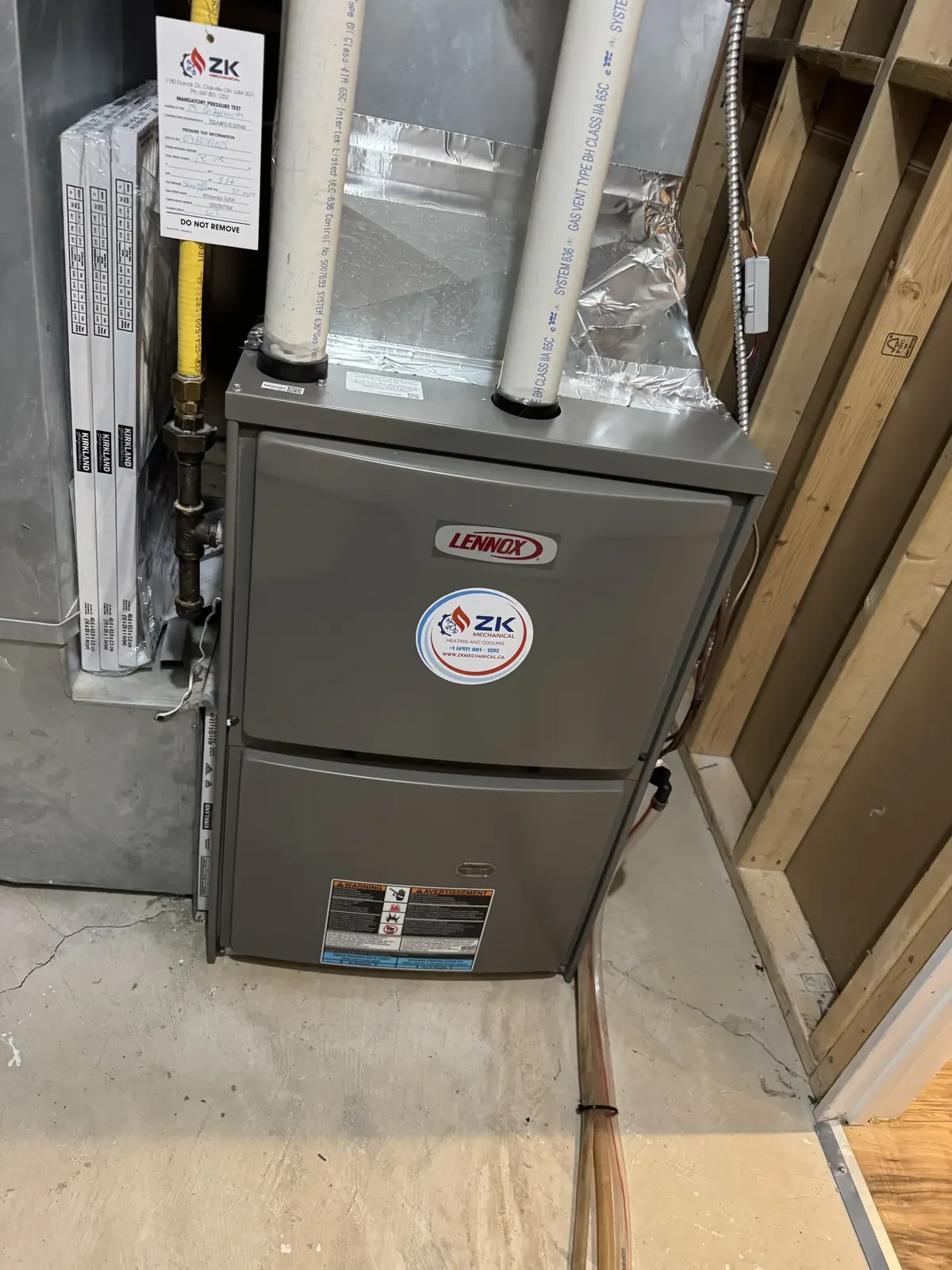
Builder-grade HVAC in Waterdown and north Oakville is rarely defective equipment — it is the least expensive package that still satisfies the Ontario Building Code and the builder's energy target. On these streets that usually means a single-stage high-efficiency furnace sized from a spreadsheet, a base-tier air conditioner, one return grille per floor, flexible duct on the longest runs, an HRV left exactly where the installer set it, and a thermostat nobody ever programmed. Three or four targeted changes fix most of the comfort complaints, and the furnace itself is normally the last thing you should touch.
What Builder-Grade Means on These Particular Streets
Waterdown grew north and east of Dundas Street and out along Parkside Drive from the late 1990s onward, and the subdivisions north of Dundas Street in Oakville — the Preserve, the Uptown Core, the streets running off Neyagawa Boulevard and William Halton Parkway — are newer still. Different builders, different elevations, but a remarkably consistent mechanical spec.
- A single-stage condensing gas furnace. It is efficient and reliable, but it has one output: full. That is why some rooms overshoot the thermostat while the far bedroom never quite catches up.
- A base-efficiency air conditioner matched to the furnace coil, typically the minimum rating allowed in the year the house closed rather than the tier you would pick yourself.
- One return air grille per floor, usually in the hallway. Close a bedroom door and that room is now a sealed box being pressurised by its supply register.
- Flexible duct on the runs that had to cross joists, occasionally with a sag or a crushed bend that nobody will ever see behind the drywall.
- An HRV, because the Building Code's ventilation requirements effectively call for one, installed on its factory default with the balancing dampers untouched.
- A basic thermostat with a schedule that was never set, and no outdoor sensor or staging logic.
None of that is a code violation. It is a budget decision made months before you walked through the model home, and it is entirely reversible one piece at a time.
Waterdown Sits on Top of the Escarpment, and the Load Reflects It
Waterdown is on the brow of the Niagara Escarpment, roughly a hundred metres above the lakeshore in Aldershot directly below it. Higher ground, more exposure, more wind — the same floor plan built in Waterdown loses more heat to infiltration on a clear January night than it would on a sheltered street south of the QEW. Snow lies longer here too, which matters for where a sidewall vent and a condenser end up.
The other thing worth knowing is jurisdictional: Waterdown is part of the City of Hamilton through the former Town of Flamborough, so its permits and inspections run through Hamilton, and Alectra Utilities distributes the electricity. North Oakville is the Town of Oakville, with Oakville Hydro on the electrical side. Enbridge Gas serves both. Contractors who work one side of the boundary only tend to be vague about this.
North Oakville's Narrow Lots and Three-Storey Towns
North of Dundas the lots are deep and narrow, which pushes the outdoor unit into a side yard barely wider than a wheelbarrow, and the houses go up rather than out. Vertical living creates predictable weak spots in a builder duct design.
- The bonus room or loft over the garage: a floor sitting above unconditioned space, two or three exterior walls, and usually one undersized supply. It is the coldest room in February and the hottest in July.
- Top-floor bedrooms in three-storey and back-to-back towns: warm air arrives there whether you want it or not in summer, and there is rarely a dedicated return to pull it back out.
- The ground-floor flex room beside the garage: long duct run, cold slab, and a garage wall on one side.
- Basements roughed in for a future bathroom with a single supply and no return, which turns any future finished space into a problem.
If one room is the whole complaint, start there rather than at the furnace — why one room is always colder than the rest walks through the airflow causes in order.
Free quotes, written pricing.
The Upgrades Worth Paying For, Ranked
- Airflow first. Balancing the dampers, correcting a crushed flex run, and adding a return or a transfer grille to the rooms that get closed off buys more comfort per dollar than any equipment change.
- A thermostat that can actually do something: a real schedule, a circulation fan setting, remote sensing for the room that misbehaves. This is the cheapest upgrade on the list and often the most noticeable.
- Commission the HRV. Set it to run continuously on low with boost on the bathroom switches, balance the supply and exhaust, and clean the core. Builders install them; almost nobody sets them up.
- A proper filter cabinet. A 1-inch slot restricts airflow and fills quickly, while a 4- or 5-inch media cabinet cuts pressure drop and catches far more drywall dust — choose it on airflow, not on the highest MERV number on the shelf.
- A whole-home humidifier ($500–$1,200 installed) if the first winter left you with static and cracked trim, but only after the HRV is set correctly, since running both blind works against you.
- Two-stage or modulating equipment — worth specifying at replacement time, not worth tearing out a working furnace for. The difference between staging types is laid out in our single-stage vs. two-stage vs. modulating comparison.
What You Should Not Replace Yet
The furnace. A builder's single-stage condensing furnace installed in 2014 has plenty of service life left, and swapping it early buys you staging you could have specified for a modest premium when it eventually dies anyway. The same goes for the air conditioner: base-tier equipment installed a decade ago is not efficient, but replacing a functioning unit rarely pays back on energy alone.
The one exception is a system that was genuinely undersized or oversized for the house. Oversizing shows up as short, frequent cycles and a house that never dries out in August; undersizing shows up as a unit that runs all evening and still loses ground. Both need a heat loss and heat gain calculation to confirm, not a guess from the name plate.
Do the Warranty Paperwork Before You Change Anything
If the home is still inside its Tarion coverage, a builder defect is the builder's cost, and a defect you paid someone else to fix is your cost. Report a duct that was never connected, an HRV that was never wired to a switch, or equipment that does not match the mechanical drawings before you hire anyone. Our Tarion HVAC warranty guide covers what falls inside the coverage, and the first-year checklist for new Oakville homes puts the deadlines in order.
Manufacturer warranties matter too. Most brands extend the parts coverage only if the equipment was registered within a short window after installation, and on a new build that registration was either done by the builder's trade or never done at all. It takes 10 minutes to check against the serial number you photographed, and it is worth doing long before you need a control board.
How We Approach a Builder-Grade Upgrade
We start with a walk-through and a static pressure reading rather than a quote. If the ductwork is choking the blower, that is the conversation; if the HRV was never commissioned, that is a service visit, not an install. Only when the distribution side is right does staging or efficiency become the honest next step, and by then you usually know exactly which upgrade you want.
We cover Waterdown from our shop on North Service Road in Burlington, a short run up the escarpment, and north Oakville is a straight shot along the QEW or Trafalgar Road. Book a walk-through and we will tell you plainly which of these upgrades your house actually needs and which ones it does not.
Frequently asked questions
Is a builder-grade furnace a bad furnace?
No. It is usually a reliable single-stage condensing unit chosen for price rather than comfort features. The limitations are staging and blower control, not durability. Most of the comfort problems people blame on it come from the duct design, the returns and an uncommissioned HRV.
Why is the room over the garage always uncomfortable in these houses?
It has a floor above unconditioned space, more exterior wall than any other room, and typically one supply register at the end of a long run with no dedicated return. Fixing it starts with airflow — a larger supply, a return or transfer grille, and sealing the floor cavity — rather than with new equipment.
Should I upgrade the thermostat before anything else?
It is the least expensive change with the most immediate effect, especially if it lets you run the circulation fan and place a remote sensor in the room that misbehaves. It will not fix a crushed duct or a missing return, so pair it with a look at the distribution side.
Does adding a return duct need a permit in Waterdown or Oakville?
In Waterdown, yes: the City of Hamilton lists new or replacement ductwork in an HVAC system among the work that requires a building permit. North Oakville goes to the Town of Oakville, whose building permit page does not spell out duct changes, so the question is put to the Town. A contractor who works in both regularly confirms the scope with the building department before quoting rather than after.