
Quick answer
An AC compressor that won't turn on while the outdoor fan runs has usually lost its start: a failed run capacitor, an open contactor pole, a tripped internal overload or an open pressure switch. A capacitor or contactor is a $150–$350 repair. A compressor that is seized or shorted to ground on an R-22 unit, or on an R-410A unit over 12 years old, points to replacing the outdoor unit.
When your AC compressor won't turn on, the outdoor unit tells you a lot before any tool comes out. Stand beside it with the thermostat calling for cooling. A fan that spins with no deeper drone underneath, air off the top that is not warm, and a large copper line that stays at room temperature all mean the fan is running alone.
Fan running, compressor silent or humming: four common causes
- Failed run capacitor. On most residential condensers one dual capacitor serves the fan and the compressor from separate terminals. The compressor side can fail while the fan side still works, leaving the compressor to hum for a few seconds and click off.
- Open contactor pole. The contactor passes 240 V to the compressor through its contacts. A burnt or pitted contact can stop passing current even though the contactor has pulled in.
- Internal overload tripped. A thermal protector buried in the compressor windings opens when the motor overheats, typically after running with a dirty coil, a dead fan or a low charge. The compressor is silent until it cools, which can take an hour or more, then starts as if nothing happened.
- Pressure safety switch open. A low-pressure switch stops the compressor when the charge has leaked down; a high-pressure switch stops it when the outdoor coil cannot shed heat. Depending on how the unit is wired, an open switch holds off the compressor alone or the whole outdoor unit, and the cause still has to be found.
If the whole outdoor unit is dead, fan included, the fault is upstream in the power or the control signal. That is a separate diagnosis: why the outside unit is not running but the inside is.
What you can do before calling
- Turn the system off at the thermostat. A compressor that hums and trips is drawing several times its normal current on each attempt.
- Check the filter and look at the outdoor coil. If the coil is matted with fluff or the filter is plugged, an overheated compressor is the likely story.
- Leave it off for two hours, then try one cooling cycle. A compressor that starts and cools after resting was tripping on its overload, and the reason it overheated still needs a technician.
- Do not keep cycling the breaker or the thermostat to coax a start.
How a technician tells a bad capacitor from a bad compressor
The order of testing matters, because the inexpensive parts fail far more often than the compressor does. The capacitor is measured in microfarads against its label, the contactor is checked for voltage in and voltage out, and the pressure switches are checked for continuity. Only when those pass does attention turn to the compressor itself.
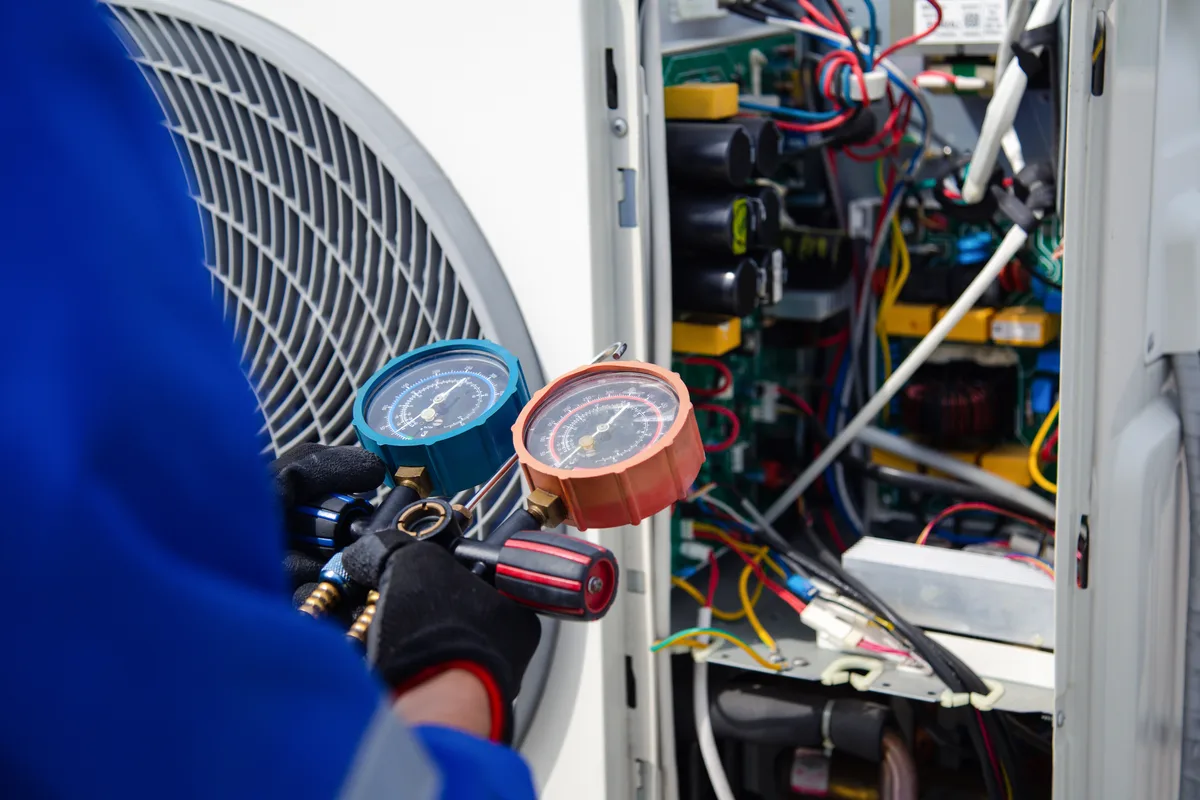
- Winding resistance. An ohmmeter across the common, start and run terminals shows an open winding or confirms that the internal overload is open.
- Megohm test. An insulation tester applies a high voltage between the windings and the compressor shell. A low reading means the windings are grounded: the motor is shorted to its casing and will trip the breaker.
- Locked-rotor amps. A clamp meter on the compressor wire during a start attempt is compared with the LRA figure on the rating plate. A compressor that pulls close to its LRA and never drops to running current is mechanically locked.
A tight compressor sometimes starts with a hard-start kit, an added start capacitor and relay. That can buy time, and it is a stopgap, not a cure.
Repair or replace: the decision rule for a failed compressor
A confirmed compressor failure on an R-22 unit, or on an R-410A unit 12 years old or more, points to replacing the outdoor unit rather than the compressor. The job needs the refrigerant recovered, the compressor brazed in, a new filter-drier, a deep vacuum and a full recharge, and it puts a new heart into a unit whose coil, fan motor and contactor are all the same age. On R-22 the refrigerant itself is phased out and only reclaimed stock is available.
On a younger R-410A unit the answer can go the other way. Manufacturers often cover the compressor under a parts warranty when the unit was registered, which leaves labour and refrigerant to pay, so find the paperwork before deciding. There is no flat price for a compressor replacement because it varies with the model, the tonnage and the refrigerant, so it is quoted in writing. What an AC compressor costs walks through what drives it.
What the smaller compressor no-start repairs cost
- Diagnostic visit: $90–$150, taken off the repair bill if you proceed.
- Dual run capacitor: $150–$350.
- Contactor: $150–$350.
- Leak repair and recharge when the low-pressure switch was the cause: $300–$800+.
- New central air conditioner when replacement makes more sense: $4,500–$7,000 installed for most homes.
ZK Mechanical tests the inexpensive parts first and shows you the meter readings before anyone mentions a new unit. If the compressor is condemned, you get the megohm and amp readings and a written price for both paths. Start with AC repair, compare the options in AC repair versus replacement, or contact us at (647) 801-1252.