
Quick answer
A mini-split that is not heating is often in a normal pause: defrost and the cold-air-prevention delay stop the indoor fan for up to 15 minutes. Real faults are a mode conflict on a multi-zone system, an outdoor unit iced over or buried in snow, a stuck reversing valve, low refrigerant, or weather below the model's limit: about -15 °C for standard units, -25 to -30 °C for cold-climate ones.
Before deciding that your mini-split is not heating, give it 15 minutes with the remote on HEAT and the setpoint 3 °C above room temperature. Two normal behaviours look exactly like a failure in that window. If warm air has not returned by the end of it, the cause is one of a short list, and the outdoor temperature tells you which end of the list to start at.
Normal pauses: defrost and the cold-air-prevention delay
A mini-split in heating mode stops blowing on purpose. At start-up the indoor fan waits until the coil is warm so you are not hit with a cold draught, a delay of a few minutes. In damp cold near freezing, the outdoor coil frosts over and the unit reverses briefly to melt it: the indoor fan stops, the lamp may flash, and the outdoor unit steams and drips. Heat resumes without any help, and the defrost cycle guide explains the timing.
The head's position misleads people too. It hangs near the ceiling and measures the air there, which runs a couple of degrees warmer than the air at couch height. A unit that reaches its setpoint and idles while your feet are cold is working; aim the vanes down, raise the fan speed and set the temperature a degree or two higher.
Mode conflict on a multi-zone system
One outdoor unit can heat or cool, never both at once. If any head on a multi-zone system is set to COOL or DRY, or to AUTO and has chosen cooling for a sunny room, the heads asking for heat go into standby and blow nothing. Most brands give priority to whichever mode started first. Put every head on HEAT, switch off the ones you are not using, and avoid AUTO on multi-zone systems in spring and fall.
Outdoor unit faults: snow, ice, the base-pan heater and the reversing valve
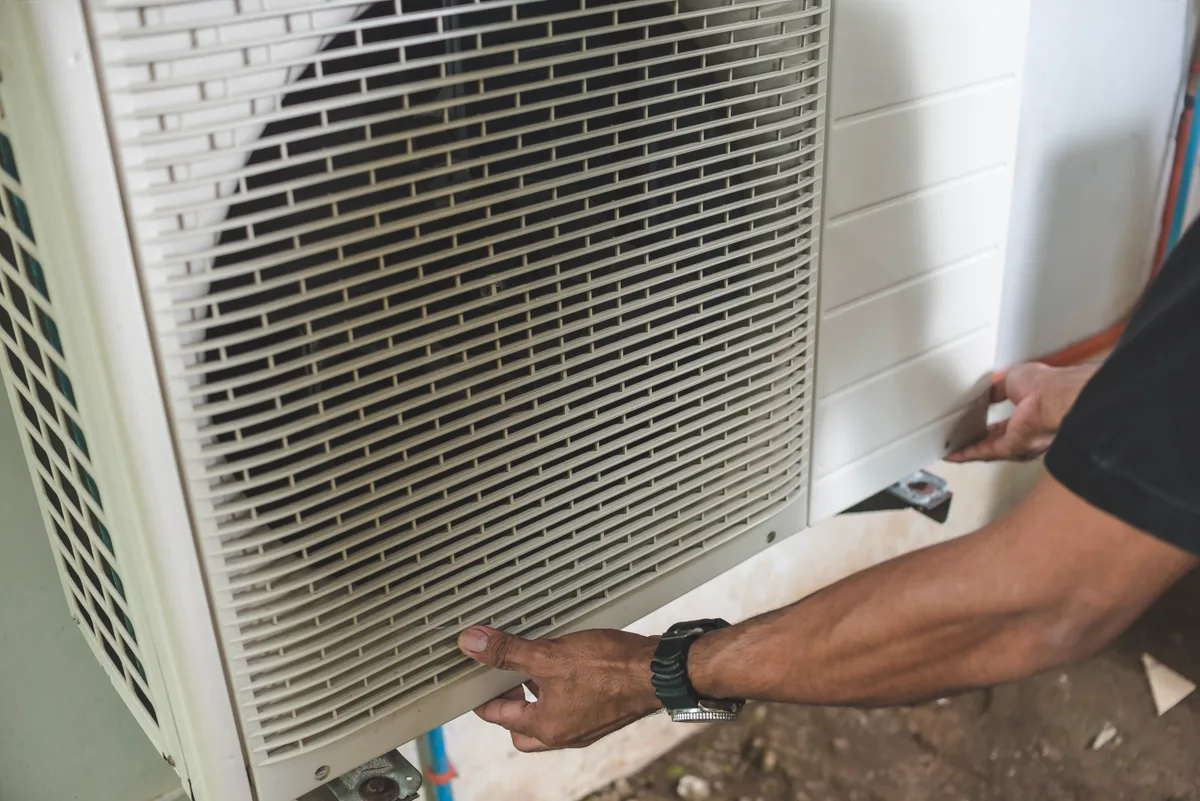
- Buried or blocked: snow drifted against the coil or packed underneath chokes the airflow the unit needs to collect heat. Clear it by hand, following what to do when a heat pump is covered in snow.
- Iced over: a coil encased in solid ice that does not clear after a defrost has a defrost fault, a failed sensor or a drainage problem.
- Failed base-pan heater: cold-climate models have an electric heater in the base so defrost meltwater can drain. When it fails, the water refreezes in the pan and the ice climbs into the coil and the fan.
- Reversing valve not shifting: this four-way valve swaps the unit between heating and cooling. If it sticks or its solenoid coil fails, the head blows cool or lukewarm air in HEAT mode while everything sounds normal. The reversing valve entry explains the part.
- No power: on most mini-splits the indoor head is powered through the outdoor unit, so a head with no lights at all sends you to the breaker and the outdoor disconnect first.
The low-temperature limit, and a low charge that only shows in winter
Every model has a rated low-ambient limit printed in its specifications. Standard mini-splits are rated to heat down to about -15 °C; cold-climate models are rated to -25 or -30 °C and hold much more of their output on the way down. Below its limit a unit loses capacity fast and may shut itself off until the weather eases. A standard unit bought mainly for air conditioning can reach that limit on the coldest nights of a Burlington or Hamilton winter, and it needs another heat source for those hours.
Refrigerant charge matters more in heating than in cooling. A slow leak at a flare connection can leave enough charge to cool a room in July and too little to heat it in January, when the system is working against a much bigger temperature difference. The signs are lukewarm supply air, an outdoor coil that frosts in one patch instead of evenly, and long run times. That calls for a leak repair, a pressure test and a weighed-in recharge by an ODP-certified technician, not a top-up.
Check this yourself, then decide whether to call
- Remote on HEAT (the sun symbol), setpoint 3 °C above room temperature, fan on auto or high.
- Every other head on the system set to HEAT or switched off.
- Filters washed and dry, because a clogged filter makes the unit overheat and cut out in heating.
- Outdoor unit clear of snow on all sides and underneath, with meltwater able to drip free.
- Breaker on, and no error code or repeating blink on the head.
- Call now if the head blows cold air for more than 20 minutes in HEAT mode.
- Call now if the outdoor coil is a solid block of ice or the fan is striking ice.
- Call now if a code or blinking pattern returns after one five-minute breaker reset.
- Call now if the mini-split is the only heat in the room and water pipes run through that space.
Expect $90–$150 for the diagnostic, credited when the repair goes ahead, and $150–$800 for most repairs. A flare leak with recharge runs $300–$800 or more. Reversing valves and base-pan heaters are quoted in writing, because the labour depends on the model and on how much refrigerant has to be recovered.
If the unit is a standard model being asked to do a cold-climate job, we will say so and price the options instead of selling a repair that cannot fix it. ZK Mechanical works on ductless heat pumps across Halton, Hamilton and Peel; see ductless mini-split service, read through the heat pump question hub, or request a visit.