
Quick answer
Rinnai error code LC means scale build-up in the heat exchanger; it shows as LC or LC0 to LC9, and as 00 in the maintenance history. You can keep running temporarily: pressing On/Off five times gives 70 hours of operation before it locks out again with the next LC number. Use that reset to restore hot water, then book a descale flush.
Scale is the whole story here. Rinnai error code LC means scale has built up in the heat exchanger and the heater needs to be flushed; it appears as LC or as LC0 through LC9, and as “00” when a technician reads the maintenance code history. Rinnai's guide lists it for SENSEI RX/CX and Non-SENSEI series heaters. Behaviour differs between generations, so the label inside the panel takes priority over a general page like this one.
What the number after LC means
The digit is a counter. Each time the code is cleared with the temporary reset and the heater is not flushed, the number goes up by one. Rinnai's own example: LC2 means the heater has been reset for three 70-hour periods without a flush and a hard reset. A high number tells the technician how long the warning has been put off.
Can you keep using the heater with LC on the display?
Temporarily, yes. On newer heaters the LC code locks the unit out, and pushing the On/Off button on the temperature controller five times (inside five seconds on SENSEI RX/CX models) lets it run for 70 hours. After that it locks out again with the next LC number.
Older Non-SENSEI heaters keep operating with the display alternating between LC and the set temperature while the controller beeps, and Rinnai notes that some older products clear the code with a power cycle. None of these resets removes any scale. Rinnai's wording is that the heat exchanger needs to be flushed to prevent damage.
The one step to take today
- Press On/Off five times to get hot water back.
- Note the LC number on the display and the date.
- Book the flush now, inside the 70-hour window, instead of waiting for the next lockout.
- Do not keep stacking resets: each one adds running hours on a scaled heat exchanger and raises the counter.
- Look for isolation valves, the pair of valves with small capped side ports on the hot and cold pipes under the unit, and tell the technician if they are missing.
Why LC appears: hard water and overdue flushing
The cause is hard water plus time. Dissolved calcium and magnesium come out of the water as it is heated and bond to the hottest surface they touch, which in a tankless heater is the inside of the heat exchanger. Halton and Hamilton have hard water, so heaters in Burlington, Oakville, Milton, Dundas and Ancaster reach LC sooner than the same model would on soft water.
How soon depends on three things: the hardness of the supply, the temperature setting, and how much hot water the household uses. Rural homes on private wells around Carlisle, Kilbride and Caledon should have the well water tested, because hardness there varies from one property to the next.
What the descale visit involves and what it costs
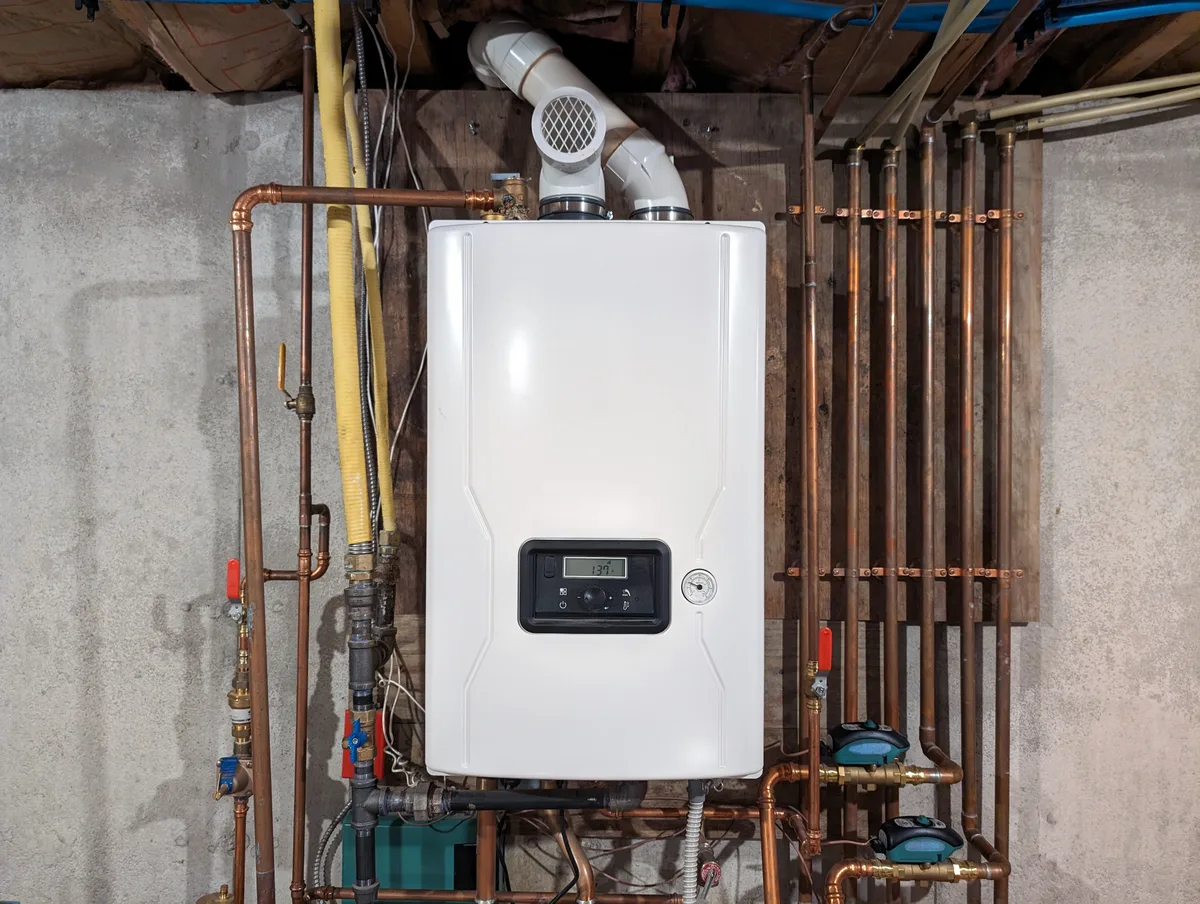
The heat exchanger is descaled through the isolation valves. The technician closes both valves, connects hoses to the service ports, and uses a small pump to circulate a descaling solution from a bucket through the heat exchanger, then rinses with fresh water. On SENSEI RX/CX models the LC code resets automatically when the flush completes properly; otherwise the technician holds two buttons on the control board for five seconds to return the counter to zero.
Rinnai also says hard water must be treated to prevent scale build-up or damage to the heat exchanger. In practice that means a softener or scale-control system ahead of the heater, or at minimum a flush schedule matched to your water. How to tell if a tankless needs descaling lists the signs that show up before the code does.
- Annual descale flush: $150–$300.
- Repairs when scale has already damaged a part: $150–$800 for most tankless jobs, with the $90–$150 diagnostic visit counted toward the work.
Adding isolation valves to a heater installed without them, or adding water treatment, is quoted in writing first.
Scale left in place leads toward the shutdown codes, such as code 16 for outlet water over 95 °C. Booking the flush when LC first appears is the inexpensive way out. ZK Mechanical flushes and repairs Rinnai heaters across Burlington, Oakville, Milton and Hamilton: see tankless water heater repair, book a flush, read about hard water and tankless heaters, or look up other codes in the Rinnai error code guide.