
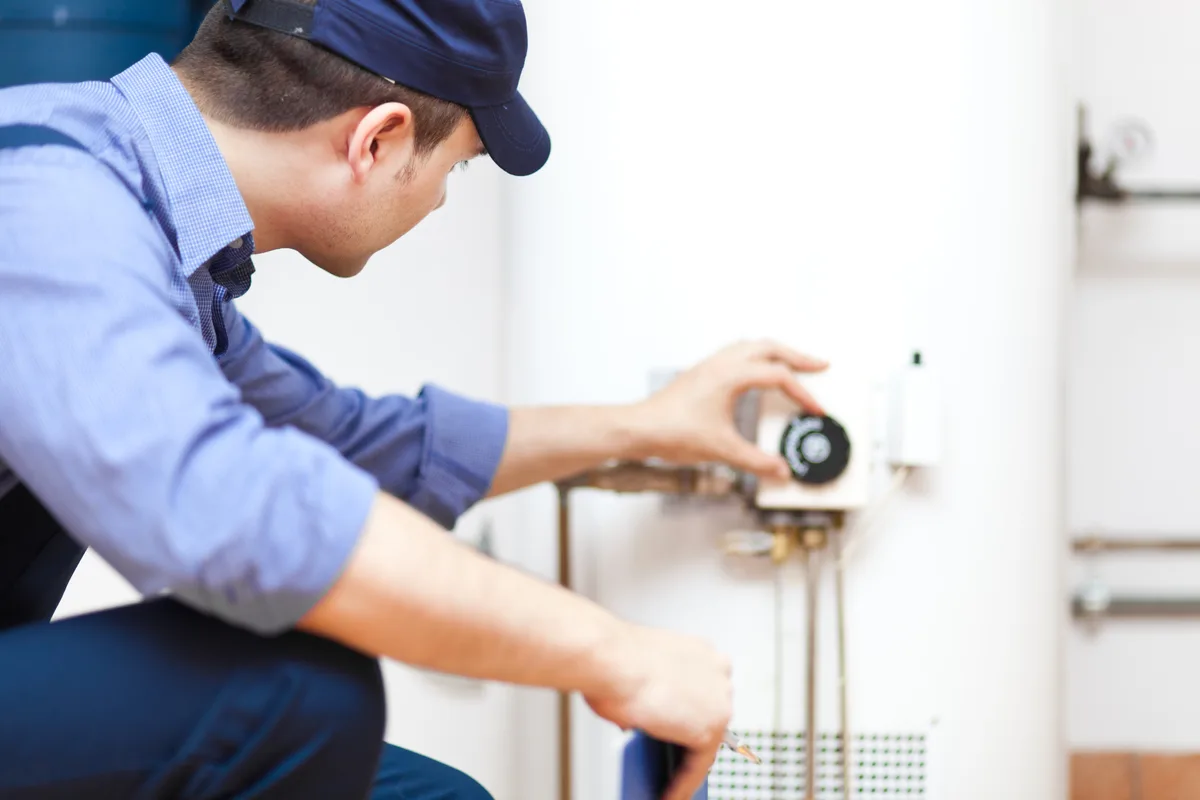
Well water and water heaters in rural Caledon are a hard pairing: sediment, iron and hardness can take years off a tank that would last 8 to 12 on municipal water. The fixes are specific. Put a sediment filter after the pressure tank, flush the heater every six months, and if the hot water smells of rotten eggs, change the magnesium anode for an aluminium-zinc or powered one. Go tankless only once the water is filtered, softened and delivered at steady pressure.
What Well Water Does to a Water Heater
Three things in the water do the damage, and each attacks a different part. Rural Caledon lots outside the village water systems draw from private wells, and no two wells are the same, so a water test tells you which of the three you are fighting.
- Sediment: sand and silt settle on the tank bottom. On a gas or propane tank the layer sits between the burner and the water, so the bottom overheats, the tank rumbles and pops, and the steel fatigues. On an electric tank it buries the lower element until the element burns out.
- Hardness: dissolved calcium and magnesium come out of solution as the water is heated. Scale coats electric elements, crusts the tank bottom and, in a tankless unit, narrows the heat exchanger passages.
- Iron: it stains fixtures, feeds iron bacteria that leave a slime in the tank, and turns hot water brown after the heater has sat unused.
The small parts suffer first. A drain valve packed with grit will not close after a flush, and a temperature and pressure relief valve crusted with scale can seize. Both are safety and service parts, and both are checked on any repair visit.
How Often to Flush a Tank on a Well, and Where the Sediment Filter Goes
Flush every six months on a well that carries visible sediment, and once a year on a well with good filtration. Drain from the bottom valve until the water runs clear. If it never clears, or the valve clogs partway, the layer on the bottom is thick and the tank is nearer the end of its life than its age suggests.
Filter placement matters as much as the filter. The order from the well should be: pressure tank, then sediment filter, then any iron filter or softener, then the water heater. The filter belongs after the pressure tank so the pump's pressure switch reads the true system pressure, and ahead of the softener and heater so both are protected.
A softener solves scale and creates a smaller problem: softened water uses up a sacrificial anode faster. On a softened well supply, have the anode inspected every two to three years. A tank with no anode left rusts from the inside and gives no warning until it leaks.
Rotten-Egg Smell From the Hot Tap Only: the Anode, the Bacteria and the Fix
If only the hot water smells, the water heater is producing the odour; if hot and cold both smell, the well is. In the heater, the cause is a reaction between the magnesium anode rod and sulphate-reducing bacteria, which are common in well water and harmless in themselves. The anode's corrosion releases hydrogen, the bacteria use it to turn sulphate in the water into hydrogen sulphide gas, and that gas is the smell.
- Aluminium-zinc anode: a direct replacement for the magnesium rod that reacts far less with the bacteria. It is the lower-cost fix and still protects the tank.
- Powered anode: a titanium electrode that protects the tank with a small electrical current and no sacrificial metal. It plugs into a standard outlet, does not wear away, and is the stronger fix where the smell returns after an aluminium-zinc rod.
- Disinfecting the tank: a chlorine or peroxide flush kills the bacteria already in the heater. Done alone, the smell comes back; done with the anode change, it usually does not.
- What not to do: remove the anode and leave it out. The smell stops, the tank loses its corrosion protection, and the manufacturer's warranty goes with it.
Free quotes, written pricing.
An anode change is a repair visit and sits inside the $150–$800 band we publish for water heater repairs; a powered anode costs more in parts than a sacrificial rod. Our answer on why hot water smells like rotten eggs covers the checks to make before calling.
Tankless on a Well: What Has to Be in Place First
A tankless water heater works on a well when three conditions are met: clean water, treated water and steady pressure. Miss one and the unit throws error codes, scales up or delivers water that swings between hot and lukewarm.
- Pre-filtration: a sediment filter upstream. A tankless unit has a fine inlet screen, and grit that a tank would simply collect on the bottom blocks it.
- Scale treatment: a softener or a scale-control cartridge sized to bring hardness under the limit in the manufacturer's manual. Scale damage is not covered by warranty, and an annual descale flush at $150–$300 stays on the schedule regardless.
- Minimum flow: the burner fires only when flow passes roughly 2 litres per minute. A trickle from a single tap, or a low-yield well, can fall below that.
- Stable pressure: a standard well system cycles between a cut-in and cut-out pressure, commonly 40 and 60 psi. As pressure sags, flow drops and the outlet temperature wobbles. A larger pressure tank or a constant-pressure pump controller evens it out.
- Fuel: where natural gas mains do not reach, the unit is a propane model, and the regulator and line have to be sized for a burner several times larger than a tank's.
Two more points are particular to wells. Groundwater enters cold all year, so a tankless unit has to lift the temperature further than the brochure flow rates assume, and it should be sized on winter numbers. And a tankless heater has no anode and stores no water, so the sulphur-smell problem that plagues tanks does not occur in it.
What Water Heater Work Costs on a Rural Property
- Diagnostic visit: $90–$150, credited toward the work if you proceed
- Repairs, including elements, thermostats, gas controls and anodes: $150–$800
- Tank replacement, gas, propane or electric: $1,200–$2,500 installed
- Tankless conversion, including gas-line and venting work: $3,500–$6,500 installed
- Annual tankless descale flush: $150–$300
Sediment filters, softeners and iron filters are water-treatment equipment and are priced separately from the heater. We tell you what the heater needs upstream and put it in the written quote, so the treatment and the heater are planned together.
Verdict: Tank or Tankless on a Caledon Well
On untreated or lightly treated well water, buy a tank. It tolerates grit and pressure swings, it can be flushed in twenty minutes, and with the right anode it stops smelling.
- Untreated well, sediment present: tank with a sediment filter after the pressure tank and a six-month flush.
- Sulphur smell from hot water: tank with an aluminium-zinc or powered anode, disinfected at the same visit.
- Filtered and softened water, steady pressure, a large household: tankless is a sound choice, with a yearly descale.
- Electric-only property on Hydro One: an electric tank is the simple option; watch the lower element and flush on schedule.
- Tank over 10 years old that rumbles and will not flush clear: replace it before it leaks.
We service and replace tank and tankless heaters on propane, natural gas and electricity across Caledon, and the first thing we ask for is a recent water test. Fuel choices for the rest of the house are covered in our guide to heating a rural Caledon home, and scale in particular in our guide to hard water and tankless heaters. See our water heater service, the page for water heaters in Caledon, or tell us what the water is doing and we will quote the repair or the replacement.
Frequently asked questions
How long does a water heater last on well water?
It depends on the water. On filtered, softened well water with the anode checked every few years, a tank can reach the same 8 to 12 years it would on a municipal supply. On untreated water with sediment and hardness, tanks fail earlier, and electric elements can burn out long before the tank does. A water test and a six-month flush are the cheapest life extension.
Will a water softener stop the rotten-egg smell?
No. A softener removes hardness, not the sulphate-reducing bacteria or the anode reaction that create the smell, and softened water can make the reaction more active. The fix is at the heater: an aluminium-zinc or powered anode and a disinfecting flush. If the cold water smells as well, the well needs treatment by a water specialist.
Is an electric or propane water heater better on a well?
Both work. A propane tank recovers faster and its burner sits under the tank, so sediment causes rumbling and overheating of the tank bottom. An electric tank has elements inside the water, and the lower one burns out when sediment buries it. Good filtration matters more than the fuel. Choose on fuel cost and what the property already has.
Does a tankless water heater work during a power outage on a well?
No, and neither does anything else on the plumbing system. The well pump needs electricity to deliver water, and a tankless heater needs electricity for its controls and fan. A tank at least holds hot water that can be drawn until the pressure tank empties. A generator sized for the pump covers both.