
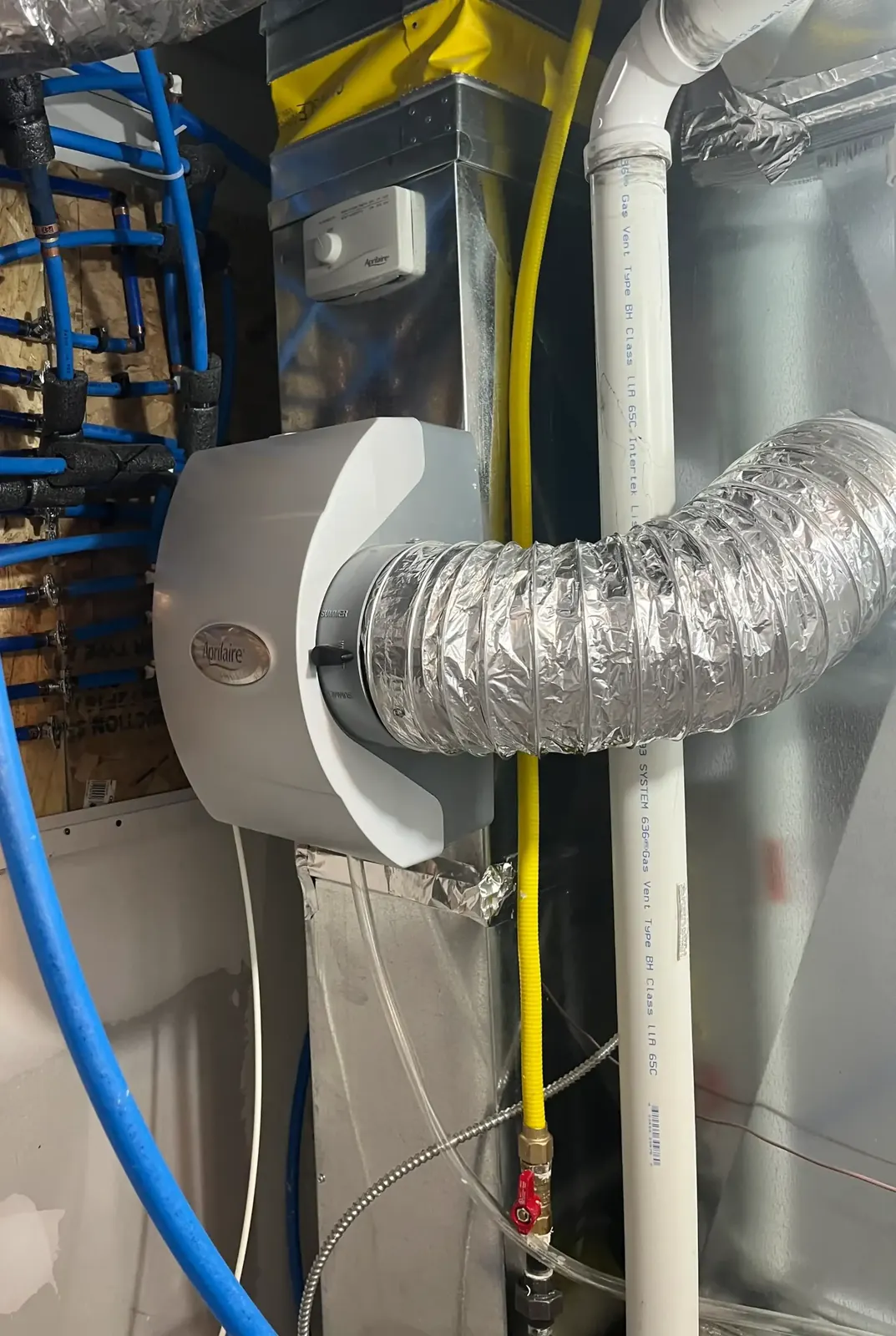
Applewood and Erindale mid-century homes need their HVAC upgrades in a set order: measure the ducts, fix the return air, then choose the equipment. Applewood Acres dates from the 1950s and the Erindale subdivisions from the 1960s and 1970s, and their bungalows and split-levels were built with duct systems designed to carry heat, not cooling. That limits how large an air conditioner or heat pump the ducts can serve, usually to less than the old unit's nameplate suggests. Buy tonnage the ducts can move, and settle the chimney and water heater in the same quote.
What Mid-Century Ductwork Was Built to Do
It was built to deliver hot air to the outside walls, and nothing else. Heating needs less airflow than cooling, so the designers of the day used small supply trunks, one central return grille in the hallway and floor registers under the windows. Central air was a luxury few of these houses had when new.
The layout varies with the house. A 1950s Applewood bungalow has a single trunk down the middle of the basement and short runs to each room. A 1960s or 1970s Erindale split-level or back-split has three or four levels on one trunk, long runs to the upper bedrooms and, in some houses, ducts cast into the slab of the lowest level.
Why Heating-Only Ducts Limit AC and Heat Pump Size
Cooling needs roughly 350 to 400 cubic feet of air per minute for each ton, and a duct system has a ceiling on what it can move. Push past that ceiling and static pressure rises. Most residential blowers are rated at a total external static pressure of 0.5 inches of water column, and we regularly measure well above that in these houses before any new equipment goes in.
High static pressure has consequences you can hear and pay for. Airflow falls, the coil runs too cold and can freeze, registers whistle, the blower motor works harder and the far bedrooms get little air. A 3-ton unit on ducts that can move 2 tons of air cools worse than a 2-ton unit would.
Our decision rule: tonnage is set by a heat-gain calculation and a static pressure test, not by the size of the unit being replaced. If the ducts measure over 0.8 inches of water column with the existing equipment, the duct corrections go in the quote before the tonnage is chosen. A heat pump makes this stricter, because it runs for more hours and at lower supply temperatures than a furnace.
Duct Fixes, From Least to Most Invasive
Most of the gain comes from the return side and the first metre of duct at the furnace, and both are reachable in an unfinished or partly finished basement.
- Add a second return or enlarge the return drop: one hallway grille is the usual bottleneck. A new return from the main living area or the upper level of a split is often a half-day of sheet-metal work.
- Replace the 1-inch filter rack with a deep media cabinet: a 4- or 5-inch filter has far more surface and lets the same air through with less resistance.
- Rebuild the supply plenum and transition: old plenums were sized for a wide, low-airflow furnace. A properly shaped transition to the new cabinet and coil removes a restriction right at the source.
- Seal the trunk joints: mid-century ducts leak at every slip joint, and sealed ducts deliver air to the far rooms.
- Add supply runs to the top level: one or two new runs to upper bedrooms, where joist bays allow it.
- Give one level its own ductless head: when the ducts cannot be brought far enough, a single-zone unit covers the level the trunk cannot reach.
One caution for 1950s houses: the grey paper tape on old duct joints and the wrap on some boots can contain asbestos. Leave it undisturbed and point it out at the quote. Sections that have to be opened are handled by a qualified abatement firm before our sheet-metal work begins.
Split-Levels in Erindale: Three or Four Levels on One Thermostat
Free quotes, written pricing.
A split-level stacks half-floors on a single duct system with a single thermostat, so the top level overheats in summer and the lowest level stays cold in winter. Return air is the usual culprit: the upper bedrooms have supply registers and no path back to the furnace once the doors are closed. A return on the top level, plus two-stage or variable-speed equipment that runs long, gentle cycles, corrects most of it.
Ducts cast in the lower-level slab are a separate problem. After 50 or 60 years some have rusted through or filled with water, and the fix is to abandon them and supply that level from overhead. Our guide to split-level house heating and cooling problems goes through the layouts one by one.
Chimney-Vented Furnace and Water Heater: What Changes With a New Furnace
A new 95% AFUE furnace vents through the side wall in plastic pipe, and that leaves the gas water heater alone on a chimney built for two appliances. The trade calls it an orphaned water heater. Its small flame cannot warm an oversized masonry flue, so the exhaust cools, condenses on the clay liner and drafts poorly, which is both a chimney-damage problem and a carbon monoxide risk.
- Line the chimney: an aluminium liner sized for the water heater alone restores the draft. This is the right call when the tank is under about five years old.
- Replace the tank with a power-vent or direct-vent model: it vents through the wall beside the furnace pipes and the chimney is retired and capped. Choose this when the tank is in the back half of its 8 to 12 year life.
- Change the fuel or type: an electric tank, a heat pump water heater or a tankless unit removes the chimney question entirely.
Exterior chimneys on bungalows are the worst case, because three sides of the flue sit in outdoor air. A quote for a new furnace that says nothing about the water heater is incomplete. The longer explanation is in our guide to chimney liners and furnace replacement.
What the Upgrades Cost
- Central AC using the existing ducts: $3,500–$7,500 installed
- High-efficiency gas furnace: $4,500–$7,500 installed
- Furnace plus AC as a single project: $7,500–$11,500
- Ducted cold-climate heat pump, 3-ton: $9,500–$15,000 before rebates
- Tank water heater replacement: $1,200–$2,500 installed
- Single-zone ductless for one level: $4,000–$7,000 installed
Duct modifications have no flat price, because they depend on how much of the basement ceiling is finished and how far the new return has to travel. We measure, sketch the change and give a written figure for it as its own line. Mississauga homes are on Alectra Utilities for electricity and Enbridge for gas, and heat pump rebates go through the Home Renovation Savings Program with approval ahead of the install.
Verdict: What to Upgrade First
Do the ducts with the equipment, not after it. A new furnace or heat pump bolted to an unchanged 1950s return will be louder, less comfortable and shorter-lived than the brochure promises, and correcting the return later means opening the same sheet metal twice.
- First: a static pressure test and a heat-loss and heat-gain calculation on the house as it is now.
- Second: return-air and plenum corrections, priced together with the equipment.
- Third: equipment sized to the calculation, two-stage or variable-speed, so it can run at lower airflow most of the time.
- Fourth: the water heater venting decision, liner or power-vent, on the same quote.
- Last: a ductless head for a top level or addition the ducts cannot serve.
If the choice of air conditioner is the open question, our guide to the best air conditioner for a home with small ducts compares the equipment types. See what our ductwork installation service covers, read about our work across Mississauga, or book a duct assessment and quote and we will put numbers on your system before recommending anything.
Frequently asked questions
Can I add central air to a 1950s Applewood bungalow?
Yes. A bungalow is the easiest mid-century layout to cool because the runs are short and every room is one floor above the trunk. The usual limits are a single hallway return and a narrow filter rack. With a second return and a media cabinet, most of these houses take a modest air conditioner or heat pump without replacing the supply ducts.
How do I know if my ducts are too small for a heat pump?
A technician measures total external static pressure with the system running and compares it to the blower's rating, then checks airflow against what the heat pump needs. You can spot warning signs yourself: whistling registers, a loud return grille, weak air in the far bedrooms and a furnace that trips off on hot-air limit in cold weather.
Do I need to replace all my ductwork to get a heat pump?
Rarely. Full replacement means opening finished ceilings, and it is seldom justified. Targeted changes do most of the work: added return air, a larger filter cabinet, a rebuilt plenum and sealed joints. Where one level still cannot be served, a ductless head for that level costs less than rebuilding the trunk to reach it.
Is it safe to leave my water heater on the old chimney after a furnace replacement?
Not without checking. With the furnace gone from the flue, the water heater may not produce enough heat to draft properly, and exhaust can spill back into the basement. The installer should test the draft and size a liner or recommend a power-vent tank. Keep a working carbon monoxide alarm near the bedrooms, as Ontario law requires.